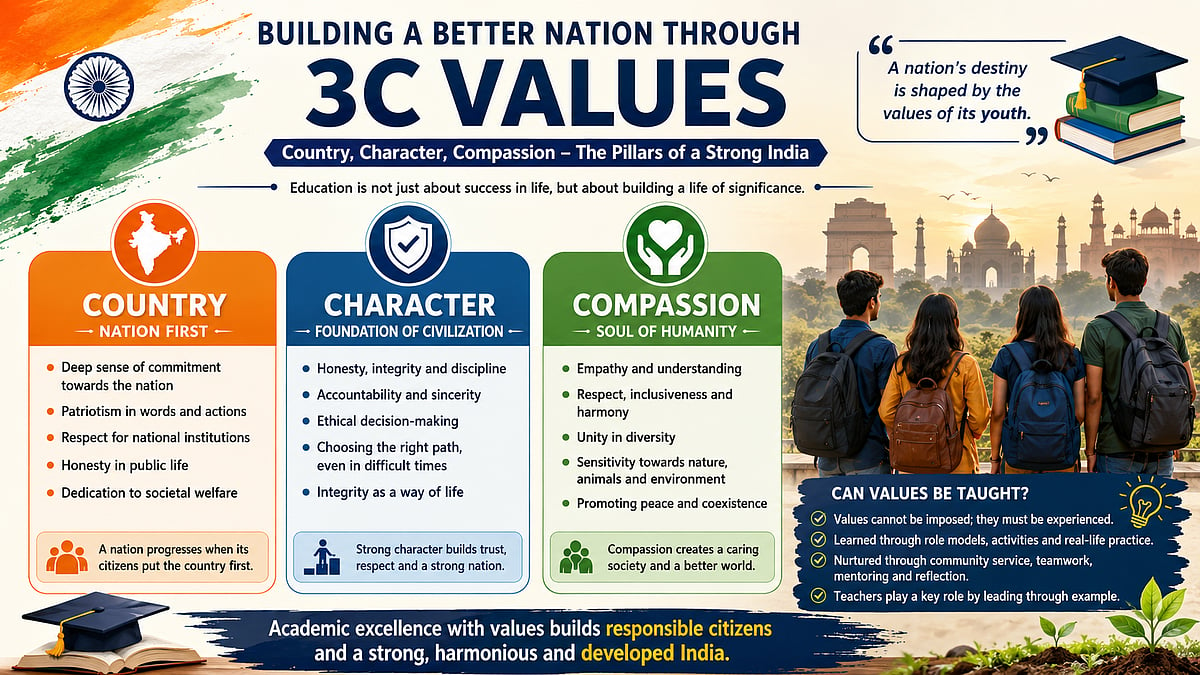
Education is often described as the process of developing knowledge, skills, and attitudes among learners. While these dimensions are undoubtedly important, modern education cannot remain confined only to academic excellence or professional competence. The true purpose of education is much broader; it is to shape responsible, ethical, and compassionate human beings who can contribute meaningfully to society and the nation. In this context, inculcation of a strong value system among students becomes important.
Unfortunately, in today’s highly competitive and materialistic world, value-based education is gradually losing its prominence. Institutions are increasingly emphasising employability, technological advancement, and performance indicators, while the moral and ethical dimensions of education often receive inadequate attention. However, no nation can achieve “sustainable progress” merely through economic growth or scientific development unless its citizens possess strong moral foundations and social responsibility.
Values and Attitudes:
The terms “values” and “attitudes” are often used interchangeably, though they are conceptually different. Values are deep-rooted universal principles that guide an individual’s understanding of right and wrong, justice and injustice. Attitudes, on the other hand, are outward behavioural expressions shaped by those values. For example, if an individual strongly believes in the value of kindness, that belief naturally reflects in a compassionate attitude towards others, especially the underprivileged and marginalised sections of society. Thus, values form the moral compass of an individual’s life.
3C Values:
A nation’s destiny is thus determined by the values cherished by its youth. In this regard, the “3C Values”: Country, Character, and Compassion, deserve special emphasis as foundational pillars of nation building.
Country: Nation First – The first and foremost value that students must develop is a deep sense of commitment towards the nation. The spirit of nationalism and the belief that “the country comes first” are essential for creating responsible citizens. Patriotism should not be understood merely as emotional attachment to one’s country; rather, it should manifest in responsible conduct, respect for national institutions, honesty in public life, and dedication towards societal welfare.
India today stands at an important juncture with the vision of becoming a “Viksit Bharat”. Achieving this dream requires a generation of youth that is not only professionally competent but also deeply committed to national interest.
Character: Foundation of Civilisation – The second core value is character. Character is the moral strength that determines whether an individual chooses the right path even in difficult circumstances. It includes honesty, integrity, discipline, accountability, sincerity, and ethical decision-making.
In contemporary society, incidents of corruption, dishonesty, intolerance, and moral decline are increasingly visible across various sectors. While scientific and technological advancements have transformed human life remarkably, ethical deterioration poses a serious threat to social harmony and institutional credibility. A nation may become economically prosperous, but without character and integrity among its citizens, such progress cannot be sustained for long. Students therefore need to be sensitized to the importance of ethical conduct both in personal and professional life. Integrity must become a way of life rather than merely a moral slogan.
Compassion: Soul of Humanity - The third important value is compassion. Compassion is the ability to understand and empathize with the pain, struggles, and needs of others. It promotes mutual respect, inclusiveness, social harmony, and peaceful coexistence. India is a land of immense diversity in terms of religion, language, culture, caste, and traditions. Such diversity is a strength when guided by compassion and mutual understanding, but it can become a source of conflict in the absence of empathy and tolerance. Therefore, cultivating compassion among students is essential for preserving the spirit of “Unity in Diversity.”
Compassion extends beyond human relationships. It also includes sensitivity towards nature, animals, the environment, and all living beings. In an era marked by rising social tensions, environmental degradation, and emotional isolation, compassion becomes more relevant than ever before.
Can Values Be Taught?
An important question arises: can values really be taught? This remains one of the greatest challenges before educators.
Unlike academic subjects, values are intangible and difficult to measure. They cannot simply be imposed through lectures or examinations. Values are experienced, practiced, and internalized over time. Therefore, value education should not be treated as a separate subject confined to the classroom. Instead, it must become an integral part of institutional culture.
Educational institutions can nurture values through experiential learning, community service, group activities, mentoring, reflective discussions, and exposure to inspiring role models. Activities such as social outreach programs, environmental campaigns, teamwork exercises, and ethical case studies can help students experience values in real-life situations.
The role of teachers in this process is extremely significant. A teacher who demonstrates fairness, compassion, discipline, and integrity naturally inspires students to imbibe similar qualities. Education ultimately becomes meaningful when it transforms not only the intellect but also the character of learners.

Moving Ahead:
The future of any nation depends largely on the values upheld by its younger generation. Academic excellence alone cannot guarantee national progress unless it is supported by strong moral and ethical foundations. The “3C Values”: Country, Character, and Compassion, are therefore essential for shaping responsible citizens and building a strong, harmonious, and progressive nation.
Educational institutions must recognise that their role extends far beyond producing degree holders or skilled professionals. Their true responsibility lies in nurturing enlightened human beings who possess patriotism, integrity, empathy, and social responsibility. Only then can education fulfil its highest purpose and contribute meaningfully to the dream of a peaceful, prosperous, and developed India.

