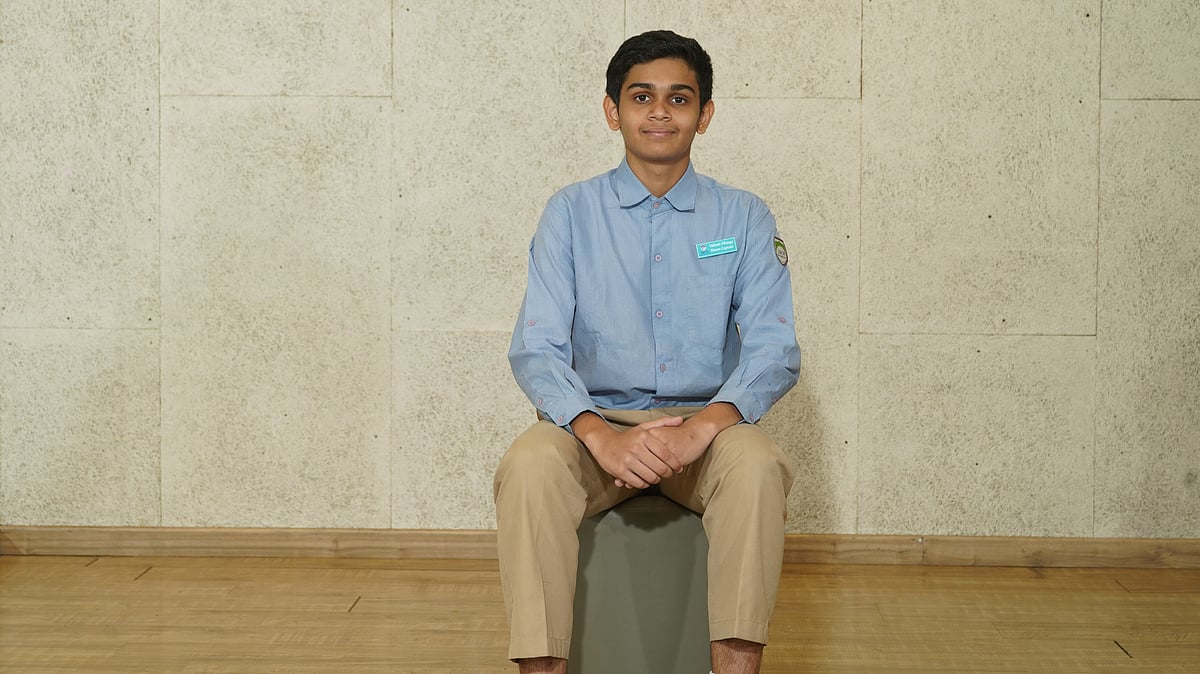
For most students stepping into Grade 10, the year ahead is largely about preparing for board examinations. For 15-year-old Aarav Lele, however, it also marks an opportunity to learn from one of the world's leading universities.
The JBCN International School, Chembur student has been selected for Stanford Pre-Collegiate Studies' highly selective Discrete Mathematics programme and is currently attending the online course, which is being conducted from July 6 to July 17. According to Aarav, only around 80 students are admitted to the programme, making it a highly competitive academic opportunity for high school students with a strong interest in mathematics.
A House Captain at JBCN Chembur, Aarav has steadily built his academic profile around mathematics, leadership and global learning experiences. Before securing a place at Stanford, he completed the Ashoka Young Scholars Programme (YSP) and had earlier attended the Johns Hopkins Center for Talented Youth (CTY) programme, experiences he believes strengthened both his perspective and his application.
More than just good grades
Aarav believes that academic scores may help open the door, but they are rarely enough on their own.
Speaking about the Stanford selection process, he said applicants were required to submit personal essays alongside their academic records. One essay asked students to explain why they wanted to pursue the course, while another focused on describing the kind of learner they are.
"Good grades are important, but they are not enough," Aarav said. "I think my essays reflected who I am as a learner. I also highlighted the extracurricular activities that genuinely mattered to me."
Among those experiences, he credits his participation in the Johns Hopkins CTY programme in 2023 as one of the strongest aspects of his application, saying it demonstrated his commitment to academic enrichment beyond school.
A Rubik's cube sparked his love for mathematics
Unlike many students who develop an interest in mathematics through classroom lessons, Aarav traces his fascination back to solving a Rubik's Cube.
He remembers being intrigued not only by solving the puzzle but also by the enormous number of possible combinations.
"I kept wondering how something so small could have such an enormous number of possible arrangements," he said. "That curiosity pushed me towards understanding the mathematics behind it."
Rather than being fascinated by the answer itself, Aarav says he has always wanted to understand the principles and structures that produce those answers.
That curiosity gradually evolved into a deeper interest in combinatorics, discrete mathematics and mathematical reasoning.
Learning beyond school
Earlier this summer, Aarav completed a five-day course on Economics, Finance & Markets through the Ashoka Young Scholars Programme.
The programme introduced him to concepts such as Game Theory and economics while giving him the opportunity to interact with professors and senior students, most of whom were studying in Grades 11 and 12.
"It made me realise how much there is to learn beyond textbooks," he said.
That experience encouraged him to continue seeking intellectually challenging opportunities and eventually led him to apply for Stanford's Discrete Mathematics programme.
According to Aarav, the Stanford course is also an important stepping stone towards the Stanford University Mathematics Camp (SUMaC), a more advanced programme for which he was not eligible this year because applications were open only to students in Grades 10 and 11.
Global exposure through Johns Hopkins
Before Stanford and Ashoka, Aarav participated in the Johns Hopkins Center for Talented Youth (CTY) residential programme, where he studied Advanced Geography and topics related to the United Nations.
While the programme covered geopolitics, diplomacy and international affairs, Aarav says its biggest takeaway was the opportunity to interact with students from across the world.
"I met students from different countries and realised that even though we came from different backgrounds, we shared similar interests," he said. "Those conversations taught me as much as the classes."
Using AI as a learning partner
Like many students today, Aarav regularly uses artificial intelligence tools such as ChatGPT and Gemini while studying.
He believes AI is most useful when it helps students understand concepts or discover new learning resources rather than complete assignments.
"If I don't understand something, I can ask ChatGPT or Gemini to explain it to me," he said. "It's really useful for learning and research."
However, he cautions against using AI as a substitute for original work.
"I wouldn't recommend using AI to write essays," he said. "It's a powerful learning tool, but original thinking should still come from the student."
According to Aarav, while AI can analyse vast amounts of information in seconds, innovation and critical thinking remain uniquely human strengths.
Past papers are his secret to exam preparation
As he prepares to enter Grade 10, Aarav says his study strategy is surprisingly straightforward.
Instead of relying on popular productivity methods, he prefers solving previous years' question papers.
"Past papers teach you everything, time management, exam patterns and application of concepts," he said. "You learn while solving them."
He believes consistent practice helps students become familiar with the style of examination questions while strengthening their conceptual understanding at the same time.
Balance is better than giving up everything
Aarav also believes students should avoid extreme approaches while preparing for examinations.
Rather than giving up extracurricular activities or completely disconnecting from social media, he recommends maintaining a healthy balance.
"If you completely restrict yourself, it usually doesn't work," he said. "The key is to use social media mindfully and avoid endless scrolling."
He adds that educational videos can be valuable, provided students also make time for reading, which he believes helps improve concentration and critical thinking.
Looking ahead
Aarav hopes to pursue higher education in the United States, where he plans to study mathematics at the undergraduate level before exploring economics in greater depth.
He also intends to apply for Stanford University Mathematics Camp (SUMaC) next year, now that he will meet the eligibility criteria.
For students hoping to build similar opportunities, his advice is simple.
"Do something because you genuinely enjoy it, not because it looks good on a college application," he said. "Passion gives you the motivation to keep going."
He also believes discipline is just as important as talent.
"Good habits grow over time," he said. "Don't just plan. Keep executing every day."
For Aarav, every opportunity has begun with curiosity. What started with a fascination for the mathematics behind a Rubik's Cube has now earned him a place in Stanford's highly selective Discrete Mathematics programme, another step towards a future he hopes to build around mathematics, research and lifelong learning.

