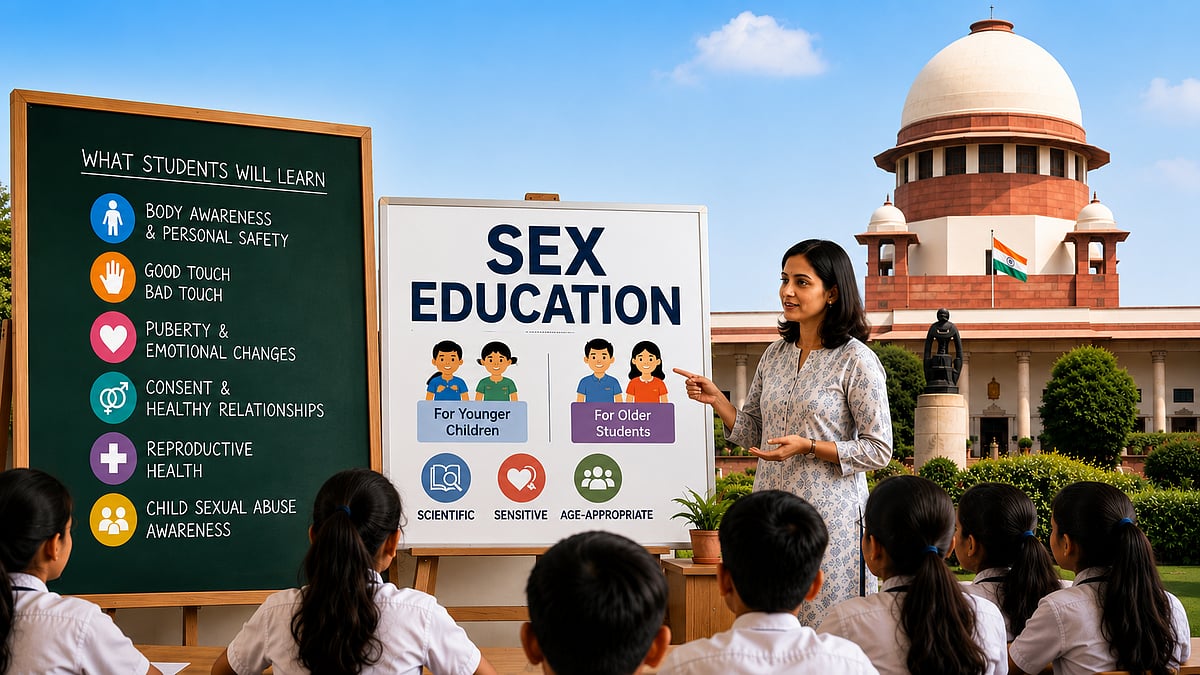
The Centre's proposal to introduce comprehensive sex education in schools and colleges across the country has received a positive response from educators, parents and medical professionals, many of whom say the move is long overdue and could help children receive accurate, age-appropriate information instead of relying on social media or peers.
On Monday, the Centre informed the Supreme Court that it has accepted the recommendations of an expert committee to introduce comprehensive sex education and will implement them after the court grants its approval.
While the announcement has sparked discussions nationwide, school leaders believe the focus should now shift from whether sex education should be taught to how it is should be introduced in classrooms.
'Schools must prepare children for life, not just exams'
For Sharmila Thakur, Principal of The Orchids International School, Dombivli, the proposal reflects the changing role of schools.
"Schools today are responsible for much more than academics. Children are exposed to information online at a very young age, but it is not always accurate or age-appropriate. If schools provide scientifically correct guidance in a structured manner, it will benefit students. The important thing is to introduce these topics gradually, keeping a child's age and maturity in mind," she said.
According to Thakur, comprehensive sex education should not be viewed narrowly.
"It helps children understand personal safety, body autonomy, puberty, consent and how to seek help if something feels wrong. It also encourages respect for others and reduces misconceptions around natural physical and emotional changes. If handled sensitively, this is really about life skills and child protection rather than just sex education."
However, she cautioned that implementation would determine the programme's success.
"Teachers will need proper training because these are sensitive topics. Schools also need age-specific teaching material and clear guidelines. Parents must also be taken into confidence because many still misunderstand what comprehensive sex education actually means."
Schools say they have already started these conversations
Many schools have already introduced sessions on personal safety and puberty through counsellors and medical experts.
Suma Das, Principal of Pawar Public School, said her school regularly conducts sessions for students entering puberty and believes a national curriculum would bring consistency.
"If it has to happen late, better late than never. But it has to be handled in a very sensitive manner so that children are guided in the right way," she said.
According to Das, children today are exposed to content much earlier than previous generations.
"From Class 5 onwards, children are already exposed to all kinds of information through peers and the internet. They often don't have a clear understanding. If it is taught scientifically with age-appropriate content, it will help students in the long run."
Sunayana Awasthi, Principal of Kanakia International School, echoed similar views, saying her school already conducts sessions on good touch, bad touch, POCSO awareness and personal safety from the pre-primary level.
"If this now becomes part of the curriculum, it is definitely a good move. Some schools have already been doing this, while others may take time."
She believes the curriculum should also include puberty, emotional and physical development and reproductive health.
"Children should understand what happens before and after puberty, how their bodies change and why. The more aware they are, the more confident they become."
Parents say schools should lead the conversation
Parents also welcomed the Centre's proposal, saying children are naturally curious and should receive factual information from trusted adults instead of searching online.
Dolly V, mother of a 16-year-old daughter and a 10-year-old son, believes schools can help remove the stigma around such discussions.
"This should have happened much earlier. When children are simply told not to ask questions or not to watch certain things, they become even more curious. If teachers explain what is right and what is wrong, children will understand better instead of depending on incomplete information from others."
Mukesh Vishwakarma, whose daughter studies in Class 3, agreed that awareness should begin early.
"Education is always good. It should start from the nursery level itself in an age-appropriate way. My daughter's previous school had already introduced sex education, and I think it helped create awareness."
Doctors stress role of parents alongside schools
Medical professionals say classroom lessons alone will not be enough unless parents also participate in these conversations.
Dr Shaheen Qureshi, Senior Resident Medical Officer at Lion TB Hospital Research Centre and Mata Lachmi Hospital, described the proposal as a welcome step but said its impact would depend on thoughtful implementation.
"The introduction of sex education in schools is a positive step, but the real focus should be on how it is implemented. The concepts should be introduced gradually, with the depth of explanation increasing as children grow older and are emotionally ready to understand them."
She also urged parents not to shy away from discussing the subject at home.
"Parents play the most important role in a child's upbringing. When they avoid these conversations, children often turn to friends or the internet, where they may receive incorrect information. Parents and schools must work together if this initiative is to achieve its purpose."
What the Centre has proposed
The Centre informed the Supreme Court that it has accepted the recommendations of a 26-member expert committee constituted after the apex court sought suggestions on issues involving adolescents, consensual relationships and the implementation of the POCSO Act.
The committee has recommended introducing comprehensive sex education and child sexual abuse awareness as part of the core curriculum. It has proposed age-appropriate lessons on personal hygiene, body awareness, good touch and bad touch, personal safety, puberty, consent, healthy relationships and reproductive health, while also recommending that NCERT revise the curriculum in line with the National Education Policy (NEP) 2020.
If approved by the Supreme Court, the proposal would pave the way for a standardised curriculum across schools and colleges, with educators and parents now hoping that equal attention is given to teacher training, parental awareness and age-appropriate implementation.

