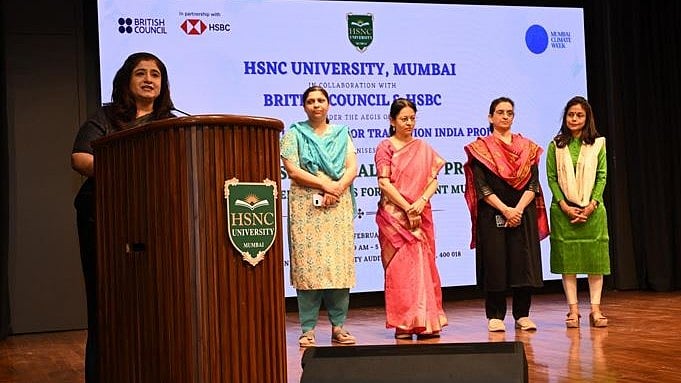
Climate change is often debated at global summits and in policy corridors. Over the past year, however, it has taken on a far more immediate and local expression across Mumbai, reflected in neighbourhood surveys, coastal conversations, air samples, heat maps and behavioural studies led by the students of HSNC University, Mumbai.
Under the Climate Skills: Seeds for Transition India Project, implemented in partnership with British Council & HSBC, nearly 800 students from across the University’s three Colleges and eight Schools were systematically equipped with climate competencies through a structured programme delivered by 61 trained Master Facilitators. Over 50% students progressed beyond classroom theory to undertake structured field inquiry and meaningful community engagement. Their efforts culminated in February 2026, with the formal presentation of 24 rigorously developed, community-oriented social action projects before faculty members, peers and key stakeholders.
While these projects have not yet entered the implementation phase, they represent carefully designed, research-backed frameworks for climate-responsive action. They demonstrate how Universities can function not only as sites of discussion, but as laboratories of solution design. Collectively, the projects reimagine how youth leadership can shape Mumbai’s environmental future, grounded in evidence, empathy and interdisciplinary thinking.
This institutional vision was articulated clearly at the showcase. Col. Dr. Hemlata K. Bagla, Vice Chancellor, HSNC University, remarked, “Young people today are not content with simply talking about climate change, they want to understand it, question it and act on it. Through the Climate Skills initiative, we have focused on giving our students the tools, the data literacy and the confidence to turn concern into capability. What we witnessed at the showcase was not just presentations, but clarity of thought, courage of conviction and a readiness to engage with real-world challenges. When Universities create space for inquiry and trust young minds with responsibility, they don’t wait for change, they begin to shape it.”
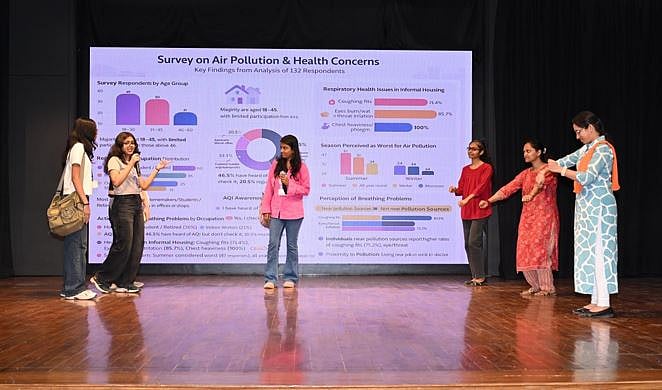
Turning data into dialogue, HSNC University students decode air pollution trends and health impacts through evidence-based research under the Climate Skills initiative |
What distinguishes this initiative is its architecture. Over 61 Master Facilitators were trained to embed climate literacy and systems thinking across disciplines. Youth Evaluators were introduced to structured impact assessment frameworks, ensuring that student proposals were not aspirational but analytically sound. Climate education here was not treated as an add-on; it was institutionalised through capacity building, research methodology training, stakeholder mapping and communication design. The result was a cohort of students capable of translating environmental concern into structured inquiry.
Before the showcase, the Climate Skills initiative invested in a year-long structured learning journey of immersive workshops and applied modules. Through systems mapping, stakeholder analysis and solution design exercises, students developed the research and analytical skills needed to shape their climate inquiries into rigorous, action-ready project frameworks. From reflection circles and collaborative mapping sessions to hands-on modules like “The Climate Web of Mumbai” and “Trash to Treasure: How Mumbai is Recycling its Waste,” students were encouraged to see climate change through their own city’s lens. They unpacked how heat, flooding, waste and infrastructure pressures intersect in everyday life. Sessions like “Problem to Opportunity Tree”, “Principles of Youth-Led Action” and guided visioning workshops helped them shift from identifying problems to designing smart, actionable solutions rooted in Mumbai’s realities.
The Project Showcase: Several initiatives examined circular economy transitions and plastic literacy through behavioural science lenses. Students analysed plastic consumption patterns in cloud kitchens, studied waste segregation behaviour in South Mumbai neighbourhoods and conducted school-level sensitisation drives under initiatives such as “Green Futures.” Digital campaigns tested peer-driven engagement strategies to understand how behavioural shifts could be catalysed within youth networks. Rather than merely diagnosing environmental challenges, these projects proposed models for habit transformation, policy nudges and scalable awareness frameworks.
Reflecting on this shift from abstract concern to personal accountability, Dr. Bagla, observed: “Once students begin studying their own consumption data, climate change stops being abstract and becomes accountable.”
Other teams connected climate science directly to public health and infrastructure resilience. Urban Heat Island patterns were mapped to understand exposure intensity in high-density zones. Festival-related noise pollution was analysed through legal awareness and enforcement frameworks. Marine biodiversity along Mumbai’s coastline was studied in relation to plastic accumulation and ecological stress. Research into airborne microflora explored the link between pollution exposure and respiratory vulnerability, underscoring how environmental risk translates into everyday health implications. These projects generated data sets and analytical insights that can inform civic planning, public awareness and future policy dialogue.
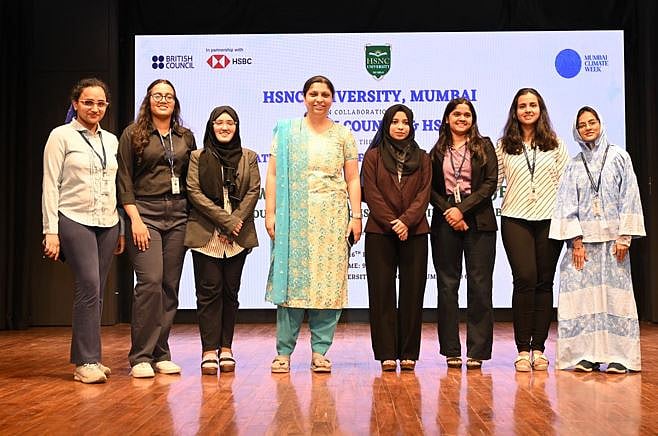
Master Facilitators and student researchers at the Climate Skills project showcase, supported by the British Council and HSBC |
The socio-ecological dimension added further depth. Students engaged with displacement narratives in Aarey Colony, explored indigenous ecological knowledge systems in Worli Koliwada and examined the interdependent relationship between the Machimar Nagar Koli community and the Arabian Sea. In these inquiries, sustainability was framed not only as environmental management but as cultural continuity, livelihood resilience and climate justice. Dr. Leena Pujari, Dean of Interdisciplinary Studies, emphasised that meaningful sustainability must balance evidence with empathy, ensuring that community voices remain central to resilience planning.
The February showcase reflected the interdisciplinary ethos of the initiative. Students presented through documentary films, interactive dashboards, street theatre performances, research talks and solution-oriented pitches, combining quantitative data with narrative storytelling. Methodologies were articulated with clarity, sampling strategies were defended with confidence and policy pathways were outlined with structure. Climate communication emerged as a skill equal in importance to climate research.
Beyond the projects themselves lies a broader institutional shift. Within a single academic year, classrooms evolved into collaborative research environments. Faculty transitioned into facilitators of inquiry and students assumed roles as field researchers, evaluators and systems thinkers. Climate competence was framed not only as environmental awareness, but as leadership development, integrating data analysis, stakeholder engagement, interdisciplinary collaboration and ethical responsibility.
The initiative also aligns local inquiry with global priorities. By situating Mumbai-specific research within broader sustainability frameworks, students engaged with climate transition not as an abstract global narrative, but as a lived urban challenge. In doing so, HSNC University has positioned itself as a youth-driven climate capacity hub one that bridges academic rigour with civic relevance.
In a city confronting heat stress, coastal vulnerability, infrastructure strain and escalating waste pressures, these 24 projects may still await implementation. Yet they have already achieved something substantive: they have demonstrated preparedness. They show that when young citizens are equipped with research tools, systems thinking frameworks and structured mentorship, they can generate insights that are thoughtful, data-backed and socially grounded.
At a time when climate discourse risks fatigue and polarisation, these student-led inquiries restore clarity and agency. They remind us that sustainable transitions are not built only in policy chambers, they are cultivated in institutions that combine rigour with responsibility.
When young minds are trained seriously and trusted meaningfully, they do not merely respond to change. They begin to design its direction.
With the series of workshops and bootcamps concluding successfully, the initiative continues to nurture networks of young leaders who will play a pivotal role in steering India towards a greener, climate-resilient future.
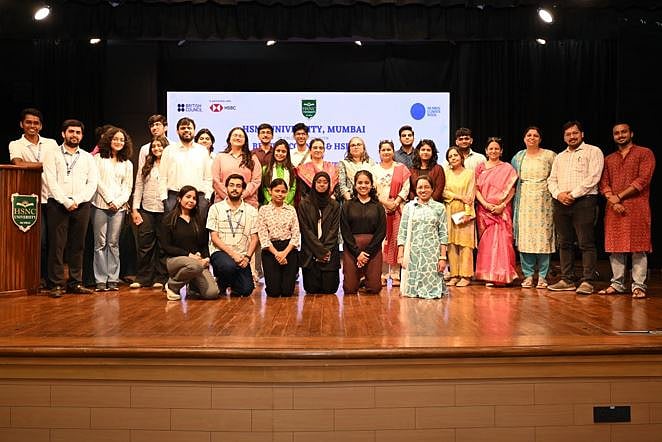
From classrooms to climate conversations, the Climate Skills community comes together after presenting 24 youth-led environmental research projects |
About Climate Skills- Seeds of Transition: Supported by the British Council and HSBC, the India leg of the global programme (also active in Brazil, Indonesia, Mexico and Vietnam) is being implemented by HSNC University, Mumbai. It aims to sensitise and empower students on local climate issues, sustainable practices, adaptation mechanisms and grassroots solutions.The workshops mentor youth to design and implement social action projects within their institutions and communities, focusing on leadership, sustainability and grassroots climate solutions.

