Backdrop:
Critical thinking is a skill that is often mentioned in corporate parlance as the ability to solve complex problems by thinking and analysing the data; in absence of adequate data, it can be through out of the box approach as well through “intuitive thinking”. Possession of this skill is extremely important for students getting ready for corporate and real world particularly in these uncertain and volatile times where complexities are changing by the day. The process of critical thinking goes beyond memorization and requires students to engage at a deeper level. Instead of accepting information at face value, critical thinkers question assumptions, identify biases, and consider alternative perspectives.
Importance of Critical Thinking:
In the context of education, critical thinking is invaluable. It is not just about learning facts or figures; it is about understanding the "why" and "how" behind those facts. This deeper understanding allows students to apply their knowledge in various contexts, enhancing their learning experience.
Moreover, in today’s world, where misinformation or AI generated information is available on a large scale, critical thinking enables students to discern credible information from unreliable sources and arrive at a rational and objective decision. Thus, this skill is particularly important in the digital age, where access to information is vast, but not all of it is accurate or unbiased.
Benefits of Critical Thinking:
Benefits of critical thinking extend beyond the classroom. Here are a few key advantages:
Improved Problem-Solving Skills: Critical thinking encourages students to analyse problems from multiple angles, consider various solutions, and anticipate potential outcomes thus enhancing their problem-solving abilities.
Better Decision Making: By developing critical thinking skills, students learn to make well-informed decisions. They learn to weigh pros and cons, consider evidence, and make choices based on logic.
Enhanced Creativity: Critical thinking fosters creativity by encouraging students to look beyond obvious and think outside the box.
Greater Academic Success: Studies have shown that students who employ critical thinking strategies tend to perform better academically. This is because they are better able to understand and engage with the material, leading to improved grades.
Increased Self-Confidence: As students develop their critical thinking skills, they become more confident in their abilities to analyse information and form their own opinions.
Developing Critical Thinking Skills-Role of Educators:
It is an ongoing process that requires practice and commitment on part of the students. The teachers must devise methodologies / pedagogies that aim at developing critical thinking among students.
Some of the methodologies that teachers particularly at HEIs can adopt are as under:
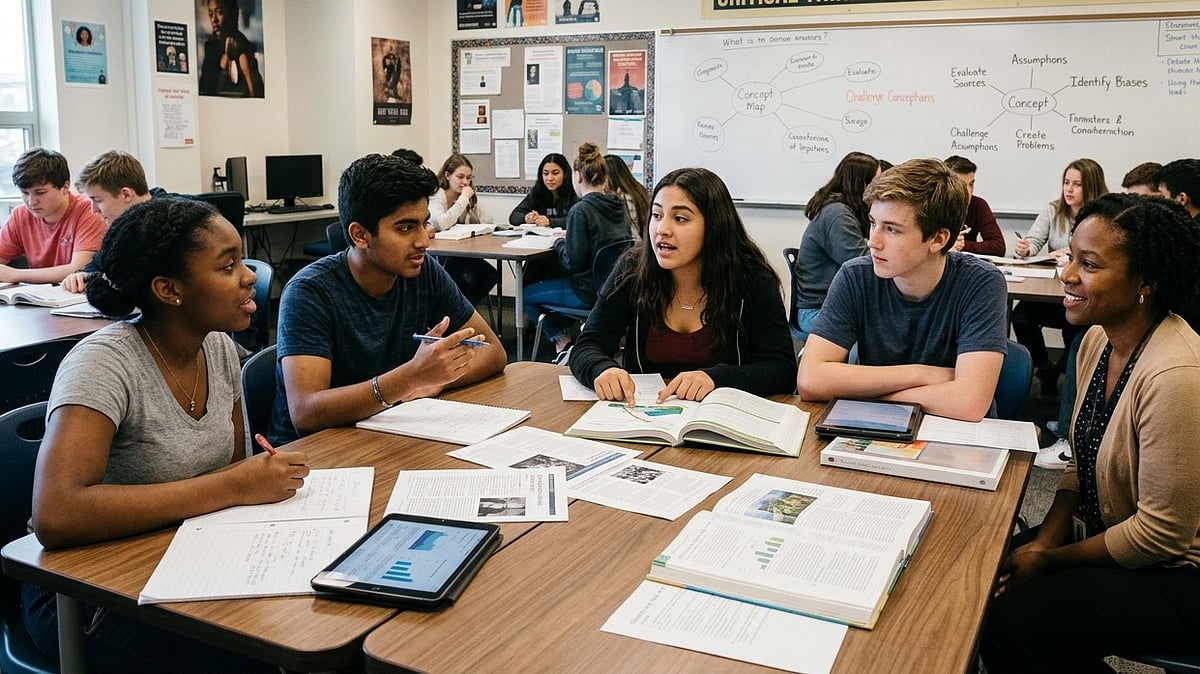
Flipped Classrooms: This is possibly one of the best methods of inculcating critical thinking among students. As the students come to classes after reading a theory / case, the class is only engaged in discussions. These in-class discussions, debates, or study groups can be an effective way to develop critical thinking skills. The role of the teachers is to act as facilitators and see that the debates are on track, time disciplined and students are reflecting on thinking process and taking decisions based on data / intuitive arguments. Students should also be prompted to reach logical conclusions without biases or logical fallacies.
Problem Based Learning: The other important pedagogy that can be adopted is PBL where the entire class is given a hypothetical / real world problem with various assumptions and to solve the problem. The teacher is once again to act as facilitator and see the “how’s” and “why’s” of problem-solving techniques. The teacher can intervene and provide “alternative frameworks” (why not or why only this or what happens if this happens or goes wrong, etc.). Such alternative scenarios provoke stimulated thinking process and provoke the students to go into further analytical modes.

Also Watch:
Running Exclusive Course on Critical Thinking: At the undergraduate level where the students come with relative fresh background without any work experience, it is better to start with an exclusive credit course on “Critical Thinking”. Besides theoretical framework, the course should also look at some of the classical tools and techniques that are often used in business problem solving processes such as “brainstorming”, “root cause analysis”, “decision trees”, “mind mapping”, “six thinking hats”, “5 why deep analysis”, “Socratic questioning circle”, among others. This type of theoretical exposure will enable the students to solve the business problems with a given framework.
Moving Forward:
Critical thinking and navigating real life business or other problems by applying the principles thereof is a continuous process; it cannot be learnt in a single day. The curriculum and the pedagogic approaches should be so designed such that critical thinking is tinkered at every level of study road; this will enable the students to emerge CRITICAL THINKERS on graduation. That will possibly be the biggest success of any higher education system. And therefore, “teacher training” becomes a crucial factor. The better “critical thinker” the teachers are, the better learning outcomes are expected to be achieved.
By Dr A K Sen Gupta, Founder, Higher Education Forum (HEF). He may be contacted at aksengupta51@gmail.com and /or 98211 28103.

