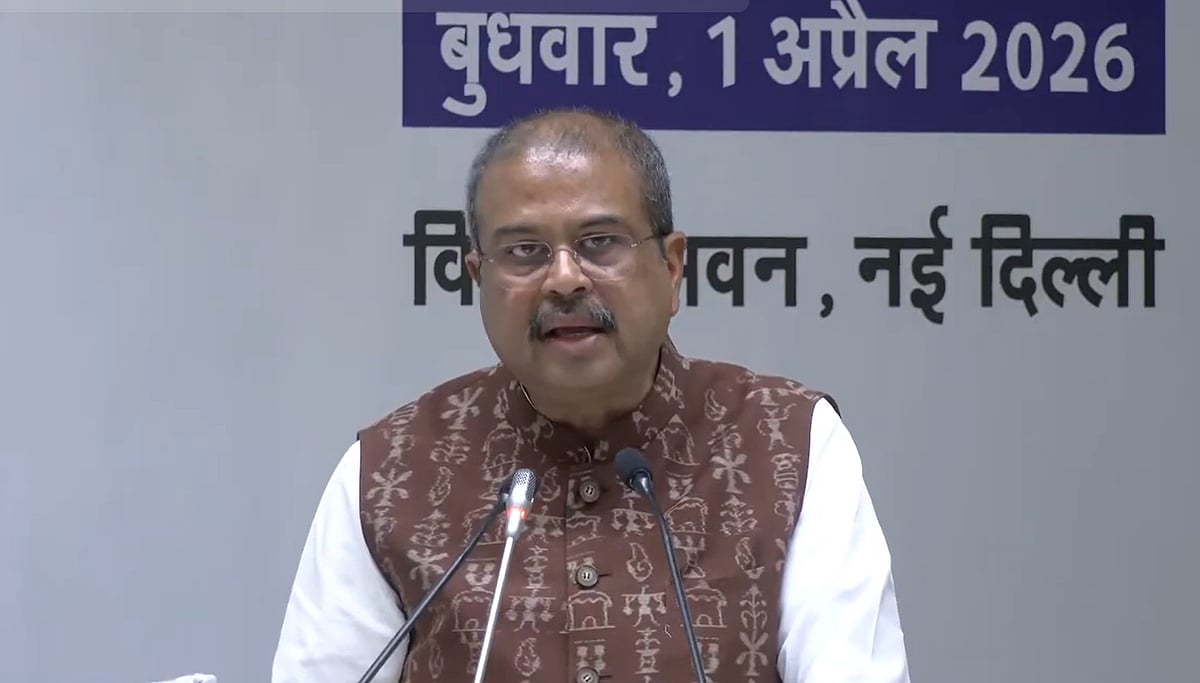
The Union Education Minister, Dharmendra Pradhan, has launched the Computational Thinking and Artificial Intelligence (CT & AI) curriculum for students of Classes 3 to 8 under the Central Board of Secondary Education (CBSE), marking the beginning of the 2026–27 academic session.
The minister said the initiative aims to shift India’s school education system from rote memorization to critical thinking and design thinking. The curriculum has been introduced from the very first day of the academic year across CBSE schools.
AI for Education and AI in Education
Pradhan highlighted that the government is moving forward with two key strategies such as “AI for Education” and “AI in Education,” to integrate technology into learning. He stated that "If we review the Stanford AI Knowledge Index today, India is the third-largest country in the world where people with AI capacity reside. This has been possible because India's academia and educational family have taken AI as their agenda. Today, we have worked to bring it into a formal structure."
Path to Viksit Bharat Lies in Mother Tongues
A major emphasis of the minister’s speech was on language inclusion. He strongly urged CBSE and other educational bodies to ensure that the AI and Computational Thinking curriculum is made available in Indian languages (Bhartiya Bhasha), rather than being limited to English.
He stated that “I will urge CBSE on two matters. Friends, I have said this with great insistence before: the path to India's development is through India's mother tongues. When we create new literature on AI and Computational Thinking, my request is not to make it "complicated"—I am using the English word—but rather, not to make it abstruse and to bring it into Indian languages. In the 14th century, when Indian mathematics developed, I can list many names like Aryabhata, Madhava, or Pathani Samanta, who did not express their ideas in English. They did so in their mother tongues.”
He further added that “Computational thinking and mathematical thinking are India's capital. CBSE should create this in Indian languages from the initial days. While we have brought it out in English today, institutions like CBSE, Navodaya, Kendriya Vidyalaya, and NIOS must insist on making curriculum, textbooks, pedagogy, and communication in Indian languages under the National Education Policy. We cannot change it overnight; there will be a transition challenge, but the policy is to move towards Indian languages."
Gradual Transition Towards Multilingual Education
While acknowledging that the current curriculum has been launched in English, he called for a gradual transition towards multilingual education, in line with the National Education Policy (NEP). He also urged NCERT to expedite translations and collaborate with state bodies to ensure wider accessibility across the country.
The minister also highlighted the difficulties of integrating technology in classrooms, particularly in a country where smartphone access frequently outnumbers computer availability. He emphasized the importance of balancing academic and non-academic use of digital tools, implying that future innovations could help bridge the gap.
Pradhan Expresses Confidence in Education Boards
Pradhan concluded his address by expressing confidence that CBSE, NCERT, and other education boards will continue to refine and expand the curriculum, making it more inclusive and adaptable.
The CT and AI curriculum represents a significant step toward modern, technology-driven, and inclusive education, with an emphasis on linguistic diversity and accessibility.

