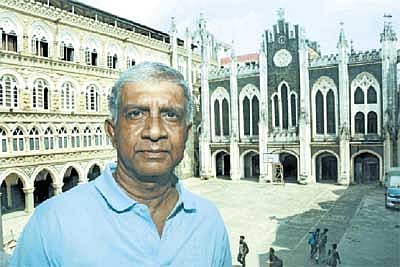
Dr. Agnelo Menezes, Principal – St. Xavier’s College, Dhobi Talao, tells students, through an interview with Shraddha Kamdar
He replied to my email requesting this interview quite enthusiastically, and within a matter of minutes and a few emails going back and forth, I had an appointment! It did not matter that he had agreed to see me late in the evening, when college is supposed to be over, and teachers should be relaxing home! Not for him, for he had just delivered a lecture to a class of management students, and come to meet me straight from there. Perhaps that’s how he manages to juggle everything he does, and he does a lot! That’s Dr. Agnelo Menezes, Principal – St. Xavier’s College, Dhobi Talao, fondly called Aggie or Aggie sir by those who know him. Apart from being the principal and lecturer at St. Xavier’s, he is also a visiting faculty at several reputed management institutes across the city.
For Dr. Menezes, archival aspects are quite valuable, because then he sees the value in belonging to this generation. He says it is essential for students to know what India was earlier (especially before 1991) and then know what it is now to understand the difference. He says that going beyond the classroom for students to develop and understanding of the subject matter is absolutely essential, particularly for a subject like Economics, in which he specialises.
“When I am teaching markets, I tell the students that until they experience the market, what I will teach will remain to be merely words. For the thought to work, they need to go out to the market. I then pair them up with partners from the other division (with an unknown partner), and each one of them contributes a seed capital of 50 rupees. They then go out to sell small common items like bob pins, glass bangles, stationery and the like. There are over a hundred items. With this exercise, they learn how to acquire the commodity, get on the right spot on a street to sell it, learn pricing with a mark-up for profit, and also learn the plight of the workers who do this for a living. It does not end there. They then learn to rotate the money, and finally contribute it towards CSR,” Dr. Menezes explains. He goes on to elaborate that at St. Xavier’s each student is to engage in 60 hours of social work, so that the idea and value of CSR is inculcated in the first year itself.
Another example Dr. Menezes offers is from the developmental Economics class in the third year. “In April (even before the academic year begins) when I get a list of the students in my class, I ask them to choose an OECD country. Once they decide on a country, they compare what they learn in class with the country they have chosen like Somalia or Jordan, among others. They then develop contacts via email with scholars at top notch universities who study these countries as well as the embassies of the countries, for more information and discussion. Going forward in the semester, I give this ‘the India twist’. I ask them to compare their chosen countries to Indian states, one which seems closest to the country. What all of this does is makes the classroom very deliberative. Students are so well informed at the end of it, and so discussion-oriented, that they sometimes even tell me that I am wrong, and I agree with them,” he says.
Apart from looking at practical experiences for the students, Dr. Menezes is also strong on research, especially by the faculty of the college. “I want to raise the bar for research and motivate them to become more research-oriented. In fact, I am constantly tracking the progress of my faculty in this area,” he says. Often, he also collaborates with his students for his research work. The students are also encouraged to write for the departmental journals in the college. He talks of how when students work on academic papers, they see the importance of the ideological shift that happens because of the paper.
With such dynamism, and the fact that St. Xavier’s is an autonomous college, it is not surprising that there are two student representatives on the board on studies. “They are vociferous, daring and caring students, who know their job. They are not yes-men. I feel that it is essential that students be a part of the board of studies since they are the stakeholders. I also believe that the students bring us down to Earth whenever necessary, since they provide a lot of perspective of a variety of topics, from methodology to material,” informs Dr. Menezes.
Despite all of these steps, at the end of the day, the students are working towards marks. What is his take on that? “At St. Xavier’s we do it differently and create a grid. We devote weightages to different parts of the evaluation. This takes place on various aspects like class work, tests, projects, presentations and so on. In fact, at our college, we make sure to assign a weightage to reflections as well, because personal reflections matter. Initially students feel a little out of place and do it because it is mandatory, but gradually they get quite comfortable with the thought and the process,” he says. He further adds that marks do not reflect capability, however, in some sense they cannot be done away with.
Moving towards talking of the underprivileged, the eminent educationist talks of the philosophy behind the various steps the college takes. For instance the commerce wing of the college is run in the evenings for those students who have passed class 12 (no matter how many attempts it took) to motivate them to gain a degree. “They also use the same infrastructure as the others, so in a sense it gives them a sense of dignified aspiration,” he says.
Towards the end of the interview, Dr. Menezes offers his final message to the students: “The shift from what to why to for whom can take place only when we get into reading. You should question, quest and quiz. I always tell me students to read up so much on a topic that they create hell for the speaker! A genuine profound kind of hell where knowledge can be created.”

