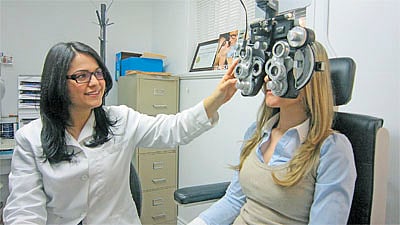
Interested in helping people see the world better, literally? Consider a career in optometry, says Reena Jhaveri
Sector overview
The ‘nerd effect’ is catching on! Gone are those days when uncles and aunts would chide you with remarks like “Watching a lot of television” or “Are you using the computer too much?” just because you wore glasses! These days, no one in college also calls you ‘Chashmish’ or ‘scholar’ just because you don a pair of smart glasses. In fact, students are increasingly opting for ‘sporty’ eyewear!
Add to that the fact that with advancing times, and with the rampant use of technology, a majority of the population needs to correct its vision. That’s where the science of optometry steps in. Optometry is an eye care profession independent of an eye specialist doctor, the ophthalmologist.
An expert in the field of optometry deals with the structure, functioning and working of a human eye. The professional has to work with the examination and diagnosis of vision problems, and suggest its correction in the form of glasses or contact lenses, perhaps even other special optical aids. For this, the optometrist can work with the ophthalmologist or independently with a store.
Since vision is an essential and a very important aspect of the human body and a person, as such, this is a profession that will stay in vogue forever. The scope for a trained optometrist within and outside the country is great. According to the 2012 article ‘The role of optometrists in India: An integral part of an eye health team’ by De Souza et al, in the Indian Journal of Ophthalmology says that profession of optometry in India is not yet regulated.
It is essential to understand that primary eye care needs will grow stronger and it cannot be covered by the ophthalmologists alone. Clinically trained optometry professionals are and will continue to be essential to the profession.
To get there
In the past many professionals entered this field purely by chance. Perhaps they got a job, and learnt while working. But in the current situation, ideologies have changed. Professional courses are available for those who are interested, and that provides a pointed direction in which students can channel their time, money and effort in learning this science. Courses are available after the student has cleared the plus two (HSC or equivalent) examination with a minim of 50% marks in physics, chemistry and biology.
A professional needs to have a Bachelor’s in Optometry (BOptom) in order to practice, and the candidate should be 17 years old to join the programme. Students who are interested in taking up this course need to take an exam called the EYECET, which is a test for entry into optometry courses. The bachelor’s programme is of four years duration. The first three years of teaching and training are followed one year of internship for clinical and trade experience. Students need to check on which institute recognises which form of EYECET, even though it is termed to be a combined, centralised test. The candidate may have to undergo a selection interview after clearing the EYECET examination, depending upon the chosen institute.
The exam consists of one question paper in English with a hundred multiple choice objective type questions, 25 each in physics, chemistry, mathematics and biology. Each correct answer gains one mark, whereas there is no negative marking.
Apart from the bachelor’s programme, there are other courses offered by many institutes across the country and city. There are several diploma and certificate programmes available as well. These include Diploma in Ophthalmic Assistant (2 years); Diploma in Optometry/ Ophthalmic Technology (2 years); Certificate – Ophthalmic Assistant (2 years) Diploma in Optometry (2 years). In addition, there is a master’s level programme as well.
Institutes in and around Mumbai
• Aditya Jyot Institute of Optometry, Wadala
• Lotus College of Optometry, Juhu
• Netra Mandir Institute of Optometry, Borivili
• Kohinoor College of Paramedical Science, Kurla
• Hirabai Haridas Khimji College of Optometry, Kalbadevi
• GS Medical College and KEM Hospital, Parel (Diploma)
• Jaslok Hospital , Pedder Road (Diploma)
• MGM University of Health Sciences, Navi Mumbai
• ITM Institute of Health Sciences, Navi Mumbai
• Dr. D. Y. Patil Institute of Optometry and Visual Sciences, Pune
• College of Optometry, Bharati Vidyapeeth Deemed University, Pune
The job market
There are several kinds of job descriptions for those who are professionally trained in this field. They work in eye testing, diagnosis of visual problems, and vision training, optometric counselling of patients with partial sight, colour blindness and hereditary vision defects, and designing and fitting of spectacles, contact lens and low vision aids.
All of the above diagnoses are possible only after certain eye tests are conducted to understand the functioning of the particular person. With that, goes the prescription of eye glasses and contact lenses. In fact, they also provide vision therapy for those with low vision.
Some optometrists are involved in perfect the glass lenses and polishing edges and adjusting the size of the lenses. Job roles include various positions in retail optical stores, owning businesses, working with ophthalmologists at hospitals or private clinics, and working with manufacturing companies.
Many optometrists also work with non-governmental organisations (NGOs) to volunteer their time in slum or rural areas. This not only provides a great social and satisfactory angle, but also offers the opportunity to learn a lot from the variety of cases they get to work with. Many who have the adequate experience opt for teaching as well, since industry professionals are highly in demand to share their experiences with students.
Remuneration
Even though it may not look quite lucrative, the work is steady and the profession is well paid. With specialty clinics and hospitals being set up in major cities and towns, the profession is growing much faster, and so is the remuneration scale. If an optometrist gets a chance to work in another country, it might open up many doors.
The amount an optometrist makes is determined by several factors including coverage under medical programmes, hours worked, practice location, services provided and patient population. Even then, the starting pay for a person in a government outfit could be around Rs. 15,000 to Rs. 20,000 pm. There could also be certain allowances above this amount.
An optometrist can start his job in the private sector as a trainee with a salary package of ` 12,000 to Rs 20,000 pm. A good optometrist can earn over Rs. 25,000 pm as a product executive. One can also opt for training or teaching at institutes. After a few years of experience, one can make over
Rs. 35,000 pm, and this figure will increase steadily with job switches. There are also instances of optometrists branching out to start their own businesses.
A student says
Mohan Thakkar / Pursuing his course
Aspirants should know what they are getting into when they opt for this field. Of course, it is not a very popular field like finance or law, but it requires tenacity and skill, not to mention a flair for helping people as well as precision in work, since after all, we are talking of the human eye. You should realise that since it is a science-based profession, love for biology (you will have to learn the human anatomy) is a must. Don’t think about this field if you do not like biology.
In addition, you do need a scientific and analytical bent of mind, since you will be required to apply scientific principles and methods. Even though one might be aware, I cannot stress enough the manual dexterity you need for this profession. Again, after all, you are dealing with an organ very delicate, which can change someone’s life for the better or for worse. You need to be accurate, and pay attention to detail. You also need to be great at organisation and follow up, and be up to date with the latest developments as well as scientific advancements, not to mention the new machines available in the market.
In the field
Ankur Shastry / Optometrist
One thing is certain. Even though you are not a doctor, you are dealing with an important aspect, and for that, you need to be proud and responsible. A great benefit will be to work in the field after acquiring the knowledge in the course, which is a requirement for the bachelor’s students, but the diploma students also need to learn how to talk to people on the job.
The bachelor’s students should try to gain hands-on experience at a clinic or store during holidays in the first three years. Even if the internship does not allow you to deal with patients independently, you can observe professionals and learn a lot, especially in terms of what kinds of queries patients have and how to sort them out delicately without offending them. It will make you industry ready in advance, and it will be a skill that will be appreciated in the field.
Optometry is an applied science, and it’s helpful to know how this knowledge is developed. Working on live cases can get you the depth beyond the theory. Both, the range and the depth of experiences are important.
An aspirant asks
Anuj Turbhe / FYJC science student
I had not thought of this course at all, but my father’s friend, who is an ophthalmologist, suggested I look into it. I think he can also offer me a break in his clinic if I pursue a programme. But I am unaware of a lot of things about this programme like scope and curriculum. Can you help? How to I get some experience in the field?
Professional Ankur Shastry answers: It is nice that your father’s friend expanded your horzon by throwing in this field in the mix, and even better to have a job waiting for you even before you graduate. The optometry course covers a wide variety of subjects. These include learning about the physical optics, knowledge of optical instruments, general anatomy, physiology and abnormal and pathological conditions of the eye. You will also learn the methods to measure refractive errors and their correction. These will be complemented by a variety of other courses related to the subject. What’s even better, in the final year, you will be expected to do your internship in the industry whereby you will practically apply all that you have studied in theory. This hands-on practice will be extremely useful to you to set up an optometry centre as part of your retail outlet or store.
Before that, you can try to work with your own optometrist or by searching for optometrists in the area, and ask them likes and dislikes about the profession.

