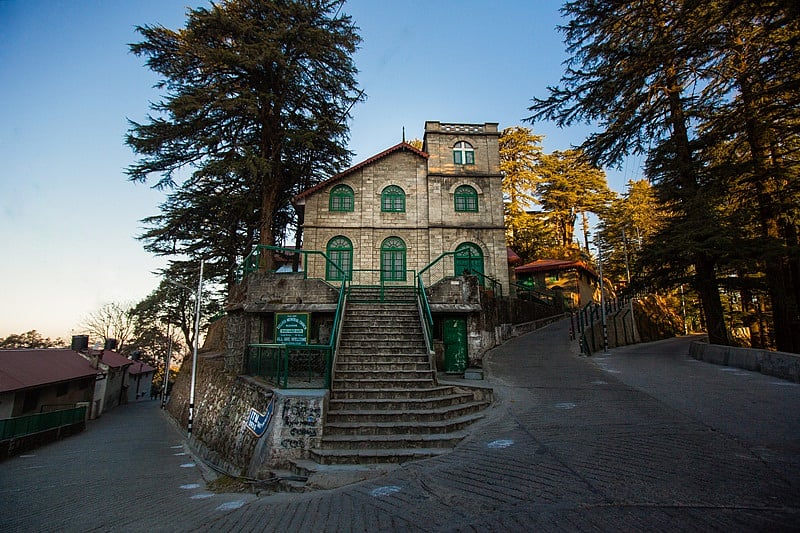
When you’re at the top of Landour, an apparition appears atop a flight of steps and if it were not for the backdrop of the Himalaya, you could easily mistake the magnificent edifice for a church transplanted straight out of Midwest America.
Founded in 1903, it was named after a Canadian Missionary, Dr Samuel H. Kellogg, and before you jump to any conclusions, I assure you he did come from the family that created the famed cereal. Learning Hindustani (as distinct from Urdu or Hindi) in 1870, he published the first book on Hindustani Grammar. Ordained minister of the church, he founded this Language School that comes highly recommended for the courses it offers in Urdu, Punjabi, Hindi and Hindustani to research scholars, wanderers and lost souls from around the world.
The mid nineteenth century saw the Bell, the Book and the Candle arrive hanging on to the coat-tails of the Raj. Finding local languages taught at different centres spread out far apart: from the deodars in Happy Valley to Dilaram on Camel’s Back and at Childers Lodge in Landour, Rev Kellogg set up, what was to be later called, the Kellogg Memorial Language School.
Ganesh Saili |
The summer of 1969, found me fishing around Landour looking for a summer job. That was when I walked into the venerable Rev. Caldwell Smith, that amazing linguist who had the rare ability to connect intonation with place. I had barely to open my mouth for him to deliver the coup de grace: “A Garhwali from Chamoli!” No wonder, his ‘Hari Kitab’ (pub:1971) or green-covered book is a manual for teachers 50 years later.
In its hundred odd years’ existence, students from universities as afar as Berkley, California, Arizona, Stanford and Chicago, some 16,000 students have learnt the ropes of Hindustani. In a lifetime spent in the hill station, I have bumped into a nosegay of unforgettable characters. There was Professor Zimmerman, who found solace in the drawings of Ahoi, in Saharanpur district; Arthur Lopatin from Columbia University was lost in the politics of Eastern Uttar Pradesh in District Balia; the balding Paul Keupfele’s took to Adwaith philosophy; and believe-it-or-not, I once met a linguist logging the whistle calls of the shepherds of the higher meadows, and then another who was listing the clucks of the muleteers egging on their stubborn charges.
I thought I had been there, seen that when, I met pretty Pauline, a summer student spending a year studying the effects of marijuana on the mind.
‘How’s the Hindustani coming along?’ I ask trying to make conversation.
‘Fine! But folks in the bazaar don’t know what I’m saying!’
I don’t think that was the least of the problem. The problem arose, I discovered, because a bulbous busybody, playing spoil sport, started making baseless complaints against the school.
On occasions like these, I am constrained to agree with those who believe Landour’s lack of oxygen plays havoc – especially with feeble minds.
