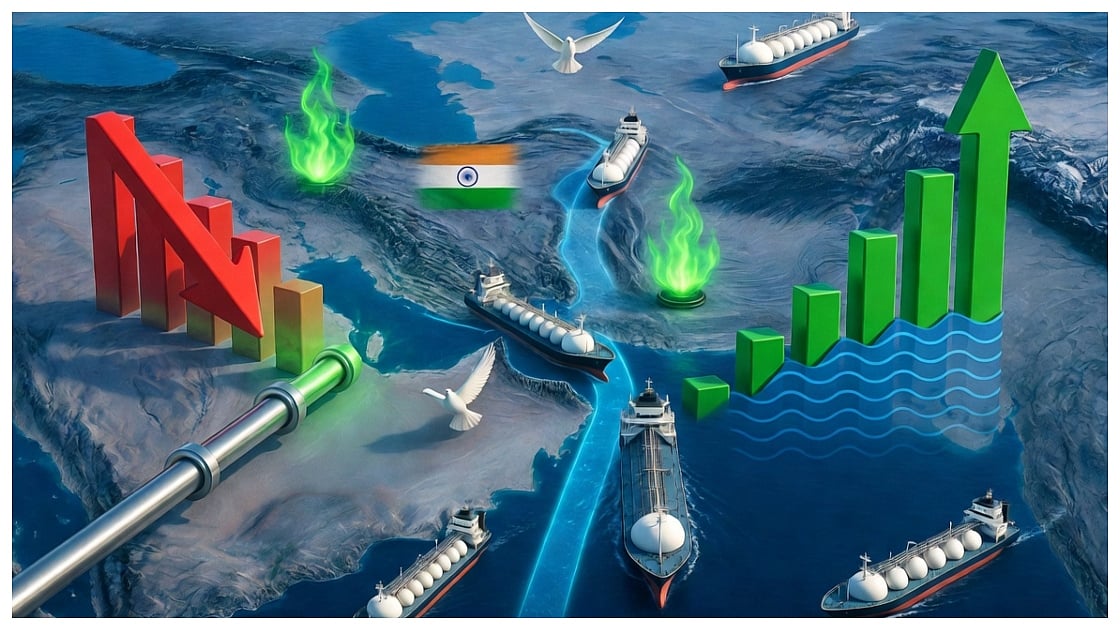
The ongoing US-Iran conflict has significantly changed India’s liquefied natural gas (LNG) import landscape, forcing the country to diversify supplies away from traditional sources.
In August, Qatar, previously India’s largest LNG supplier, did not ship any cargoes, while the US emerged as the top supplier.
According to a report by Moneycontrol, data from commodity analytics firm Kpler showed that India imported 858,500 tonnes of LNG from the US in August, an increase of 18.6% compared with July. The US accounted for around 35% of India’s total LNG imports during the month.
India expands LNG supplier base amid geopolitical risks
Nigeria became the second-largest LNG supplier to India in August, shipping 540,700 tonnes, an 84% increase from the previous month. The country accounted for 22% of India’s LNG imports.
Other suppliers included Oman, which shipped 524,700 tonnes compared with 459,000 tonnes in July, while the UAE supplied 244,400 tonnes. Mozambique and Australia also contributed 225,900 tonnes and 69,400 tonnes, respectively.
India’s overall LNG imports increased 5.2% to 2.5 million tonnes in August from 2.3 million tonnes in July.
Natural gas plays an important role in sectors such as fertiliser production, industrial heating, electricity generation and urban transport. Qatar had earlier been a dominant supplier, accounting for around 45% of India’s LNG imports before disruptions caused by tensions in West Asia.
Diversification becomes key for energy security
India has been working to reduce dependence on any single geography for energy imports. Officials said the country has expanded sourcing across LNG, LPG and crude oil markets, with supplies increasing from countries including the US, Canada and Algeria.
However, analysts believe LNG and LPG markets remain more exposed to geopolitical disruptions compared with crude oil due to fewer immediate alternatives.
Shipping activity through the Strait of Hormuz, a crucial energy route, declined sharply as tensions between the US and Iran escalated. The reduction in vessel movement raised concerns over possible supply disruptions and higher energy prices.
While India’s crude oil supplies are relatively protected due to diversified sourcing, LNG and LPG imports continue to face greater risks from Gulf-region instability. The latest developments highlight the importance of expanding supply networks to strengthen India’s energy security.

