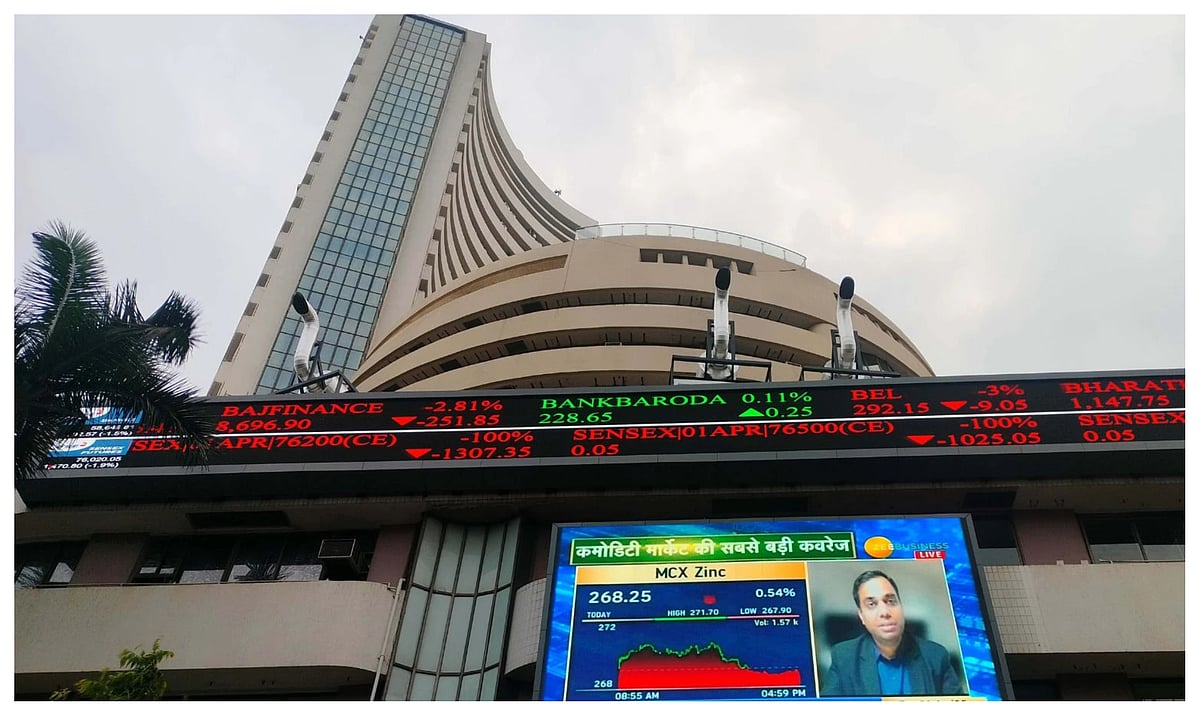
The Sensex witnessed sharp intraday volatility during the Closing Auction Session (CAS) on the BSE on Thursday, coinciding with the first monthly expiry of derivatives contracts since the new mechanism was introduced.
Between 3:18 pm and 3:23 pm, the Sensex plunged by more than 2,200 points, before rebounding nearly 2,000 points over the following minutes. The index ultimately closed at 76,934, down 539 points from the previous session.
According to some market experts, the swing in the index was significant to give a return of 44 times in just 5 minutes.
"If you have invested 1L in Sensex option 76500 PE at 3:15 AM and exited at 3:20 PM you would have made 44 lakhs. 44 times in just 5 min. Power of CAS," said Sebi registered research analyst Vibhor Varshney in a post on X.
The Nifty also experienced unusual movements during the corresponding period, although the swings were smaller. It fell by more than 100 points between 3:18 pm and 3:22 pm before recovering some of the losses, ending at 24,091, down 117 points.

Sharp Moves in Key Stocks
Several major Sensex constituents also saw significant price fluctuations during the auction period. Reliance Industries, the index's largest-weighted stock, slipped from around ₹1,280 to ₹1,250 within minutes before recovering and ending at ₹1,288.
HDFC Bank, ITC and Bharti Airtel were among other major stocks that recorded notable movements during the CAS window.
Introduced by the Securities and Exchange Board of India (Sebi) on August 3, CAS determines closing prices for around 200 stocks with active equity derivatives contracts. Non-derivative stocks continue to use the VWAP-based system.
Sebi Monitoring New Closing Mechanism
Under CAS, eligible stocks enter an auction following regular trading, with orders matched to establish the final closing price. Sebi says the system is designed to strengthen price discovery and limit the influence of last-minute orders.
Sebi Chairman Tuhin Kanta Pandey has described CAS as a significant market microstructure reform, noting that similar mechanisms operate in several major global markets.
According to Pandey, dependable closing prices are particularly important for indices, passive investment products and mutual fund NAV calculations. He has also said indicative prices and random closing times improve transparency and reduce attempts to influence the final price.
Sebi is currently monitoring market feedback and has indicated that the framework could be modified if necessary. Pandey has also noted that differences between index levels at the end of regular trading and final CAS closing values have moderated since the mechanism was introduced.

