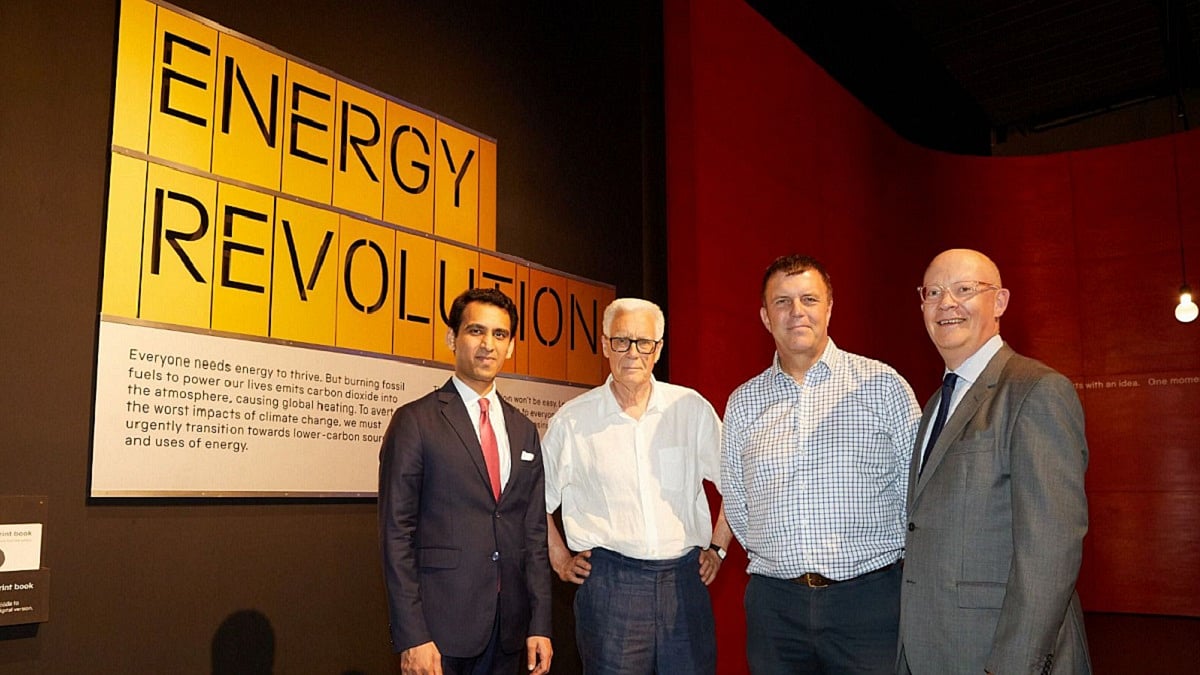
London, June 26: Speaking at the inaugural Adani Green Electrification Dialogue in London, Sagar Adani, Executive Director of Adani Green Energy, highlighted the growing need for energy security, affordability and sustainability amid global geopolitical challenges. He also outlined India's energy transition plans and the Adani Group's long-term investments in renewable energy, storage, transmission and nuclear power.
Speech By Sagar Adani At Inaugural Of 'Adani Green Electrification Dialogue':
Good afternoon!
Welcome to the inaugural Adani Green Electrification Dialogue. It is a privilege to host you here at the iconic London Science Museum in collaboration with the Energy Transitions Commission.
We are here today because never before has the mandate of energy security been more critical - all over the world, but especially in Asia.
The events of the past three months have left every nation thinking.
Today, all countries – developed or developing – are being forced to come to terms with what it means to futureproof their economies against relentless geopolitical shocks.
At the same time, for most of the developing world, where hundreds of millions of people are rising into the middle class and are increasing their energy consumption for a better quality of life, affordability of energy continues to remain a fundamental necessity.
And of course, these constant geopolitical disruptions have turned this necessity into a monumental battle for survival.
Completely independent to the two factors above, most countries in the world have also not been able to diversify themselves off fossil fuel sources and move to predominantly green sources of power. The concern of climate change and the sustainability of energy use from Renewable and clean sources have also not been addressed in one global voice.
So my friends - Energy Security, Energy Affordability, and Energy Sustainability. This is the ultimate global trifecta.
As we’ve all discussed I’m sure many times before, one of the small answers to this challenge is electrification of the economy. I thank Lord Adair Turner for leading our upcoming panel on how to accelerate this global shift of electrification and I look forward to the insights from Greg Jackson and Alice Williams.
My friends, let us talk about the one country whose explosive growth in energy consumption is going to arguably be one of the most critical factors affecting global energy roadmap going forward. India.
Nowhere is electrification more critical and even challenging, than in India.
It is helpful to consider India’s electricity demand and supply in the broader context of the country’s final energy consumption.
In 2024, India consumed about 10,000 Terawatt-hours across all sources — coal, oil, gas, nuclear and renewables.
China, with a similarly sized population of 1.4 billion, consumed 32,810 Terawatt-hours, or more than three times as much.
Let’s put the scale of India’s challenge into perspective.
We are talking about a structural leap, adding nearly 2,000 gigawatts of new capacity over the next two decades.
All while ensuring that this energy remains affordable, accessible, and increasingly clean.
That is the scale of the opportunity. And that is India’s defining challenge.
For India, the path forward is clear. We must electrify everything, reducing structural dependence on imported energy.
We must build an energy backbone anchored in resources that are available within the country.
And this is where we must be pragmatic, leveraging every energy source available to us.
Renewables. Hydro. Efficient thermal. And nuclear.
Because without firm, scalable baseload power, the math simply does not work.
It would also be incomplete not to recognize the role that the government and the country’s leadership have played in enabling this journey.
Over the past decade, India’s leadership has played an exceptional role in cutting red tape, getting rid of unnecessary and outdated regulations, revitalizing public undertakings and encouraging private investments.
Countless macro and micro policy changes by the government have resulted in an environment where business can grow, flourish and prosper.
From accelerating infrastructure development, to expanding renewable capacity, strengthening transmission networks, and enabling long-term investments
There has been both clarity of intent and continuity of action. And that continuity is a critical enabler of resilience.
Coming to the role of industry—and specifically, the Adani Group.
We are India’s largest private sector operator in every aspect of the electricity value chain.
We operate thermal power assets. We are building one of the world’s largest renewable energy portfolios, targeting 50GW by 2030, and a substantial nuclear portfolio of 10 GW by 2035.
We are investing in large-scale energy storage including pumped hydro and utility-scale batteries, expanding transmission networks to move power efficiently across the country and developing green hydrogen ecosystems.
We are doing it all, at a scale and speed the world has rarely seen. Because incremental change will not cut it.
To make this a reality, our Chairman, Gautam Adani, has committed over 100 billion dollars towards energy transition — one of the largest private-sector commitments in the world. This is not a set of isolated investments, but an integrated strategy.
For us at Adani Green, this is not just a financial pledge. It is our marching order.
The Energy challenge and opportunity in front of India is far greater than any one business group can meet alone. It will require collective action across India and the developing world, continued policy innovation and billions of dollars in financing to deliver the ultimate trifecta I spoke about earlier – energy security, energy affordability and energy sustainability – for all of humanity.
Hence, I am very grateful to Nigel Topping for chairing the panel on “how to fund the acceleration of electrification” and intrigued about the thoughts of the panelists Sean Kidney and Rhian-Mari Thomas.
Finally, on behalf of Adani Green, i would like to extend our sincere gratitude to Sir Ian Blatchford for our partnership with the Science Museum.
And, to all of you, the leaders in energy, policy and finance communities, thank you for being here.
Let the dialogue begin!

