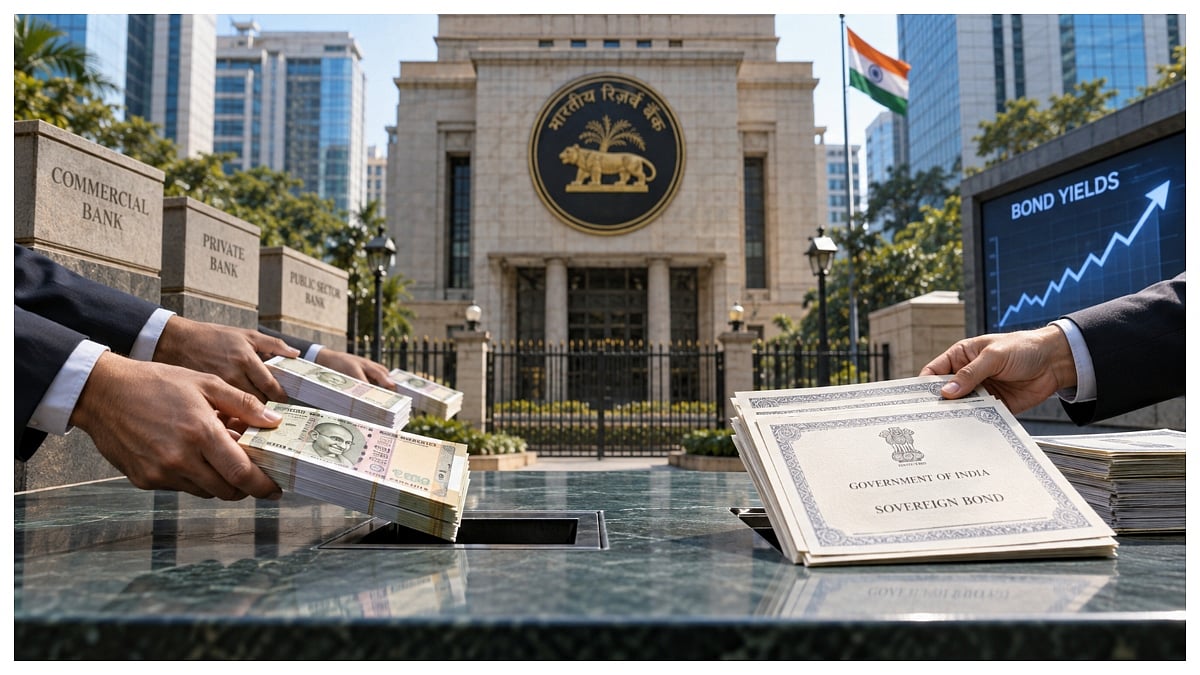
Mumbai: The Reserve Bank of India has taken its biggest liquidity-tightening step in years, selling government bonds worth Rs 50,000 crore through an open market operation. The auction on September 17 marked the first comparable net debt sale since November 2017.
But why did the central bank act now, and what does it mean for borrowers, depositors and financial markets?
Why Did RBI Sell Bonds?
The RBI sold bonds mainly to drain excess cash from the banking system. Banks entered September with average surplus liquidity of nearly Rs 10.25 lakh crore, equal to about 3.8 percent of deposits.
When banks have far more cash than they need, overnight borrowing rates can fall below the RBI’s intended policy level. By selling securities, the central bank collects money from banks and removes those rupees from circulation.
Unlike short-term reverse repo auctions, where funds return after maturity, an outright bond sale removes liquidity for a longer period unless the RBI later injects money through another measure.
How Was The Auction Structured?
The RBI accepted the entire notified amount of Rs 50,000 crore, around USD 5.2 billion. Six government securities maturing between 2029 and 2032 were sold through a multiple-price auction.
The largest allocation was Rs 18,840 crore in the 8.28 percent Government Security maturing in 2032, accounting for more than one-third of the accepted bids.
The auction was the first part of a Rs 1 lakh crore programme announced on September 11. Two further sales of Rs 25,000 crore each are planned for September 21 and September 28.
Will Loan EMIs Rise Now?
The bond sale does not change the repo rate and will not automatically increase existing loan EMIs. Floating-rate loans will continue to follow the benchmark and reset terms specified in their contracts, while fixed-rate loans should remain unchanged unless repricing is permitted.
However, the impact may emerge gradually. If banks are left with less spare cash, they may have to compete for deposits or borrow funds at higher rates. This could eventually raise the cost of new home, vehicle, personal and business loans.
Depositors, meanwhile, could benefit if banks raise fixed deposit rates to attract funds. Such a move is not guaranteed after a single auction.
Why Is The Move Significant?
The RBI had used bond purchases and foreign-exchange swaps to inject liquidity during 2025. By September 2026, the position had reversed, with excessive funds pushing short-term rates below the policy corridor.
The latest sale signals that the RBI is prepared to use durable tools to restore balance. Markets will now closely track the next two auctions, particularly accepted amounts and yields, to see whether liquidity can be reduced without sharply increasing government borrowing costs. That balance will determine the wider impact.

