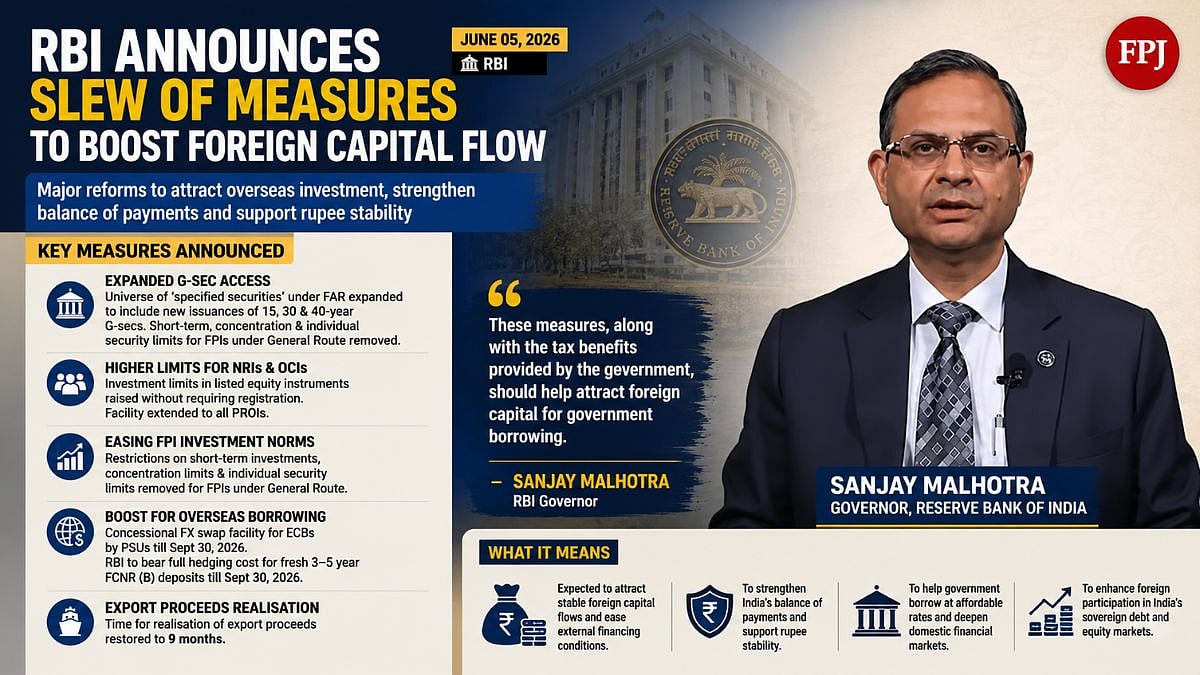
Mumbai, June 5: The Reserve Bank on Friday announced a slew of measures, including expanding the basket of specified government securities (G-secs) for overseas investors, to attract foreign capital.
Expansion of government securities access
"For government securities under the Fully Accessible Route (FAR), we are expanding the universe of 'specified securities' by including all new issuances of 15, 30 and 40-year tenor G-secs. In addition, limits pertaining to short-term investment, concentration and individual securities on FPI investment under the General Route are being removed," RBI Governor Sanjay Malhotra said.
These measures, along with the tax benefits provided by the government, should help attract foreign capital for government borrowing, he said.
The government has scrapped long-term capital gains tax on investments made by foreign institutional investors (FIIs) in government securities through an Ordinance issued on Friday.
Commenting on the government move, Malhotra said it is a positive step and it will further strengthen the Balance of Payment.
Broader access for NRIs and FPIs
Besides, the RBI also raised investment limits for non-resident Indians (NRIs) and Overseas Citizens of India (OCIs) in listed equity instruments without requiring registration with the securities regulator.
The facility has now been extended to all individual Persons Resident Outside India (PROIs), broadening access to Indian equity markets.
The RBI also removed restrictions on short-term investments, concentration limits and individual security limits for Foreign Portfolio Investors (FPIs) investing through the General Route.
Asked about the quantum of dollar inflow these measures would lead to, Malhotra said the RBI is not targeting any specific amount.
However, he said, "We do expect a healthy flow of foreign capital."
Support for sovereign debt market and rupee
RBI measures, coupled with tax exemptions announced on investments in government securities, are expected to support foreign participation in India's sovereign debt market and facilitate government borrowing at affordable interest rates.
The move also lends support to the rupee, which has weakened more than 6 per cent this year amid rising crude oil prices and foreign portfolio outflows from equities.
Facilities for overseas borrowing
To encourage overseas borrowing, the central bank said it would provide a concessional foreign-exchange swap facility until September 30, 2026, for external commercial borrowings (ECBs) raised by public sector undertakings.
In addition, authorised dealer banks will be eligible for a temporary facility under which the RBI will bear the full hedging cost for fresh three-to five-year Foreign Currency Non-Resident (Bank), or FCNR (B) deposits mobilised until September 30, 2026.
Also Watch:
The RBI also proposed to restore the time for realisation of export proceeds to nine months.
The measures are aimed at attracting stable foreign capital flows, easing external financing conditions and strengthening India's balance of payments amid heightened global volatility.
(Disclaimer: Except for the headline, this article has not been edited by FPJ's editorial team and is auto-generated from an agency feed.)

