
Do you really need an income-tax clearance certificate (ITCC) every time before leaving the country?
Depends on who you are asking.
According to PIB Fact Check, no such certificate is required for regular individuals.
This clarification has come on an Instagram video by influencer Sarthak Ahuja, who is talking about Form 157, which is required to be filed by individuals without a PAN card or without taxable income.
While the PIB Fact Check has called the claims in the video fake, the provision for submitting Form 157 for the above-mentioned individuals is effective from April 1.
What Was The video About?
According to Ahuja's video, which is now archived on Instagram but still visible on Facebook, Indian citizens will need to visit the income tax officer every time they leave the country.
Ahuja was referring to Form 157, which is required to be filed by individuals without a PAN card or without taxable income.
“Now, every time that you leave the country, you will first have to visit the income tax officer,” influencer Sarthak Ahuja, with over 3 million followers on Instagram and 388,000 followers on Facebook, is seen saying in the video.
He explained that the form will be required for individuals who are minors, homemakers, retired parents, etc. He raised concerns that this may lead to further friction in foreign travel, as the process of obtaining a visa was already lengthy.
The form is required to be submitted manually to the local Jurisdictional Assessing Officer. However, he is not seen talking about any “income tax clearance certificate”.
What Does PIB Fact Check Say
As this video was going viral on social media and raising concern and confusion among people planning to take an overseas flight, the fact-check unit of PIB termed the claim as fake.
In a post on X (formerly Twitter), PIB Fact Check said that an income-tax clearance certificate is not mandatory for everyone. The government body also clipped the first 20 seconds of the video which is originally 1 minute and 30 seconds long.
“They (income tax certificate) are only required for specific individuals under certain legal circumstances. This rule has remained unchanged since 2003, even after the amendments vide Finance (No. 2) Act, 2024,” it said in the post.
It also shared a detailed clarification from the Central Board of Direct Taxes (CBDT), stating the specific circumstances in which one would be required to obtain such a certificate.
“Only certain persons, in respect of whom circumstances exist which make it necessary to obtain a tax clearance certificate, are required to obtain the said certificate,” the CBDT said.
It also listed the conditions in which such a certificate is required:
where the person is involved in serious financial irregularities and their presence is necessary in the investigation of cases under the Income-tax Act or the Wealth-tax Act, and it is likely that a tax demand will be raised against them, or
where the person has direct tax arrears exceeding Rs. 10 lakh outstanding against them, which have not been stayed by any authority
However, the Instagram influencer alleged that the government misconstrued his video and criticised calling his claim fake.
“Terrible how they can misconstrue what I said to call it fake when the post clearly mentioned that the people who need to submit the form are those who don’t have taxable income or PAN. People can look at Form 157 in the new tax rules and see for themselves,” he said in an Instagram post with a screenshot of the fact-check tweet by the PIB.
He also replied to the PIB post on X, saying, "Horrible. The video does not say all citizens. It clearly states that people who don’t have taxable income or PAN. So why pick on selectively showcasing it as incorrect!"
Ahuja has also archived the original video from Instagram after the tweet by PIB.
However, Ahuja’s claims are in line with a government document which addresses frequently asked questions about Form 157.
The document says that individuals without a PAN card or without taxable income will be required to manually submit Form 157 to the local jurisdictional assessing officer every time they leave the country.
FAQ link: https://www.incometaxindia.gov.in/documents/d/guest/form-157-faqs
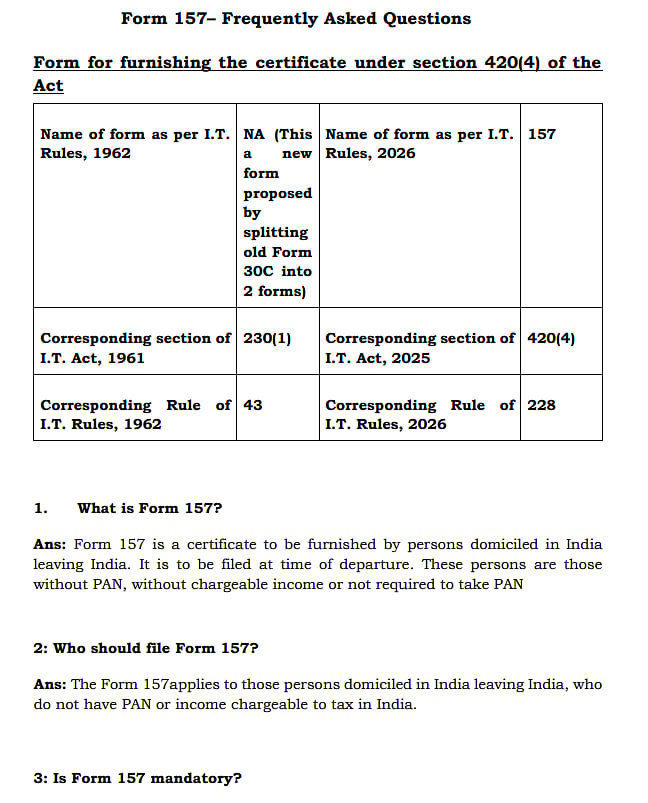
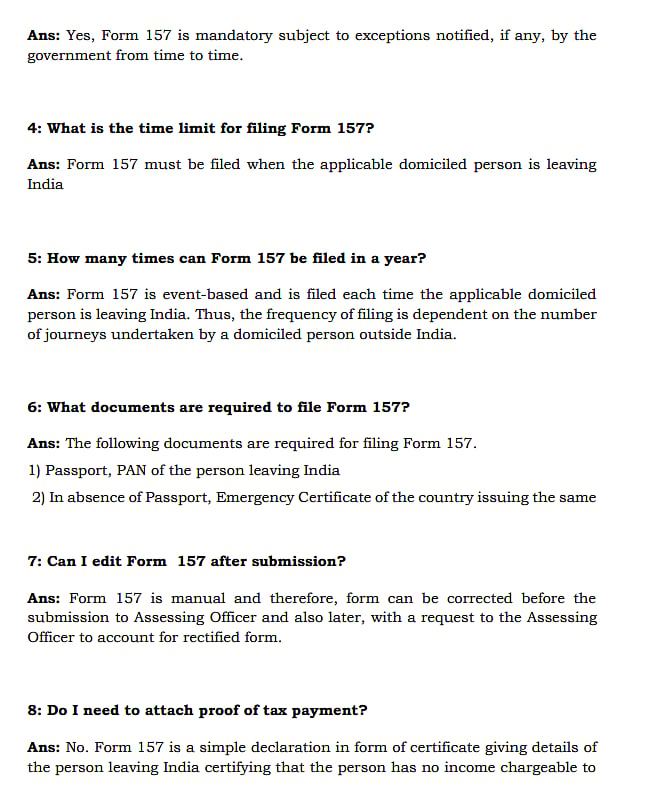
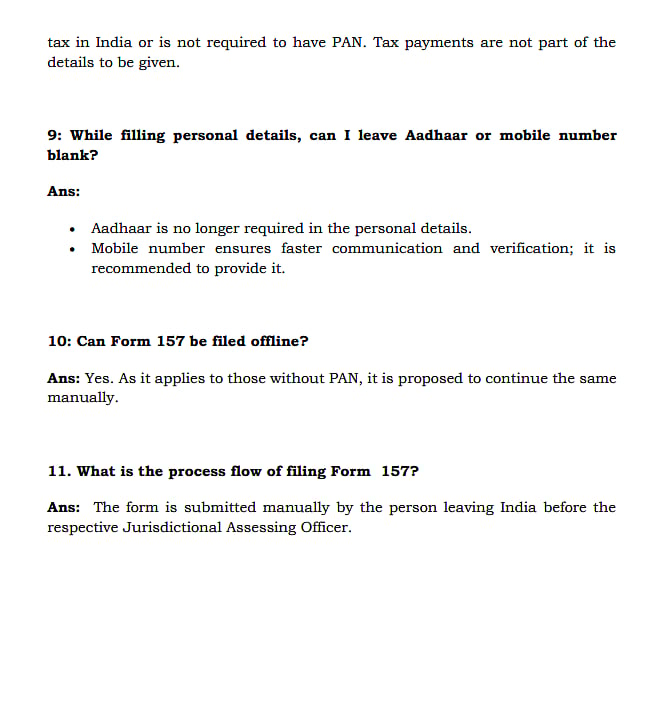
“Form 157 is event-based and is filed each time the applicable domiciled person is leaving India. Thus, the frequency of filing is dependent on the number of journeys undertaken by a domiciled person outside India,” it says.
The document also says that filing this form is mandatory for the above-mentioned individuals.
“Yes, Form 157 is mandatory, subject to exceptions notified, if any, by the government from time to time,” it says.
In his video, Ahuja also advised the government to halt the requirement of the form until an online process is established for convenience.

