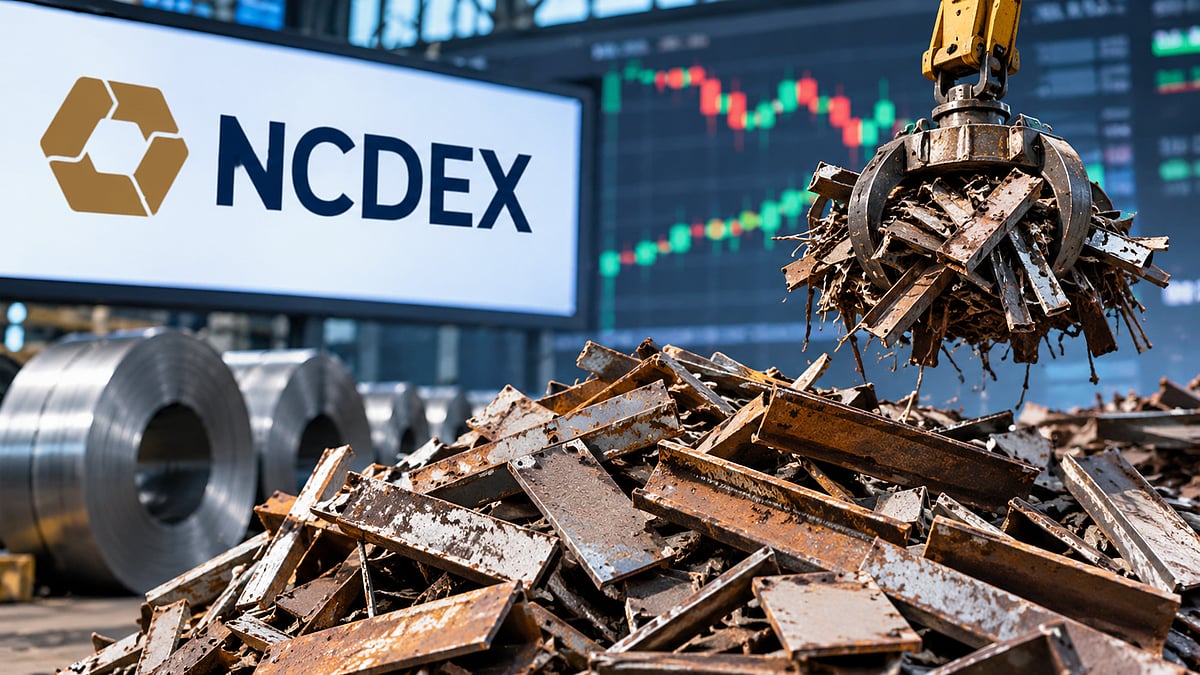
New Delhi, Nov 11: National Commodity & Derivatives Exchange (NCDEX) on Wednesday launched steel scrap futures, the country’s first futures contract in the segment to be based on a price-reporting agency benchmark, aiming to give steelmakers and traders a way to hedge price risk.
The contract is based on HMS 80:20, a widely used import grade consisting of 80 per cent heavy melting scrap grade 1 and 20 per cent grade 2, and is a benchmark across Asian markets, the exchange said in a statement.
Prices will be referenced to assessments by BigMint Technologies, which has signed a memorandum of understanding with the exchange to act as the price reference agency.
Contract Specifications And Settlement Details
The contract has a trading unit of 10 tonnes and a maximum order size of 500 tonnes. The tick size is Rs 10 per tonne, and the contract will be cash-settled against a basis centre of Mandi Gobindgarh, Punjab, excluding goods and services tax.
India’s steel scrap market is fragmented, with prices varying by region and grade, NCDEX said.
“Steel scrap is an increasingly important component of India’s steel value chain... Yet its price risk has had no exchange-traded answer,” NCDEX Managing Director and Chief Executive Vikas Goel said.
The exchange said the contract follows a framework compliant with the International Organization of Securities Commissions (IOSCO) principles for price reporting agencies.

India's Steel Production And Scrap Trends
India, the world’s second-largest crude steel producer, raised output by more than 10.7 per cent to about 168.4 million tonnes in the year to March 2026, while global production fell about 2 per cent, according to worldsteel data cited by the exchange.
Domestic scrap generation rose 22 per cent to 32 million tonnes, while ferrous scrap imports fell 20 per cent, NCDEX said.
BigMint data show HMS 80:20 prices have a 90 per cent correlation with billet and 89 per cent with wire rod, the exchange said.
Also Watch:
Futures To Help Hedge Price Risks
Steelmakers could buy the futures to lock in scrap costs, while billet and wire rod producers and sponge iron makers could sell them to hedge against price declines, it added.
NCDEX Chief Business Officer Kedar Deshpande said the contract should help steel clusters in Delhi-NCR, Punjab, Rajasthan, Gujarat, Maharashtra, West Bengal, Chhattisgarh, Odisha and Tamil Nadu manage price volatility.
Level up your brain the fun way. Play daily games and quizzes on FPJ Smart!
(Except for the headline, this article has not been edited by FPJ's editorial team and is auto-generated from an agency feed.)

