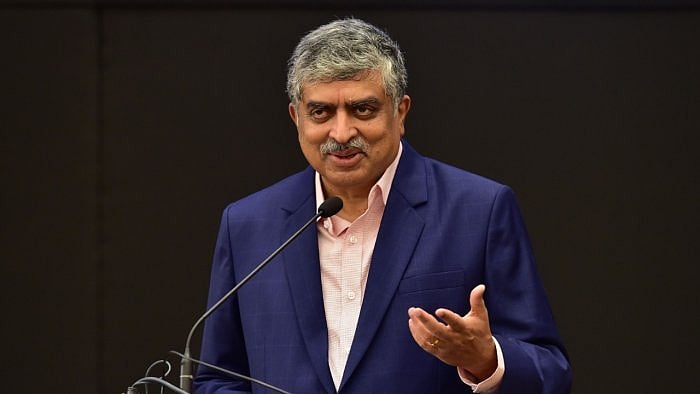
Infosys Chairman Nandan Nilekani has said India may be better placed to tackle the employment risks posed by artificial intelligence by encouraging the growth of millions of small businesses rather than relying primarily on large corporations.
Speaking at the Global Fintech Fest in Mumbai, Nilekani said large companies could use AI to significantly improve efficiency while reducing their workforce. This, he argued, makes it necessary to expand the base of businesses capable of generating employment.
“One of the big concerns in AI is what happens to jobs. And it's a legitimate concern because large companies can actually apply AI effectively to reduce jobs,” Nilekani said.

“If you want to create an economy that's generating jobs, it's not necessarily done by having a few big companies. It's going to come from having millions of small companies,” he noted.
Small Businesses Could Strengthen Job Creation
Nilekani said spreading employment across smaller enterprises could make the economy more resilient as AI transforms conventional workforce requirements.
“You actually should create a situation where job creation is done by millions of small companies,” he said, adding that jobs created by smaller businesses could be “safer” and help “AI-proof an economy”.
He also highlighted how digital infrastructure could allow small businesses to access sophisticated capabilities at relatively low cost.
“You can have a small business with a 24/7 agent, the best analysis on the Internet, a token that talks to itself and a marketplace, and sell it or give a loan against it,” he said.
Technology Should Reach Smaller Enterprises
Nilekani said technology should allow smaller firms to compete more effectively with larger companies.
“If you want businesses to have access, you should be able to make it easy for a small business to participate as if it's a large business,” Nilekani said.
He also stressed inclusive digital infrastructure. “We must build systems that can reach everybody. It's not for a few that we do this,” he said.
“Technology [must] reach the masses and add value to their lives,” he added.
Nilekani also backed public-chain infrastructure for creating global markets for tokenised assets and said ecosystem design would be critical for regulated assets and liquidity.

