
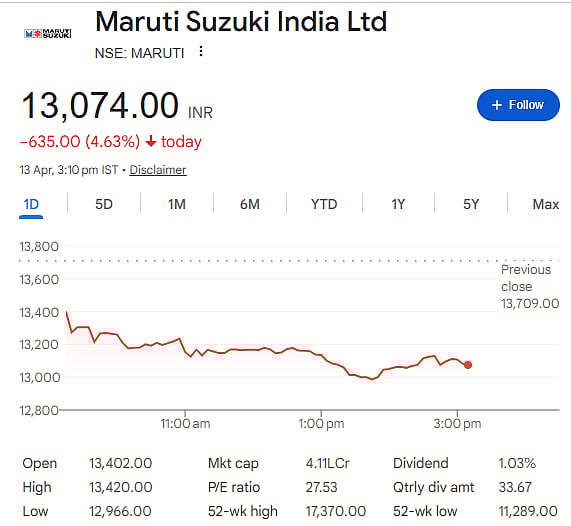
Mumbai: Shares of Maruti Suzuki India declined sharply on Monday, April 13. The stock fell over 4.6 percent to around Rs 13,074, making it one of the worst performers in the auto sector.
The stock opened at Rs 13,402 and slipped to a low of Rs 12,966 during the day, showing strong selling pressure. It remained below its previous close of Rs 13,709 throughout the session.
New emission norms trigger concerns
The main reason for the fall is the draft CAFE 2027 emission norms. These new rules aim to reduce pollution and push companies towards cleaner technologies.
For Maruti, this creates a challenge because of its current product strategy, which mainly focuses on petrol and hybrid vehicles.

Hybrid advantage reduced
Under the new draft, benefits given to strong hybrid vehicles have been reduced. Earlier, hybrids received a higher credit benefit, but now this has been cut.
Also, there are no extra benefits for small cars anymore. This removes an advantage Maruti had earlier, as it mainly sells small, fuel-efficient cars.
EV push creates pressure
The policy direction clearly supports electric vehicles (EVs). This is where Maruti is currently behind some competitors.
Companies like Tata Motors and Mahindra & Mahindra already have strong EV plans and products in the market. Maruti’s EV rollout is still in early stages and may take time to scale.

Strategy shift may be needed
Maruti may now need to rethink its long-term strategy. It can either invest more in EVs or continue focusing on hybrids, which now have fewer benefits.
The company can also buy carbon credits to meet rules, but this may increase costs and affect margins.
Outlook remains uncertain
Although the new norms offer some flexibility through phased targets, the long-term pressure remains.
Investors are concerned about how quickly Maruti can adapt to the changing environment. This uncertainty has led to the recent fall in the stock.

