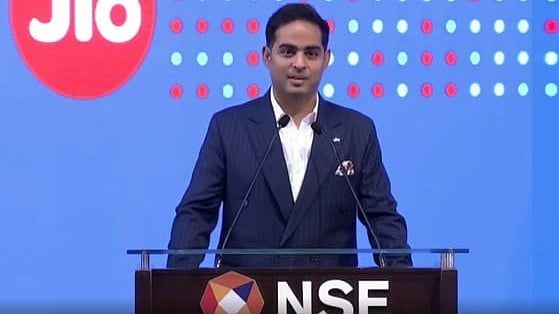
Mukesh Ambani-backed Jio Platforms made a strong stock market debut on Wednesday with its shares listing at ₹1,358 on both the Bombay Stock Exchange (BSE) and National Stock Exchange (NSE).
The listing price represented a 21.36% premium over the initial public offering (IPO) price of ₹1,119, delivering substantial gains to investors allotted shares.
At debut, Jio Platforms commanded a market capitalisation of ₹12.5 lakh crore, becoming India's second-most valuable listed company after parent Reliance Industries Limited (RIL), valued at ₹16.15 lakh crore.
Bharti Airtel ranked third with a valuation of ₹12.18 lakh crore, according to BSE data.

The ₹30,213 crore IPO received an overwhelming response, achieving full subscription within 100 minutes of opening on Oct 21.
Overall, the issue was subscribed 22.19 times, with investors bidding for approximately 438.26 crore shares against 19.75 crore shares available.
Qualified institutional buyers led demand, subscribing 70.55 times their allocated portion.
Non-institutional investors subscribed 14.09 times, while retail participation reached 2.72 times.
Employee and shareholder categories recorded subscriptions of 2.93 times and 7.60 times, respectively.
Before the public offering, Jio Platforms allocated shares worth ₹8,109.85 crore to 212 anchor investors.
Institutional demand reportedly exceeded ₹2.5 lakh crore.
The entirely fresh issue also reportedly attracted more than one crore applications, surpassing the previous global benchmark of approximately 97 lakh.
The listing ceremony was attended by Managing Director Akash Ambani and non-executive director Isha Ambani.
Jio Platforms has expanded from mobile telecommunications into broadband, digital entertainment, cloud computing and enterprise services.
The company reported 533.3 million subscribers as of June 2026 and accounted for nearly 60% of India's data traffic.
IPO proceeds will partly fund debt repayment at its telecom subsidiary, with the balance allocated to general corporate purposes.
Reliance Industries continues to hold a majority stake in the company following its stock market debut.

