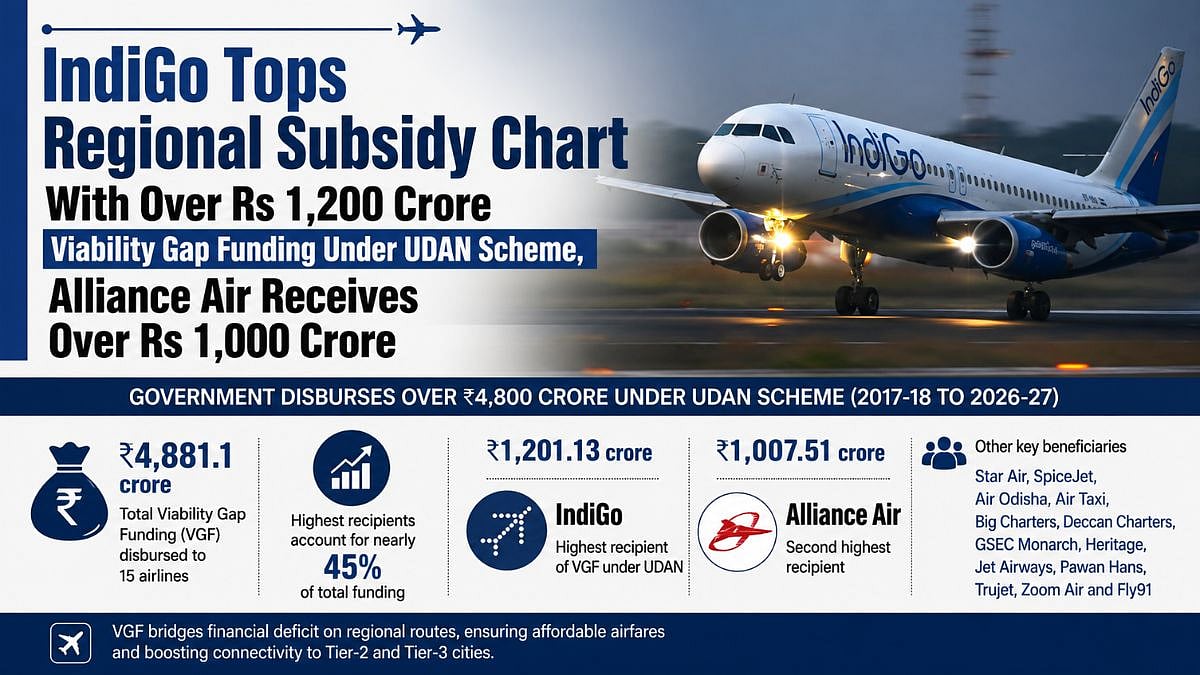
Mumbai, July 27, 2026: India's largest carrier, IndiGo, has emerged as the biggest beneficiary of government subsidies under the Regional Connectivity Scheme (RCS)-UDAN over the last nine years, securing more than Rs 1,200 crore in viability gap funding (VGF).
State-owned Alliance Air followed closely as the second-largest recipient, receiving more than Rs 1,000 crore, with the total subsidies disbursed exceeding Rs 4,800 crore.
Subsidy Disbursement Details
The figures were disclosed in the Lok Sabha by the Ministry of Civil Aviation in response to a question. According to the ministry, a total of Rs 4,881.10 crore has been disbursed under VGF to selected airline operators from the financial year 2017-18 to 2026-27. A total of 15 airlines have benefited from the government scheme over the past nine years.
The government's VGF is designed to bridge the financial deficit on regional routes by capping airfares for common citizens while compensating airlines for operational losses during the initial development phase of Tier-2 and Tier-3 markets.
According to the Ministry of Civil Aviation (MoCA), market leader IndiGo received the highest amount at Rs 1,201.13 crore, while state-backed Alliance Air received Rs 1,007.51 crore over the nine-year period. Together, they absorbed nearly 45 per cent of the total Rs 4,881.10 crore funding pool.
Regional player Star Air, operated by the Ghodawat Group, secured the third-highest allocation with Rs 757.30 crore, while budget airline SpiceJet received Rs 662.54 crore. Other beneficiaries include Air Odisha, Air Taxi, Big Charters, Deccan Charters, GSEC Monarch, Heritage, Jet Airways, Pawan Hans, TruJet, Zoom Air and Fly91.
Route-Specific Funding
Addressing specific sector funding, the ministry revealed that Alliance Air received Rs 13.81 crore in targeted VGF for operating regional flights on the Bengaluru-Salem-Bengaluru route. The payments cover operations from October 16, 2023, to the present.
Regional Aviation Expansion
The data highlights a significant shift in India's regional aviation landscape, as even major scheduled carriers such as IndiGo have successfully expanded their regional fleets, including ATR 72-600 aircraft, to tap subsidised demand across regional airport networks. Meanwhile, regional carriers such as Star Air and newer entrants like Fly91 continue to leverage VGF allocations to establish niche regional hubs.
Alslo Watch:
Moreover, smaller and now-defunct operators, including TruJet, Air Odisha and Deccan Charters, account for a combined legacy allocation, reflecting the operational turnover in regional aviation over the duration of the scheme.
To get details on exclusive and budget-friendly property deals in Mumbai & surrounding regions, do visit: https://budgetproperties.in/

