Mumbai: Neelkanth Mishra, India’s Executive Director at the World Bank, has strongly rejected criticism of the government’s revised gross domestic product series, calling some claims 'ill-educated and egregiously wrong'.
His response was directed mainly at former Finance and Economic Affairs Secretary Subhash Chandra Garg, who questioned whether India’s 7.8 percent real GDP growth in the April-June quarter of FY27 accurately reflected economic activity.
Garg argued that growth should also be examined at current prices, before adjusting for inflation. Using the previous base for the June quarter, he estimated nominal GDP growth at below 2.5 percent, compared with the 10.3 percent nominal expansion indicated by the revised official data.
Real versus nominal growth
Mishra said that comparison was flawed because it placed a nominal, current-price estimate based on the old series against a real, inflation-adjusted growth rate calculated under the revised framework.
In a post on X, he said fiscal headwinds were easing while monetary headwinds were turning into tailwinds as credit growth accelerated. These conditions, he argued, could lift consensus trend-growth estimates towards 7 percent or higher.
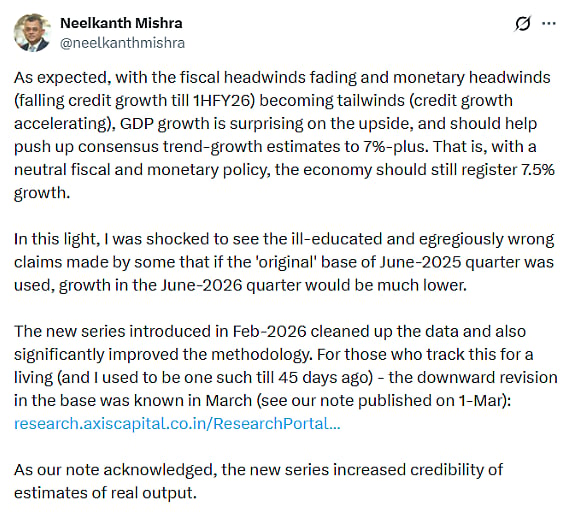
Mishra said India could record 7.5 percent growth even with a neutral fiscal and monetary policy stance. He added that he had tracked such data professionally until joining the World Bank from Axis Bank in June 2026.
Why GDP estimates changed?
The new GDP series, introduced in February 2026, lowered India’s nominal GDP estimate by about 4 percent. The reduction was driven largely by downward revisions in services, especially trade, hotels, transport and communication.
Financial services were revised upwards because the series included wider coverage of private non-banking financial companies. Public administration and defence spending was lowered after pension payments were adjusted.
Officials and independent economists have broadly viewed the revisions, including the adoption of double deflation, as a methodological clean-up rather than manipulation of growth figures.
Earlier research flagged revision
Mishra also pointed to a March 1, 2026 note from Axis Bank’s economics team, which he headed at the time. The report had identified the likely downward revision months before the latest GDP debate.
The note attributed the change mainly to an overestimation of the informal economy’s post-Covid recovery in FY23, rather than weakness in the current growth cycle.
It said the reduction in real GDP, estimated at around 7 percentage points, was concentrated largely in FY23. Under the new series, growth in gross fixed capital formation and private final consumption expenditure was notably stronger for FY26 than under the old framework.

Axis Bank had retained an above-consensus FY27 growth forecast of 7.5 percent, which Mishra has reiterated after the latest data.
The disagreement therefore centres on incompatible measures. Garg’s below-2.5 percent calculation represents nominal growth using the old base, while the official 7.8 percent figure measures real growth under the new series. Mishra maintains that combining them wrongly presents a methodological revision as an economic slowdown.
His central argument is that the revised historical base changes the level and composition of GDP, but does not itself signal a collapse in underlying economic momentum today.

