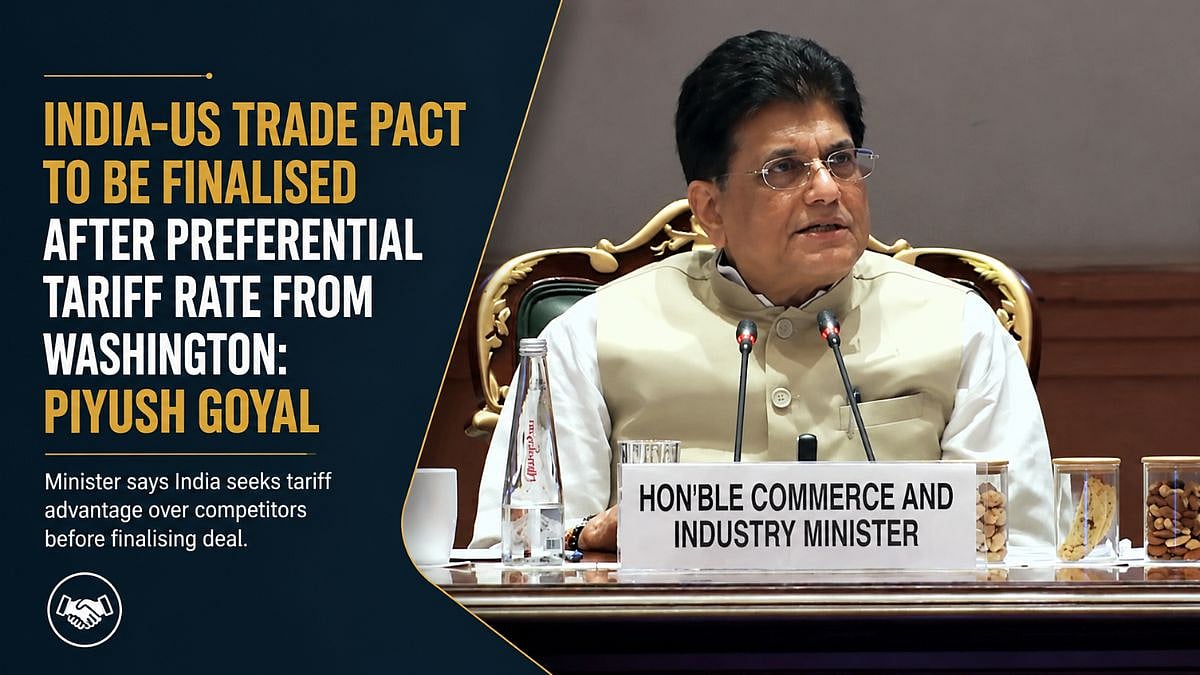
New Delhi, September 3, 2026: Commerce and Industry Minister Piyush Goyal on Thursday said India will finalise its Bilateral Trade Agreement (BTA) with the US once Washington offers the country a preferential tariff rate compared with its competitors. The final details of the agreement will then be announced.
Goyal said India's nine free trade agreements (FTAs), covering economies representing about $60 trillion of GDP, would provide preferential access to nearly two-thirds of global trade. With several more trade agreements in the pipeline, India is looking to turn lower tariffs and wider market access into a major advantage for its exporters.
US Deal Hinges On Tariff Edge
India is also working on FTAs with Canada, Mexico, Chile, Mercosur, the Southern African Customs Union (SACU), the Gulf Cooperation Council (GCC) and Israel. Along with reviews of existing trade deals with the Association of Southeast Asian Nations (ASEAN), South Korea and Japan, these agreements could give India access to 75% of global trade at rates lower than those available to its competitors, Goyal said.
India has implemented trade agreements with the UK, Mauritius, Oman, the UAE and Australia. The agreement with New Zealand is expected to become operational soon, followed by the deal with the 27-member European Union.
"(Trade pact with) New Zealand will get live soon and thereafter (FTA with) EU, the 27-nation bloc, will get live. And as soon as the US is able to give us the preferential rate, in comparison to our competition, we will finalise the BTA and announce the final details," Goyal said at a workshop on free trade agreements organised by the Commerce Ministry.
US Tariffs Complicate Negotiations
India and the US announced the finalisation of a framework for the first phase of their trade pact in February. However, changes in the US tariff landscape have led to further negotiations between the two countries.
The US imposed an additional 10% tariff on several countries, including India, from July 24. Countries such as Sri Lanka, Bangladesh, Thailand, Cambodia, Vietnam, Indonesia and Malaysia are among India's major competitors in the US market. A tariff advantage over these countries could make Indian goods more price-competitive in the American market, PTI reports.
Goyal is scheduled to visit the US in late September to attend the G20 Trade Ministerial in Milwaukee and hold bilateral talks with US Trade Representative Jamieson Greer. Issues related to the trade pact are expected to figure in the discussions. The two-day ministerial begins on September 30. The US holds the G20 presidency in 2026.
India exported goods worth about $87 billion to the US in 2025-26.
Push To Make Better Use Of FTAs
Addressing the National Workshop on Leveraging FTAs an Outreach Programme, Goyal called for a focused and nationwide effort to maximise the use of trade agreements and ensure that businesses across the country benefit from improved market access.
The day-long workshop brought together senior Central Government officials, representatives of states and Union Territories, Export Promotion Councils and industry associations. Its focus was on translating India's growing network of trade agreements into measurable gains for exporters, particularly micro, small and medium enterprises (MSMEs) and first-time exporters.
Goyal said the absolute tariff rate was less important than how it compared with the tariffs faced by India's competitors.
Citing the textile industry, he said India had struggled for years to compete with Bangladesh and Vietnam. Bangladesh benefited from its least developed country (LDC) status, while Vietnam benefited from FTAs, allowing them to enter developed markets at zero or lower duties while Indian goods faced higher tariffs.
Goyal said the situation had now changed, with India securing better rates than competing geographies in almost all developed markets. For Indian businesses, the opportunity now comes with responsibility: preferential access will matter only if exporters can compete on scale, quality and reliability.
He urged the industry to focus on scale, quality, customer trust and timely delivery of orders, saying "the ball is now entirely in our court".
$1 Trillion Export Target
Goyal said India has set a $1 trillion export target for the current year. Exports during the first four months reached about $317 billion, compared with $280 billion during April-July last year.
Calling the trend a good sign, he stressed the need to sustain the growth. He also said ways should be found to support small exporters wherever problems caused by the Strait of Hormuz affected them.
By 2030, Goyal said, India should aspire to achieve the $2 trillion export target that had been set several years ago.
Exporters would also receive priority support in the upcoming 100 BHAVYA industrial parks, he said. Concessions would be offered in allocations to exporters committing to higher levels, while facilities required for plug-and-play operations would also be introduced.
States Asked To Spot Export Opportunities
Goyal said every state should identify products and clusters where FTAs were already benefiting businesses as well as areas where the benefits remained underutilised. This would allow the government to assess the support required.
He said e-commerce offered MSMEs and first-time exporters a lower-barrier route into international markets and that changes had been made to encourage large-scale exports through e-commerce.
Commerce Secretary Rajesh Agarwal, addressing the workshop, urged exporters to take advantage of the opportunities created by India's trade agreements. He cautioned, however, that the advantage would not last indefinitely as competing countries could eventually sign their own agreements and secure similar benefits.
"We need to keep in mind that the window of opportunity that is opening before us through this FTA is not for an infinite period of time," Agarwal said.
"So we need to use the time effectively because if we miss the time window, then maybe we will miss the opportunity," he added.
Quality Could Decide Who Wins
India trades in about 12,300 tariff lines, or product categories, and most are affected in some form by the country's trade agreements.
Agarwal said higher quality standards would be a key challenge in markets opened through these agreements. "One of the key features of all these markets that have been opened up is also that the quality thresholds will be higher in these markets. If we have to actually leverage European Union market, UK market, the quality thresholds are going to be higher," he said.
He stressed the need to use the next five to 10 years to build new supply chains and translate FTAs into actual trade gains. Without adequate quality, he said, accessing these markets over the long term would be difficult.
Also Watch:

The expanding network of trade agreements therefore gives India an opening, but tariffs alone will not determine the outcome. As both Goyal and Agarwal indicated, exporters will have to use this window to improve quality, build scale and establish reliable supply chains before competitors secure similar advantages.
To get details on exclusive and budget-friendly property deals in Mumbai & surrounding regions, do visit: https://budgetproperties.in/

