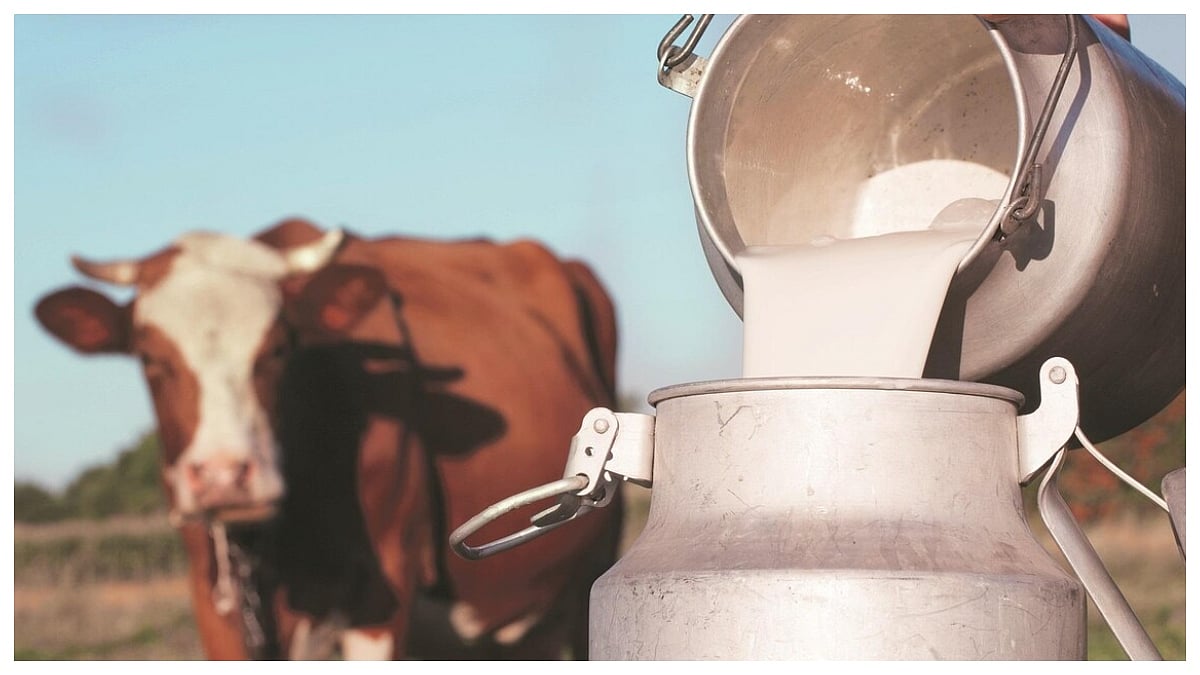
Bhiwandi: Fresh milk sold directly by local cattle sheds has reached nearly ₹100 per litre in Bhiwandi, putting additional pressure on household budgets as festive-season consumption boosts demand. While consumers are struggling to cope with rising prices, dairy farmers say the sharp increase in cattle feed, fodder and livestock costs is squeezing their margins, making milk production increasingly difficult to sustain.
Local dairy owners and milk vendors have periodically raised retail prices by ₹2 to ₹4 per litre. The latest rates have left middle- and lower-income families struggling to manage their monthly expenses, particularly as milk remains a daily necessity for children, senior citizens and people requiring nutritional support.
The festive season, which typically brings an increase in milk consumption and demand, has added to the pressure on the local market. However, dairy producers maintain that the key problem is not simply the price consumers pay, but the widening gap between production costs and the procurement rates farmers receive.
Cattle feed prices surge within weeks
Anand Gadre president of the Bhiwandi Taluka Milk Producers and Vendors Association said consumers were noticing the rise in milk prices but overlooking the sharp increase in the cost of maintaining cattle.
Milk prices have not increased in proportion to the rising cost of production. It is cattle feed and fodder that have become more expensive Gadre said.
According to Gadre cattle feed prices have risen sharply over the past 20 to 25 days. Oil cake, which previously cost ₹38–₹40 per kg, has crossed ₹50 per kg. Chuni, a cattle-feed by-product, has increased from ₹30–₹32 to ₹40 per kg.
The price of bhusa, or dry fodder, has risen from ₹950–₹960 to ₹1,370. Paddy straw, earlier available at ₹7–₹8 per kg, has reportedly reached ₹24 per kg. Grass prices have climbed from ₹22–₹23 to ₹30 per kg, while chaff and feed mixtures have crossed ₹50 per kg from ₹38–₹40. Jawar and bajra stalk chaff, previously priced at ₹15–₹16 per kg, now costs more than ₹20.
Livestock acquisition costs have also increased substantially. A cow now costs more than ₹1 lakh, while the price of a buffalo, previously around ₹1 lakh to ₹1.5 lakh, has risen to ₹2 lakh–₹3 lakh, Gadre said.
Farmers must also bear the costs of medicines, veterinary care and daily maintenance, further increasing the financial burden of dairy farming.

Shahapur farmers begin indefinite strike
The mounting financial pressure has prompted milk producers in Shahapur to launch an indefinite strike and stop supplying milk to dairy operators. Led by the Milk Producers Farmers Social Organisation, the protesting farmers have submitted a memorandum of demands to the tehsildar.
Dairy farming is a major source of livelihood for numerous families in rural parts of Shahapur taluka. Farmers say the rising cost of maintaining cattle, coupled with procurement prices that do not adequately reflect production expenses, has made the business increasingly unviable.
Many farmers purchase milch animals using borrowed money and continue spending on feed, fodder and treatment. They argue that the returns from selling milk are no longer sufficient to cover these expenses.
The protesters have demanded an immediate increase in milk procurement prices and warned that supplies to dairies will remain suspended until they receive a fair and remunerative rate. They have also sought the administration’s intervention to facilitate coordination between milk producers and dairy operators.
The farmers said their agitation was peaceful and democratic, urging the authorities to address their concerns without delay.
Also Watch:
There is no government support for this business’
Gadre said dairy farming remained a high-risk business with no adequate government support for producers.
There is no guarantee that a cow or buffalo that gives milk in the evening will give milk the following morning. The business involves considerable risk, and farmers have to bear the costs regardless of how much milk their animals produce he said.
With retail prices touching ₹100 per litre, festive demand rising and farmers protesting inadequate procurement rates, the dairy sector faces pressure at both ends of the supply chain. Consumers are struggling with higher household expenses, while producers say escalating input costs are threatening the viability of their livelihoods.
To get details on exclusive and budget-friendly property deals in Mumbai & surrounding regions, do visit: https://budgetproperties.in/

