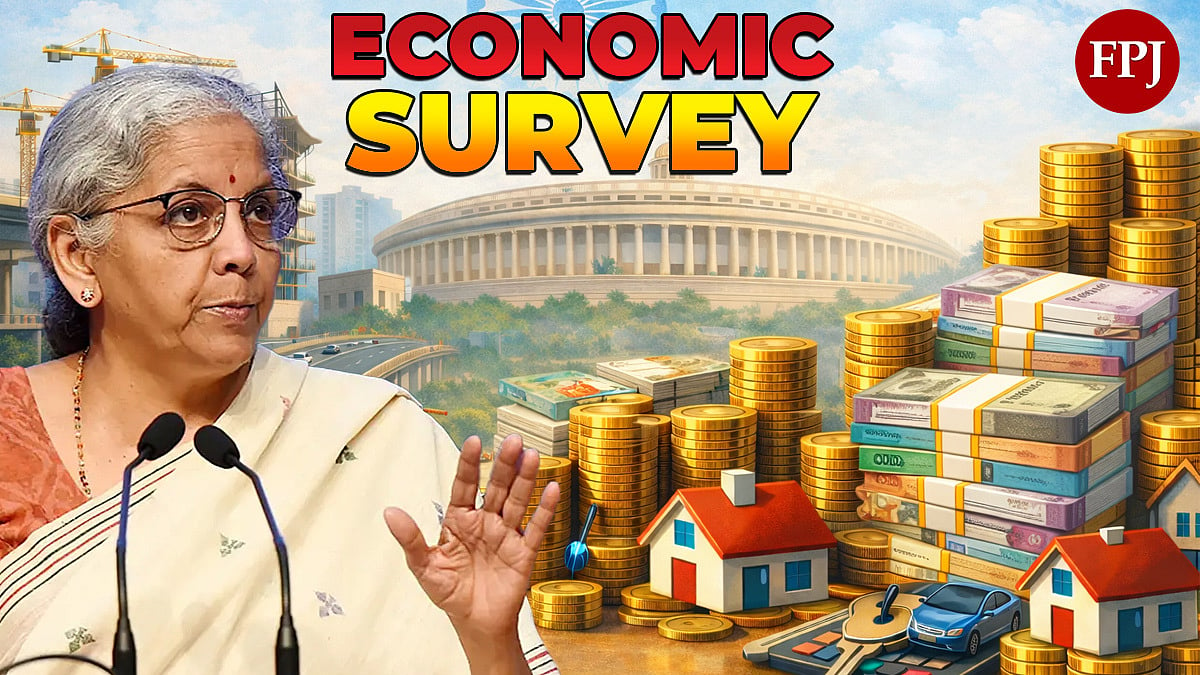
Bengaluru, Jan 29: The Economic Survey 2025–26 projects India will achieve 7.4 per cent real GDP growth (after adjusting for inflation) in FY26 and sustain momentum at 6.8–7.2 per cent in FY27, while upgrading the country's potential growth rate from 6.5 per cent to 7.0 per cent — a significant revision that signals confidence in India's structural capacity.
Chief Economic Adviser V. Anantha Nageswaran, in his preface to the Economic Survey, the government’s annual economic review, declares this upgrade reflects how “sustained domestic reforms and public investment could lift the economy's underlying growth capacity. That possibility is now being realised.”
Strong first-half performance, slower momentum later
The survey's confidence rests on an impressive first-half performance: 8 per cent growth in H1 FY26, driven by services (9.3 per cent) and manufacturing (8.4 per cent). Even though the survey is overall optimistic, its own data suggest that economic momentum is slowing as the year progresses.
Q3 FY26 growth stands at 7 per cent — a full percentage point below the H1 average. This deceleration raises an uncomfortable question: is the 7 per cent-plus trajectory truly sustainable, or does H1’s outperformance mask a weakening trend?
Consumption boost driven by temporary factors
The survey highlights private consumption growing by 7.5 per cent and rising to 61.5 per cent of GDP, “the highest level since FY12,” attributable to “low inflation, stable employment conditions, and rising real purchasing power.”
The survey admits that the very low inflation rate of 1.7 per cent resulted mainly from statistical effects from last year’s prices, not because inflation has permanently come down. Food prices actually fell by 2.71 per cent, largely because good weather improved supply.
This means inflation looks low mostly because of temporary factors and base effects, not structural economic changes. When these effects fade in FY27 and inflation rises again to around 4 per cent, questions remain on whether consumption will continue to hold up.
Employment and structural concerns
The survey notes “stable employment conditions” but also acknowledges that 46.1 per cent of the workforce remains in agriculture, which contributes only around 20 per cent to GDP. Factory employment data show large productivity and wage gaps between large and small firms, indicating that the structural employment transformation needed for sustained consumption growth remains incomplete.
Public capex doing the heavy lifting
Public capital expenditure continues to drive growth. The survey notes that central government capital spending surged from 12.5 per cent to 22.6 per cent of total expenditure, reaching 4 per cent of GDP. However, this pace is unlikely to be sustained, as fiscal consolidation targets a 4.4 per cent deficit in FY26, implying moderation in capex growth.
Private investment revival questioned
While the survey refers to a revival in private investment, it lacks granular data. It notes that India’s corporate sector displays “low R&D intensity, caution in frontier manufacturing, and concentration in real estate-linked, regulated, or quasi-monopolistic sectors,” raising doubts about the depth of the investment cycle.
High cost of capital remains a constraint
The survey identifies a persistent structural constraint: “A country that persistently runs current-account deficits and depends on foreign savings must, by definition, pay a risk premium to global capital.” Until India becomes a surplus-generating economy, capital is likely to remain expensive, limiting private investment appetite.
Sectoral performance and risks
Services grew 9.3 per cent and now account for 53.6 per cent of GDP. Manufacturing grew 8.4 per cent, but this came amid a 50 per cent decline in manufacturing’s terms of trade, indicating erosion in pricing power.
The survey cautions that service exports do not necessarily force broad institutional reform, limiting their ability to drive productivity gains. It also questions whether manufacturing momentum is largely driven by production-linked incentives (PLI), noting that PLI sectors show import growth outpacing export growth.
Agriculture’s estimated 3.6 per cent growth in FY26 continues to weigh on overall performance, especially given its large employment share. The survey also highlights mining contraction in H1 due to excessive rainfall, underlining vulnerability to weather shocks.
Global risks and cautious optimism
The survey acknowledges risks from “coercive trade,” sanctions, and financial stress events, noting that while India is relatively better positioned than many countries, this “does not guarantee insulation.” It also flags risks from volatile capital flows and pressure on the rupee in a geopolitically turbulent world.
Also Watch:
Labour input growth is projected to slow from 4.0 per cent in FY25 to 2.6 per cent during FY26–30, raising further questions on sustaining a 7 per cent potential growth rate.
The survey’s optimism, while politically necessary, may be economically premature.

