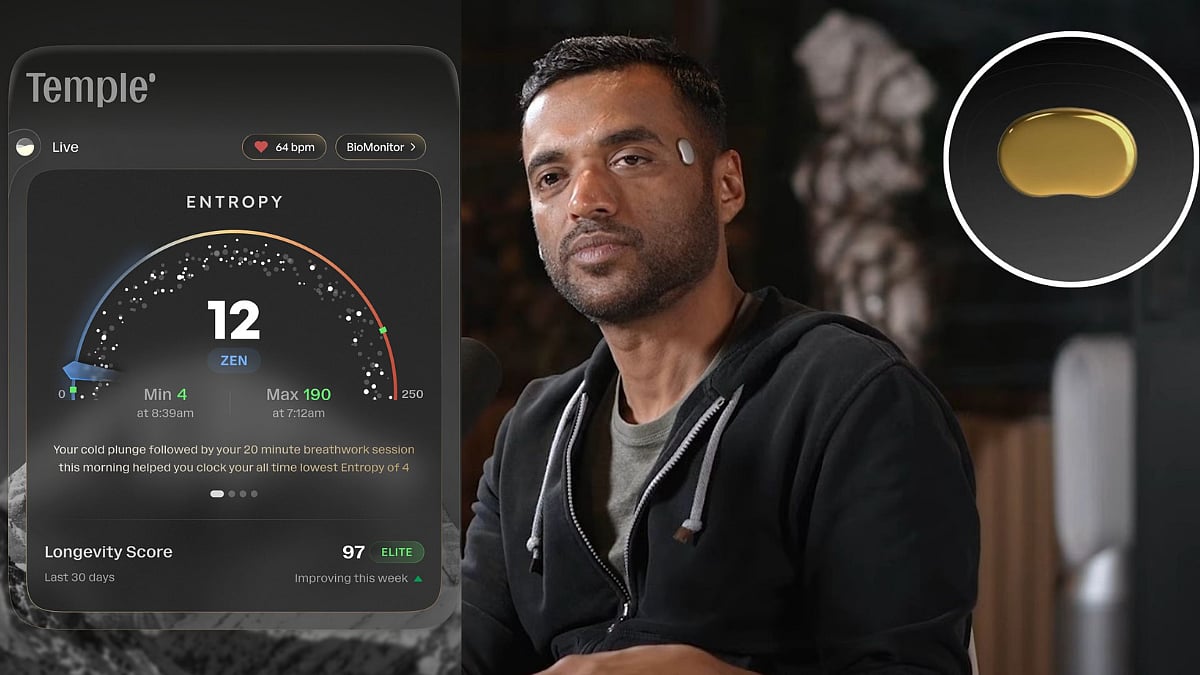
Deepinder Goyal has announced that his team at Temple has developed a new biomarker called “Entropy,” which it claims can measure the body’s real-time metabolic cost.
The metric, according to Goyal, is derived from readings taken at the temple region and is designed to track how much energy the body is expending at any given moment.
The announcement was shared on X, where Goyal also invited users to apply for early access to the platform. He described Entropy as a live metric displayed on Temple’s home screen that updates every second.
The score ranges from 1 to 250, with lower values reflecting deeper rest states and higher values indicating intense physical activity.
Goyal said the lowest Entropy readings have been observed in experienced meditators during deep meditation, while the highest readings are seen in elite athletes during peak exertion.
The company claims the metric continuously reflects changes in the body’s metabolic state.
According to Temple, Entropy responds dynamically to various factors such as sleep, stress, exercise, meals, caffeine consumption, cold exposure, meditation, and strength training. These inputs influence metabolism and therefore alter energy expenditure in real time, rather than through periodic measurement systems.
However, Temple has not disclosed detailed technical documentation explaining how the biomarker is calculated or the underlying technology used.
A key claim is that Entropy is more closely aligned with metabolic activity than heart rate. Goyal stated that the company compared Entropy readings with data from a metabolic cart, a laboratory-grade device used to measure energy expenditure. He said Entropy showed a correlation coefficient of r=0.93 across more than 100 cardio sessions, compared to r=0.55 for heart rate.

The company has also introduced two derived metrics: Entropy Maxima, representing peak physical output capacity, and Entropy Minima, indicating the lowest resting metabolic state.
Temple suggests users should aim to improve maximum capacity while reducing resting metabolic cost over time.
The platform is currently accepting early access applications, but no details have been shared regarding pricing, commercial rollout, hardware requirements, or peer-reviewed validation. While the claims have attracted interest from fitness enthusiasts, users have also raised questions about sample size, methodology, and scientific backing.

