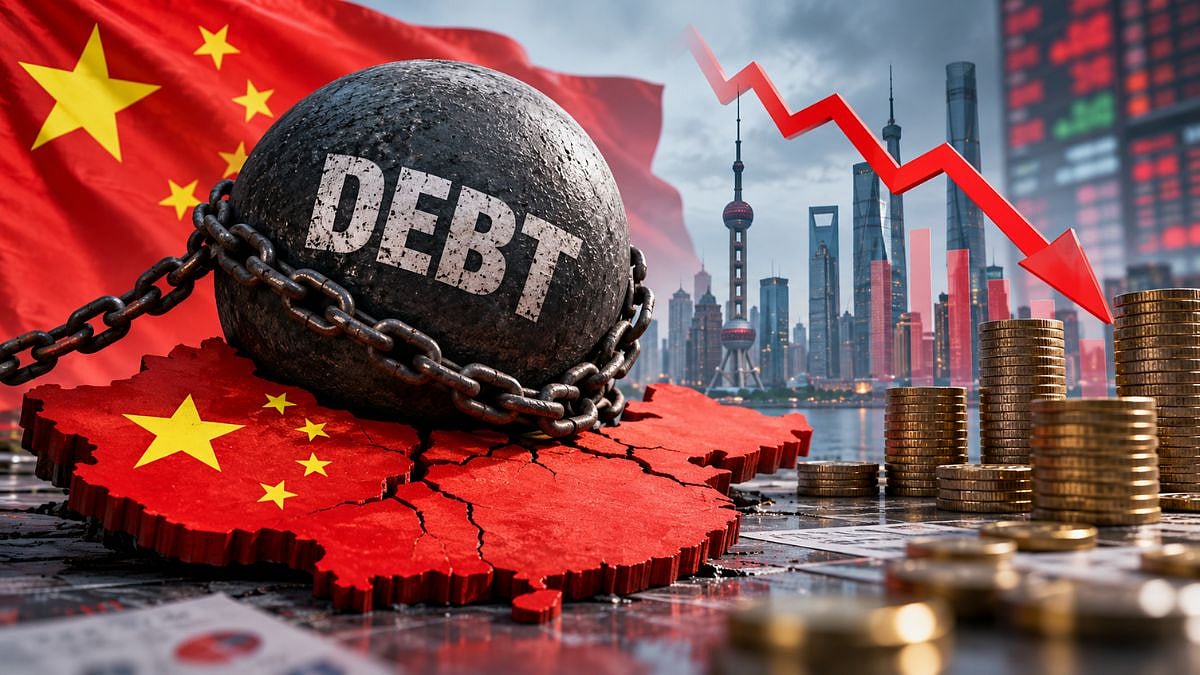
New Delhi, October 15, 2026: China’s debt burden has increased sharply in recent years, pushing the country’s interest payments on borrowings above even the high levels seen in the US economy, according to a media report.
Citing new estimates from the Conference Board, the Financial Times reported that debt-servicing payments in China will account for 19.2% of the central government’s general public budget this year, up from 12% in 2014. Fortune has also reported on the country’s mounting debt burden.
A separate report earlier this year by the Center for Strategic and International Studies (CSIS) found that 19% of Beijing’s spending was earmarked for interest payments on debt, compared with 14% of the US federal budget allocated to interest costs.
CSIS added that China’s spending on interest payments surged 341% between 2013 and 2025, faster than any other major budget category. By comparison, total spending increased 102% during the same period, while outlays on social security and employment rose 207%, science and technology spending increased 137%, and defence spending grew 141%.
US And China Follow Diverging Economic Paths
A report by Jason Ma noted that although US spending on debt interest also presents a serious challenge, having surged around 390% since 2013 to $1 trillion, the world’s two largest economies have been diverging in key ways, with implications for future growth and indebtedness.
“The US economy is accelerating, helped by the AI boom, and despite high inflation, resilient consumers have continued to spend. Unemployment is low and signals full employment, while stock markets are at or near record highs,” the report stated.
China’s GDP growth, on the other hand, has been slowing and is on course to fall short of its annual target of 4.5% to 5%. While export-oriented sectors are growing rapidly, trading partners are imposing barriers, Chinese consumers remain reluctant to spend, investment is weak, the property sector continues to recover from a severe crash, and Chinese stocks have remained subdued, the report observed.
Also Watch:

State-Led Growth Model Faces Challenges
Beijing has also directed state-owned banks to provide financing to priority industries such as electric vehicles, robotics, artificial intelligence and renewable energy.
China’s state-led growth model now appears to be running out of steam, while the rapidly expanding debt burden serves as a warning sign. Local governments often seek to boost favoured industries through low-cost loans, the report observed.
(Disclaimer: Except for the headline, this article has not been edited by FPJ's editorial team and is auto-generated from an agency feed.)

