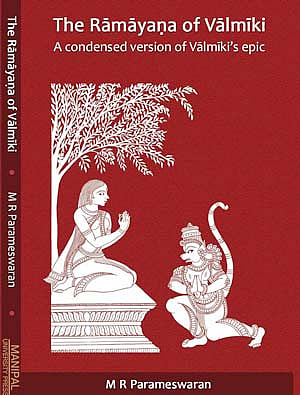
The present book is probably the first condensed version in English of the most reliable version of Valmiki Ramayana and will interest readers of all ages.
Valmiki – should we call him India’s first historian? – composed an epic poem of about 24,000 verses about 2,500 years ago, consisting of seven books (Kaandas) and 500 cantos (sargas) written in a 32 syllable meter called anustab. It is a classic of its kind never before or, for that matter never again paralleled. It describes itself as Ramasya Charitam and also as Sitayas Charitam Mahat. Of course we have the
The Ramayana of Valmiki: A Condensed Version of Valmiki’s Epic
M.R. Parameswaran
Manipal University Press
Pages: 267; Price: Rs 340 |
Mahabharata to reckon with, but
Valmiki stands alone in the sheer grandeur of his literary greatness.
Like the Mahabharata, the Ramayana is not just a story: it presents India’s culture, its philosophical foundation in all its variety and glory. As Hinduism spread in South-east Asia, so did the Ramayana, in countries like Indonesia, Philippines, Thailand, Vietnam, Cambodia, Myanmar and Malaysia. Since the classic was spread orally, over the decades and centuries it came slowly to be conceptualised to meet local requirements and ethos with the result that today there are suppose to be around three hundred variations of the same theme stories, with incidents getting literally perverted, with one variation even stating that the lady who was kidnapped was not Sita but Kausalya!
There are, under the circumstances, Jain, Buddhist Tamil, Kannada and Hindi variations, to name only a few, though the status of Valmiki as the put or of the original work has never been disputed. So we have Adhyatma Ramayana, Vasishta Ramayana, Adbhuta Ramayana, Pampa Ramayana, Kumudendu Ramayana, Torave Ramayana and many others to deal with. So what is the true, real Ramayana? This is where the text published by the Manipal Press comes into the picture.
In the middle of the last century, the Oriental Research Institute in Baroda (Vadodara) embarked on a remarkable project. A large number of scholars were gathered to examine more than 2,000 palm leaf and other manuscripts in various scripts like Devanagari, Grantha, Bengali, Marathi or Malayalam from all over India and Nepal. After several years of hard work the scholars compiled what is called the ‘Critical Edition of Valmiki’s Ramayana’ (C.E) thereby meaning that it is about what must be the closest resemblance of the original text of Valmiki. It is now claimed that the Critical Edition, is about the most reliable text of Valmiki’s Ramayana though the scholars modestly aver that it may not be “totally free from errors”. Yet contemporary scholars call it “monumental”, which surely it is.
The Critical Edition has now been translated into English, but what Manipal Press has published is a condensed version of the original English translation. Mangalam R. Parameswaran who has done this condensed version in his preface says that he has tried to keep the Ramayana text and to not omit anything that is important. He adds: “I have omitted the passages contained in some sargas (chapters) Ramayana if they do not contribute anything significant to the story of Rama. The superior dependability of the CE in comparison with recensions of the Ramayana like the southern or ‘Kumbakonum’ recension illustrated by a few examples.
Thus, in original Valmiki Ramayana Dasharatha is described as most virtuous, truthful and one who has conquered his senses. While in the recension some verses say that he was ‘infatuated’ with Kaikeyi, being ‘smitten by the arrows of Manmatha’. Then there is also a text called Uttara Ramayana: it is clearly not by Valmiki and is therefore disregarded in the present condensed version of Valmiki’s Ramayana.
So the edition here reviewed consists of Balakanda, Ayodhya Kanda, Aranya Kanda, Kishkinda Kanda and Yuddha Kanda. The question may well be asked: In what way do the two versions really differ? Take another example: When Vali and Sugriva met in combat for the second time, Sugriva was supposedly in dire straits and at the point of being worsted by Vali, when Rama shot a fatal arrow at Vali. These verses are contradicted by other verses. There are a whole lot of contradictory verses and the Critical Edition has attempted to correct them. What Parameswaran has done in this fascinating work is not to omit anything that is important but when an explanation is called for, to give it.
Here is one more such explanation: “Was Rama really condemning Dasharatha as having acted out of passion for Kaikeyi and was he condemning him on proper grounds? Was Rama in his right mind when he uttered those words? (In the recension). Was there some hidden reason behind his words? Was there perhaps a combination of several factors? Rama knew fully well that king Dasharatha was caught not in the snare of passion but in the snare of truthfulness; that Rama’s exile came about not because of any special feeling Dasharatha had for Kaikeyi.
Dasharatha himself had told Rama that he had been deceived by Kaikheyi into granting her a boon and that he felt miserable about it. He even wanted Rama to depose him and take over the throne. Rama knew that whatever affection Dasharatha had for Kaikeyi had been replaced by loathing and that Dasharatha had cursed her repeatedly and repudiated her…”
Rama, according to Critical Edition was sure that his father was “self-controlled” and was “righteous”. Between the original Valmiki Ramayana and the several recen¬sions that followed thus, the differences are vast, but one thing can be said: in the end o more beautiful story has ever been written.
Was Rama unconquerable? Not so. In the Yuddh Kanda it is claimed that during the fight, both Rama and Lakshmana had been brought down and at one time were lying unconscious on a bed of arrows. Ravana thereafter had ordered that Sita be taken in the pushpaka to see the battleground and when she saw Rama and Lakshmana on a bed of arrows, their bodies pierced, she sunk in sorrow.
Students of Ramayana, indeed anybody interested in Ramayana for its own sake will enjoy reading this Critical Edition. In the end, of course, Rama emerges victorious and after his vanavas is over, returns to Ayodhya. That is what Valmiki tells us and it is nice to know what the definitive version is. Thank you
Parameswaran for your contribution in enlightening us.
M V KAMATH
