Title: Making the Right Connections
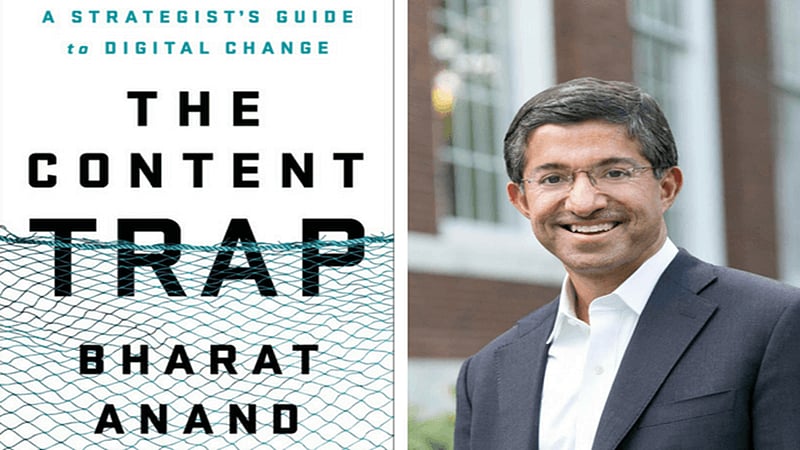
Book: The Content Trap
Author: Bharat Anand
Price: 448 (paperback)
Pages: 423
ISBN: 9780143428619
Publisher: Penguin Random House
What if a fire arises from a burning cigarette? What if this fire spreads? And what if the same fire leads to become the worst in the history of America’s Yellowstone National Park? These were the series of events that occurred in the year 1988, and here’s where Bharat Anand, professor of business administration at the Harvard business school, initiates the discussion on his book ‘The Content Trap’.
Through the metaphor of the ‘The North Fork Fire’ of July 1988 the author begins the narrative that shows the importance of connections. At face value this point seems distant and irrelevant to the core idea that the book deals with, but as one discovers, the patterns start to emerge. Did the ‘North Fork Fire’ really initiate because a wood cutter threw his burning cigarette in the woods? Something as trivial as this cannot cause the most destructive fire in the history of America, can it? Unless ‘Something’ else was at play. This ‘Something’ provided the necessary condition for the fire to spread.
One explanation might be that a two year draught in the west had caused excessive dryness in the surrounding area of the park. Dryness, not the burning cigarette, was responsible for the fire to spread. Bharat Anand finds a connection between ‘The North Fork Fire’ of 1988 and the digital fires that spread across various industries. He puts forward the idea of ‘The Content Trap” which he feels is the reason why many companies fail, because these companies have focussed on the wrong trigger. For Bharat Anand, focus on content is not the correct priority, user connections are.
In the length of this book, the author discusses multiple case studies. Through Cable networks, Personal computing, Print Media, Education, Music concerts and Advertising, he steers through myriad companies, and various industries but one aspect stands out in his research, that no matter how diverse the company is, something that leads to the success of the company is how they maximize on user connections. He discusses stories of Apple, Walmart, Star TV, Schibsted, the Economist, IMG, Tencent, New York Times and Netflix amongst a few examples and concludes with his own experience in Harvard business school’s attempt to make a digital education platform called HBX.
`Through various case studies, Bharat Anand discusses the unpredictable decisions each company made and how these decisions led to giving each company the right image. Any of these decisions replicated by other companies wouldn’t lead to the desired result. That is because these decisions are specific to the cause of one company, suits their user connections and individual decisions. The content of the most prestigious and prodigious companies of the world is not specific to them. The same content can be found elsewhere. But the strategy to tackle digital change, which has stormed the market in the new millennium, involves identifying one’s own target and joining the necessary dots.
The Book takes one through analysis, and choices, that companies make in times of Digital change. But most of these companies (like Apple, New York Times, Walmart) had the liberty to spend enormous amounts of revenue on their choices. There are examples of the‘Khan Academy’ which changed the way digital education is seen and of ‘Netflix’ that took away a multi-million dollar business away from ‘Blockbuster’, but can any of these businesses survive if they have a sub-standard product?
Many businesses discussed in the book have novel products, new technology, legacy, and a brand image already established that new companies are attempting to make. One can argue that the user connections are already established for many of these companies and for them to make these connections in the digital forum isn’t that difficult because they carry their reputation from one forum to the other. Doesn’t Harvard Business School’s brand image spill over from its university campus to its digital course? Isn’t the fire already burning brightly for them?
Bharat Anand’s‘The Content Trap’ showcases how difficult decisions are made in times of change, and how well informed ones can lead to a transition into digital forums. The case studies are diverse, enriching, and enlightening. They reveal how strategic decisions, of multimillion dollar conglomerates, are made and how these decisions affect user choices, where companies fail and where do they succeed, ‘Where to play?’ and ‘where to win?’ Anand identifies the conditions under which digital fires spread and become like the ‘North Fork Fire.’ And how businesses shouldn’t fight every change that comes about but adapt it into their own strategy. The buck shouldn’t stop at a good product; it should roll on till it reaches the right user on the highway of network connections.
