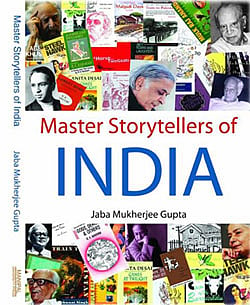
It is a critical study of the short stories of seven major Indo-Anglian short story writers of India and traces the beginnings of short story writing in India, the influences on the writers, the themes used and the techniques employed in writing the short story in English.
Master Storytellers of India
Jaba Mukherjee Gupta
Manipal University Press
Pages: 236; Price: Rs 220 |
Time was when there were few Indian writers in English — and let us admit it – on any subject, let alone short stories. The field was occupied by the likes of Ruyard Kipling, E M Forster, George Orwell and John Masters, not to mention Thomas Hardy, Arthur Conan Doyle took detective stories to great heights with ‘The Adventures of Sherlock Holmes’.
Then we had G K Chesterton, Agatha Christie, Dorothy Sayers and H G Wells. And how can we forget say, Virginia Woolf and Graham Greene? The point is the art of short story writing in English was largely the monopoly of English writers. Indian writers in English came much later, as was only natural, considering English was a “foreign” language.
It wasn’t that Indians were not good at writing short stories. Indian literature is rich with ‘Jataka Tales’, ‘Pancha Tantra’ and ‘Kathasagara’ leading the field. But for modern Indian writers telling their stories in English – language of their ruling masters – is another tale. But in the beginning of the 20th century, a start had been made, somewhat hesitatingly, one suspects, by people like Cornelia Sorabji, a Parsi lady educated in Britain, S C Dutt, S M Natesa Sastri, Sunita Devee, Madhavaiah and Shovana Devi and a few more – all to be quickly forgotten.
Then came a virtual explosion, starting with Mulk Raj Anand’s ‘The Lost Child and Other Stories’ (1934) after which it can be said, the Indo- Anglian short story came of age. There seemed just no stopping people like R K Narayan, Raja Rao, K A Abbas, Bhabhani Bhattacharya, Manohar Malgaonkar, Ruth Jhabwala, Anita Desai and Kamala Das – and not
necessarily in that order. Rabindranath Tagore, of course, had preceded them all and his book ‘Gora’ remains a classic.
One can add the names of at least a dozen others who have, in the last one decade, attempted to join their predecessors like Sudha Murty, author of ‘The Day I Stopped Drinking Milk’, and one can say, that the Indian writer in English has come to stay.
What Jaba Mukherjee Gupta has done is, Gupta has analysed the works of seven of all writers, namely, Mulk Raj Anand, R K Narayan (of ‘Malgudi’ fame), Raja Rao, Bhabhani Bhattacharya, Khushwant Singh, Manohar Malgaonkar and Anita Desai – a somewhat formidable task but completed with some verve.
Each understandably has his, or her own style. What is common between them is the evocation of the Indian atmosphere in all its variety. As the author puts it: “There is the character story in which the writers attempt to fathom the human psyche, the human predicament and the perennial conflict between drama and reality”. The statement is made that these Indian writers wrote in English is something of an achievement.
But English as written by Indian authors has a distinctly Indian tinge. Again, to quote the author: “The English language has been adopted to suit the Indian thought and sensitivity by interpolation of well-known Indian words into English” by translation of idiom and phrases from the Indian language and sometimes by violating syntax and usage, as is evident in the writings of Mulk Raj Anand and Raja Rao.
Is that fair? Is that right? Can an Indian change the “inner substance” of English to suit his own purpose? But then now can one expect an Indian to “think” English as a true-blue Englishman does? Take two professional journalists, Mark Tully and Adam Clapham’s writings, for instance. The latter’s Blood On The Carpet’ comes through as “pure” English, even though Clapham has spent years in India. One can mention several such books like Vyvyen Denton’s ‘Children of The Raj’.
This is not to underplay the writings of say, Malgaonkar, Khushwant Singh and Anita Desai, varied as are their styles, which the author analyses at great length. As a matter of fact, this study focuses entirely on how the Indian short story in English has acquired characteristic flavour of its own through themes, techniques and language to create an atmosphere of the Indian milieu.
And let it also be said that the problem of language has been discussed time and again by critics who wish to sit in judgement over Indo-Anglian writings. But, says the author – and one can easily agree with her: “In my opinion the writers have proved themselves and have been accepted and welcomed by readers at home and abroad; the criticism no longer holds good”.
This is not the first time that a study has been made of Indo-Anglian literature. We have, for instance, C V Venugopal’s ‘The India Short In English: A Survey’. What Jaba Mukherjee Gupta has done is to focus fully on seven Indian writers and examine their works in great and substantial retail.
Thus she notes that Mulk Raj Anand has dealt with the theme of exploitation in Indian society in a large number of short stories. R K Narayan, Bhabhani Bhattacharya and Anita Desai have a child as the central character, Khushwant Singh, like some others, has written on the theme of corruption.
She is equally appreciative of Malgoankar’s stories reflecting his experience of action in the Second World War – Malgaonkar served in the Indian Army – that gave details regarding the lives of soldiers.
Should a writer have a message to convey through his stories? The author raises this question and lets R K Narayan answer it. Narayan had once said – and he is quoted here – that he does not believe that the creative process can be consciously controlled. As he said: “If asked I cannot explain how a story comes to be written. A story may have its origin in personal experience or a bit of observation or a conversation overheard”. To sum it all up, it has been a delight to read this book, considering that the authors discussed are in a class by themselves and are, in a sense, widely different from their fellow writers in Indian native languages.
M V KAMATH
