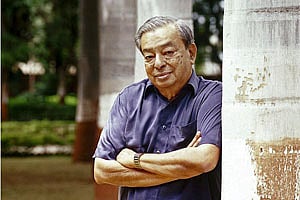
In these memoirs, Dr Verghese Kurien, popularly known as the ‘father of the white revolution’, recounts, with customary candour, the story of his life and how he shaped the dairy industry. Profoundly inspiring, these memoirs help us comprehend the magnitude of his contributions and his multifaceted personality.
M.V. KAMATH
Verghese Kurien, the man who introduced he milk revolution in India, passed away on September 9, deeply mourned and greatly praised. And rightly so. In a foreword to this book, published when Kurien was still very much alive, Ratan Tata made the point that Kurien’s memoirs “reveal the experiences and inner feelings of a great nationalist who has made an enormous contribution to the development of rural India and who will leave his mark long into the future”. And no truer words have been said.
I might state here that I am the only one to have written Kurien’s biography, but that was over a dozen years ago. It has been a pleasure to read his memoirs, recounted to another profess-ional journalist Gouri Salvi. Understandably Kurien has more revelations to make that reveals him even more fully and what emerges in this straightforward volume is a, man deeply committed to rural India and passionately devoted to the uplift of the farmers and fully confident in their capabilities.
As he put it: “when farmers are helped to become self-reliant, to manage their own affairs and to manage their livelihoods, they become the strong spine of the nation’s a democracy”. Reminiscences, personal account of his long and originally undreamt of career are remembered in page after informative page, like how he came to be a dairy engineer when his aspiration was to become a nuclear engineer, what brought him to Anand, a place he had never before had heard of, what problems he faced and how he overcame them, how the Fates decided his career and how he not only survived, but how, in the end he emerged victorious.
He literally worked miracles, overcoming the hurdles that were set up by politicians, bureaucrats, competitors both native and alien, establishing in the process the most powerful body dealing with the production and marketing of milk, namely, the National Dairy Development Board (NDDB), besides the Gujrat Coperative Milk Marketing Federation (GCMMF), not to mention the Kaira District Co-operative Milk Producers Union Ltd (KDCMPUL), but he wasn’t interested in making a fortune for himself.
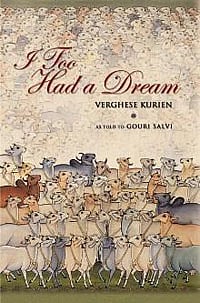
I Too Had A Dream
Verghese Kurien
As told to Gouri Salvi
Roli Books
Pages: 249; Price: Rs.295 |
As he recounts, the maximum salary he ever drew was Rs.5,000 as the chairman of GCMMF, when he could have earned twenty times that amount per month as an executive in a multinational firm. As he recounts his life he “never felt underpaid”!
Kurien trusted the farmers who, in turn, trusted him. But there were others who had just as much faith in his talent as much as in his integrity among whom could be counted Jawaharlal Nehru, Lal Bahadur Shastri, Indira Gandhi, Vallabhbhai Patel and Morarji Desai all of whom he had hosted in his modest home in Anand. As Knrien notes, “Sardar Vallabhbhii Patel’s vision has always been a source of great inspira-tion” as was that of a local leader, the gentle Tribhuvandas Patel who “through-out the year, trudged tirelessly, mile after mile, from village to village, almost single-mindedly, persuading the farmers of Kaira district to form co-operative milk societies!
From, a modest 200 litres a day the collection has ended up to 20,000 litres a day. The NDDB later went into the vegetable oil marketing, investing as much as Rs.700 crore in 1979. By 1986, NBDB was operating in seven states in India with over 300,000 farmers joining 2600 Oilseeds Growers Co-operatives, which later were organised into unions and state federations responsible for the production, procurement, processing and marketing, as well as method a for improving yields. India’s edible oil import bill came down from Rs.1,000 crore per annum to a paltry Rs.165 crore.
Kurien’s patriotism was unchallengeable. And he was not going to be taken in by foreign experts, some of whose arrogance he treated with the contempt it deserved. The story of how Operation Flood was conceived and executed merits detailed study. An entire chapter is devoted to this subject. It was to make India self-sufficient in milk, and Kurien says “this was achieved entirely through the co-operative structure” and he explains how.
Kurien was suspicious of foreign ‘experts’, many of whom believed that buffalo milk cannot be turned into milk powder. Kurien showed them how that could be done. As Kurien saw it, technical advice of foreign ‘experts’ was all too often dictated by the economic interests of the advanced countries and not by the needs or ground realities in developing countries. He was chary of them. He was later to show that his own expertise was way, way ahead of so-called dairy experts from such notable countries like New Zealand who had contempt-uously dismissed Indian experts as ‘natives’.
Kurien had to put them in their place and extract an apology from one of them. He had come to the conclusion that “a multinational never plays by the rules in somebody’s else’s country”. In dealing with them he would take a tough stand, but behind his appearance as an unyielding operator was a man deeply humble. He would quote Mahatma Gandhi who once said: “Be the change you want to see.”
Kurien even had the capacity to laugh at himself, but behind whatever facade he put up was his immense faith in his fellow countrymen. As he told Gouri Salvi: “I am positive that we will stand among the world’s most powerful nations” as an equal. And, of course, he proved it. Just in 1,017 villages in Kaira district members to co-operatives numbered 573,962 and the quantum of milk collected from them per day was 7.39 lakh litres – unheard of anywhere else in the world. The annual turnover was to the tune of Rs.5,092 million!

Because he believed that true development lay in development of men and women, Kurien determinedly stayed in what he called “the small and sleepy town of Anand for over fifty years as an employee of farmers”. This book is a delight to read because Kurien is such a good teller of tales. For a servant of farmers he did a splendid job. He sought nothing for himself though be won a number of top awards like the Ramon Magsaysay Award, the Wateler Peace Prize and right in his own country, the second highest Padma Vibhushan. He wanted to leave the world as quietly as he came and had asked that his body be cremated, even if he was a Christian. And so he was.

