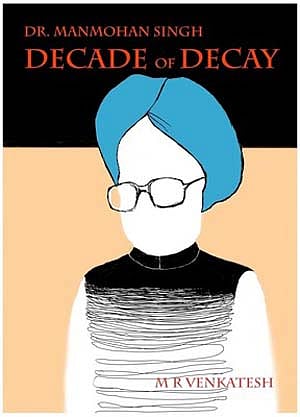
This book is a compilation of articles by M. R. Venkatesh on various aspects affecting our nation in the last 10 years.
Dr. Manmohan Singh: A Decade of Decay
M.R Venkatesh
Rare Publications
Pages: 501; |
Price: Rs 350
Government in the past had to face pretty stringent criticism and there have been over a dozen such governments, but to the best of my knowledge, no government has had to face so strong and eternally damning criticism as UPA – both I and II – and its two leaders Sonia Gandhi and Dr Manmohan Singh.
According to Venkatesh, the days of Team Manmohan comprising of Pranab Mukherjee, P Chidambaram, Montek Singh, Kaushik Basu and Rangarajan are all over, they are well beyond their sell by date and a first step to fix the economy is that the UPA has to go, lock, stock and barrel. Worse, if Venkatesh is to be believed, with India slowing down, literally going down the drain, the thing to do is to “try Manmohan Singh on the grounds of acting contrary to public interest”.
As Venkatesh so brashly put it: “The next government has to take quick, decisive and laser-like action on Dr. Singh, hold him accountable, try him in a court of law and if found guilty, punish him. It may be an outlandish idea now. But think about it, plan it, and effectuate it. The benefits overwhelm the cost several times over.”
Venkatesh is no ordinary man. He is a professional and is distinguished as a well-known commentator of issues of finance and economics. Probably he is even more knowledgeable about contemporary economics, considering that he is an active Chartered Accountant and is involved in resolving economic problems on a day-to-day basis.
What is surprising is that he is, judging, from his writings, a master commentator with the talent to present issues and problems with no holds barred. His credentials are best judged by his writings.
He has authored a monograph on ‘Capital Accounts Convertibility’ published in as well as on inflation. In 2007 he authored a book entitled ‘Global Imbalances & The Impending Dollar Crisis’ foreseeing the on-coming financial crisis of 2008 and in 2011 he authored another book titled ‘Sense, Sensex and Sentiments’. They have world-wide readership.
This book is a collection of his articles that first appeared in Re.diff.com between 2011 and 2013. It is divided into ten chap¬ters, revealing more than anybody else has, in the last one decade.
They are on Scam, Governance, FDI in Retail, Economic Slow Down, Black Money, Vodafone Mess, Corruption, PM as an economist and finally on ideology and politics. Each chapter is so powerfully strengthened with facts that it is impossible to question the conclusion arrived at.
Venkatesh knows his subject, obviously has more information than many of us do and presents them with skill commanding due attention. And what are these conclusions? Here are a few:
l There is no historical parallel in any democracy where the image of the incumbent government is so completely disgraced as India.
l A Finance Minister cannot, innocently or otherwise, look the other way while his Cabinet colleagues loot the Public Exchequer. l The story of UPA is one of omissions and commissions.
l The 2G Scam is a perfect occasion for us to travel a bit further and punish all those who could have prevented the fraud and yet chose to remain silent.
l Expectedly India is ranked a poof 83 (out of 98 countries) when it comes to the absence of corruption. The 2013 report ranks India at 132 among 155 countries on an overall basis.
l The experience of 2G Scam have demonstrated that at 65, India can be best described as Republic Without Responsibility, a Democracy without any duty.
l While the Middle Class believe that while Dr Singh may not exactly be corrupt they simultaneously also perceive that the best bet for anyone to loot and scoot is while he continues to be around.
l 98% of the total investments made in India has come from domestic savings with the balance two coming from abroad as foreign capital.
Venkatesh is merciless in criticising the UPA in general and Dr Singh in particular. Thus he makes the point that “the near decade of India under Dr Sing has convinced most that India is an Absent State where governance is grossly missing and the rule of law virtually non-existent.
To that he adds that even in a case where law exists, order does not. The point he makes is that at the root of the present economic crisis is lack of governance and government deficit in turn adversely impacts production of ordinary goods.
He does not spare the Opposition either. As he put it: “We simply do not have policy or operational alternatives from the main Opposition Party. And there is a complete consensus out there. It is this consensual politics that is at the root of our moral malaise, policy paralysis and the extent economic crisis.”
As for black money, the pages are chockfull of facts that are most damning. Says Venkatesh: Unfortunately in India most political parties (ruling or opposition) some in our judiciary, the intelligentsia, many members of our media, are beneficiaries of the illicit wealth parked in Switzerland.”
And he asks, quite rightly: “Why is the Indian Government reluctant to reveal the names of these crooks who have stashed our wealth abroad? Why are we reluctant to name, frame and shame such account holders?”
The chapter on Black Money is to be read to be believed. It is summed up in one paragraph that says: “Corruption has become a way of life in India. Scam is India’s gift the English language which suggests the following paradigm: one, that indicates massive level of corruption, two, the availability of irrefutable evidence and three, the impotence of the law enforcers to punish those who violate the law with impunity.”
M.V. KAMATH
