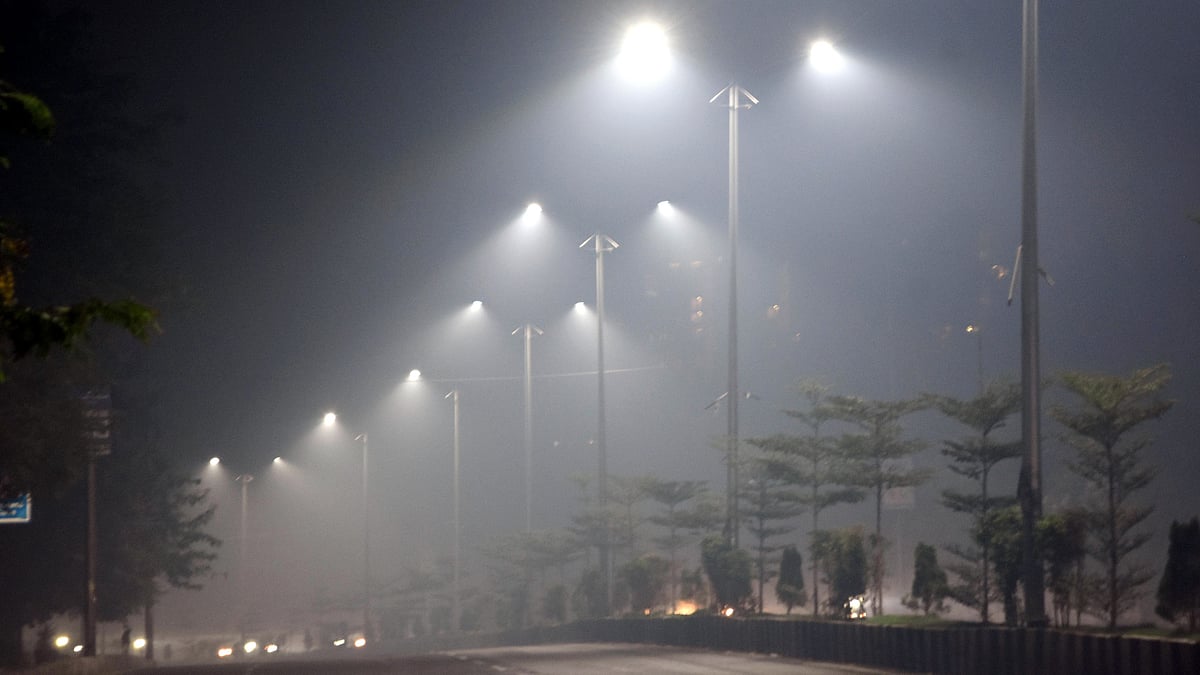
Bhopal (Madhya Pradesh): A tender night, a clear sky, the bright moon, and twinkling stars remain behind a curtain of smoke generated by firecrackers and petrol in Bhopal these days, but it was not so a few years ago. The celestial bodies were visible to the naked eye.
The above lines of Keats sprang to mind the other day, when a patch of thick sulphur-laced grey smoke was wafting over the Jail Road. It was nearly 30 feet above the surface of the thoroughfare and around ten feet above the tree tops and electric poles.
A few commuters mistook it for clouds floating just above their heads and tried to take its photograph, but instead of a patch of cloud, it was a plume of smoke generated by firecrackers. It gradually drifted away, casting a shadow of fear on the minds of those who saw it – the fear of a major ecological disturbance.
The city has already witnessed the worst industrial disaster of the century, which claimed thousands of lives and maimed as many. So, it cannot afford to witness an ecological disturbance that may trigger another catastrophe.
Similarly, another unusual thing has happened this year: Diwali insects have failed to keep their dates with the city. Irritating as they remain, their presence before the festival of lights necessitates tolerance because their absence shows something has gone wrong in the weather cycle.
Seasonal moths and green leafhoppers stayed away from Bhopal this year mainly because of heavy smoke emanating from vehicles day and night and a lack of post-monsoon rain. As a result, temperature dropped early, and the pre-autumn weather remained dry.
The seasonal bugs require post-wet season conditions to breed and flutter around lights. They disappear soon after Diwali when the temperature declines.
As the festival fell on November 8, it pushed the celebrations deeper into autumn compared to the years when it occurred in October.
The state capital witnessed an early winter chill in the first week of November when the minimum temperatures dipped to 12.8°C, and as the night temperatures fall, the seasonal insects remain dormant or die.
The surroundings of the state capital have lost the green cover because of rapid housing expansion and industrialisation. Leafhoppers generally breed in agricultural fields, but the loss of such paddy and wheat fields has reduced the swarms. Further, the excessive use of chemical fertilisers and pesticides has also pared them down.
The state capital still has some places with tree canopies. Yet, its air quality deteriorated with AQI levels crossing 400 after Diwali because of firecrackers. Thus, dry weather, heavy smoke, heat, and chemical remnants of firecrackers shooed away the insects from the city.
Even at nights, the grey-black smoke, which the vehicles generate throughout the day, covers the bright Milky Way that once used to attract stargazers at night. A clear sky; the Milky Way; the Plough (the constellation of seven stars); the beautiful Venus; the fiery Mars; and the meditating Jupiter, which were once visible to the naked eye, remain invisible these days because of the smoke. The Orion constellation, or the Cosmic Man (Kalpurusha); the star Alcor (Arundhati); Swati (the star Arcturus); and many others were once easily observable. And the stargazers in the city used to enjoy their magnificent present in the endless horizon. But today, one needs powerful binoculars to watch these celestial bodies.
Even the Queen of Night, the Luna, often loses her brightness on a full-moon night because of fuel smoke that has begun to choke the city’s green and clean environment. Ergo, such a clear sky has become a thing of the past and exists only in the pages of Thomas Hardy’s Far from the Madding Crowd: The sky was clear --
remarkably clear -- and the twinkling of all the stars seemed to be but throbs of one body, timed by a common pulse.