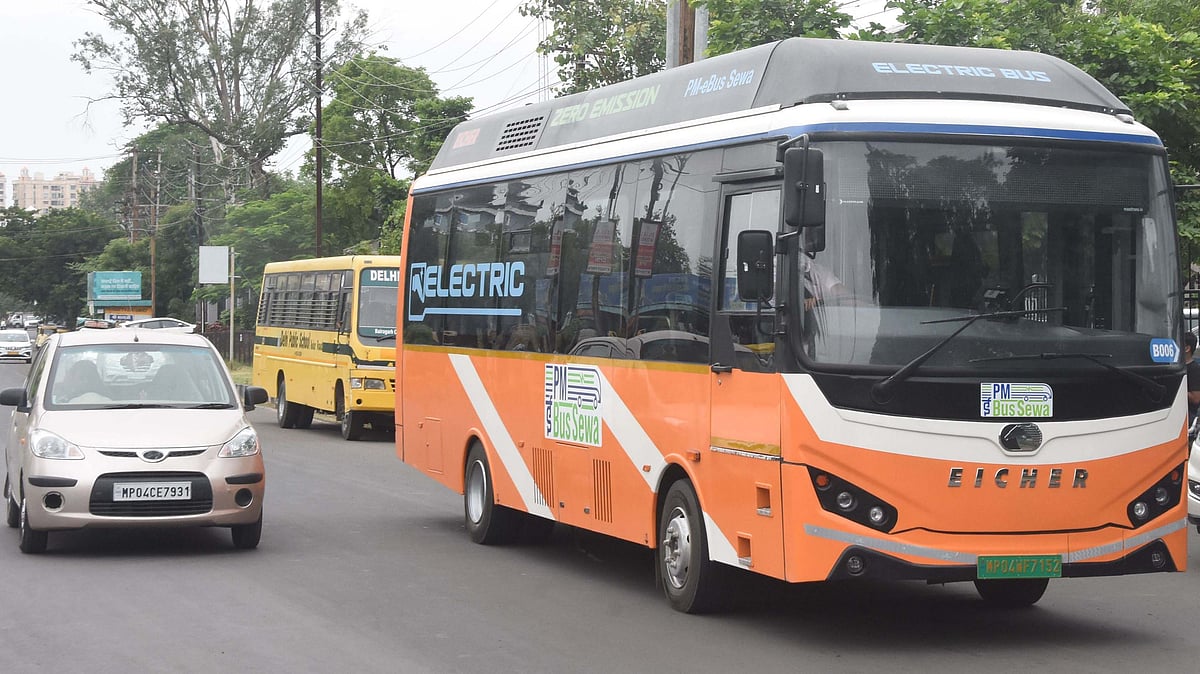
Bhopal (Madhya Pradesh): The state capital's public transport network is set for a major upgrade as free passenger trials of 10 air-conditioned electric buses with modern AI safety features will begin today on two routes under the PM e-Bus Sewa scheme.
The city is expected to have a fleet of 245 electric buses, with officials estimating that more than one lakh commuters will benefit from the expanded service.
In the first phase, 100 buses have been sanctioned under the PM e-Bus Sewa scheme on the Gross Cost Contract (GCC) model, while another 145 buses will be inducted by Bhopal City Link Limited (BCLL) in subsequent phases. So far, 21 buses have reached the newly developed Bairagarh depot.
Free trial route:
The trial service will operate on two routes: Chirayu Hospital-Board Office Metro Station-Bairagarh Chichli and Chirayu Hospital-Board Office Metro Station-Railway Coach Factory. Passengers can travel free during the trial period. Commercial operations of the first 100 buses are scheduled to begin on Aug 15.
12 routes approved across Bhopal region
The transport department has approved 12 routes for e-bus operations out of 26 proposed by BCLL. The longest route will connect Sehore to Ratapani (68.5 km), while the shortest will run between Acharpura Industrial Area and BDA Colony (32 km). Other routes include Sukhi Sewaniya-Bhojpur, Coach Factory-Obaidullaganj, Bilkhiria-Sehore and Phanda-Mandideep.
GCC model and depot infrastructure
Of the 100 PM e-Bus Sewa buses, 65 will operate from the Bairagarh depot and 35 from the Kasturba Nagar (ISBT) depot. Green Cell Mobility, selected by the Centre, will provide drivers and maintenance staff. It has already installed 11 charging stations at the Bairagarh depot. Under the GCC model, each bus must operate at least 180 km daily. The operator will receive Rs 58.14 per km, including a Central subsidy of Rs 22 per km and Rs 36.14 per km from the state government.
Modern safety and passenger amenities
The new fleet is equipped with AIS-140 GPS tracking, air conditioning, five CCTV cameras, AI-based passenger counters, panic buttons, wheelchair lifts, emergency hammers, a public announcement system, LED passenger information displays and a mobile app for digital ticketing and passes, with real-time monitoring from the BCLL control room.