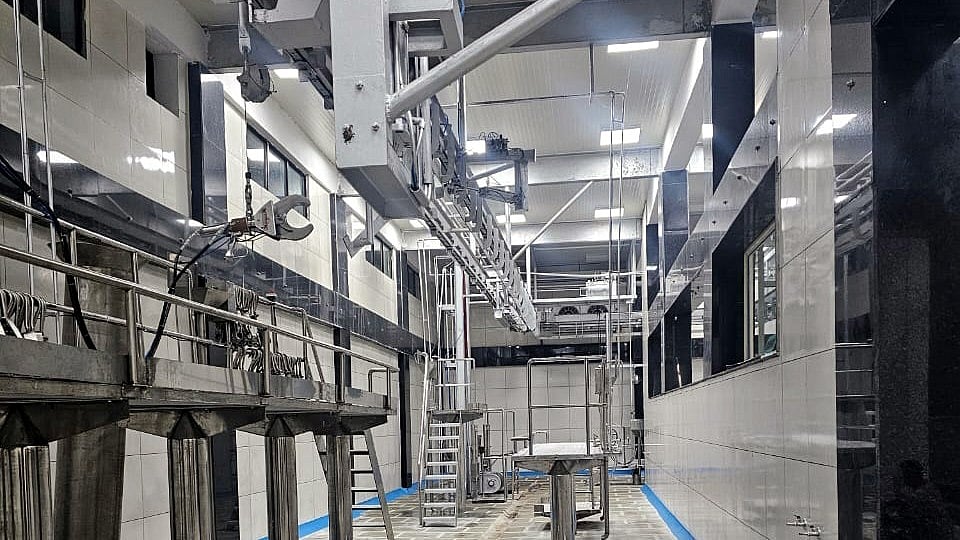
Bhopal (Madhya Pradesh): Nearly 45 days after the Madhya Pradesh High Court directed authorities to decide on the stored materials at Bhopal's modern slaughterhouse, the Bhopal Municipal Corporation (BMC) is yet to conduct the promised inspection.
The delay has raised concerns over public safety and compliance with judicial directions. Experts warn that the material stored at the facility could trigger a major explosion, potentially affecting a large area and putting nearby residents at risk.
The concern centres on approximately six tonnes of ammonium nitrate reportedly stored for use in the operation of the slaughterhouse on Maida Mill Road, Jinsi.
The facility shares a boundary wall with the Madhya Pradesh Metro Rail Corporation Limited office and is located near the Bhopal Metro depot at Subhash Nagar, with nearly one lakh residents living nearby and raising concerns about the potential consequences of a chemical incident.
The reported presence of the material has raised concerns among residents in the surrounding areas, particularly following recent major fire incidents in Bhopal.
BMC officials said the slaughterhouse remains closed and that Livestock Food Processors Pvt Ltd continues to pay electricity bills of nearly Rs 16 lakh per month.
Seven-member panel yet to visit site
Despite the High Court's Aug 25, 2026, directions requiring a decision within seven days, the BMC constituted a seven-member joint inspection team only on Sept 28. The inspection was proposed for Sept 29, but the committee had reportedly not visited the premises.
The case concerns M/s Livestock Food Processors Pvt Ltd versus State of Madhya Pradesh and Others (Writ Petition No. 34797/2026). The panel was constituted to inspect the premises, examine the seized materials and assess the condition of animal products.
The High Court had directed authorities to decide on the seized meat-processing plant and related articles, including those destroyed or preserved. It also directed that the ammonia plant be stopped after the articles were removed.
Meanwhile, on Sept 1, the Madhya Pradesh High Court dismissed a PIL seeking permanent closure of the modern slaughterhouse. The court also cited the delay in filing the petition and noted that the issue had previously been considered by the National Green Tribunal.
Chemical experts flag storage risks
Prof S Suresh, head of the chemical engineering department at MANIT, Bhopal, said ammonium nitrate requires carefully controlled storage temperatures depending on its concentration.
He said temperatures exceeding 210 C could trigger thermal decomposition, while temperatures above 260 C could rapidly generate toxic nitrogen oxides and increase explosion risks.
The actual danger at the site would depend on the chemical's composition, quantity, storage conditions and other factors.
Official statement
BMC commissioner Sanskriti Jain told Free Press that the committee could not inspect because of the festive season. She said the court's directions would be complied with after an inspection next week.