All the areas that you are touching, heritage, education and the environment, are not areas where you can get results quickly or measure outcomes instantly. How do you stay committed long-term to philanthropy work in subjects that do not naturally lend themselves to quick results?
If it's easy, it's not fun, right? I'm joking there, but the entire journey of picking these different sectors has been organic. The first project we started was Pehlay Akshar in the English education space—I was 22 then. The Right to Education had done an amazing job by bringing children into school, but the problem of children not learning really remained. The other big issue was English not being taught in our schools. It was politicised—the central government was pushing Hindi, states were pushing regional languages, and standing for English was not politically favourable for anybody. But the reality was that English is transformational. So I said, "If I have to think of one space that is ignored and has huge potential to change someone's life, it would be English at this stage." And so we zoned in on it.
We developed a program where we taught functional English, we built our own curriculum, which guaranteed in six years that a child who was never exposed to English would walk out, post eighth standard or tenth standard, with basic skills. We knew we were doing something right when the government asked us to take more schools—the best impact assessment you can have. I was very focused on quality and couldn’t grow in those kinds of numbers. That taught me how to partner with the government at scale. We started training teachers, which really scaled up our impact.
When COVID hit, we developed a curriculum which then went on to Doordarshan, and became the highest watched show on DD. I think the journey towards growth, scale, partnership, all this happened organically.
What was the journey like from being educated in the US to working on a farm project in Vidarbha?
We are very fortunate that we have such fertile lands, but we are exploiting our soils by putting a lot of chemicals in it, fertilisers, pesticides, etc. If a government had to push organic farming, it would be highly unpopular because immediately there would be a drop in yield. As a long-term agenda, it is an ignored space. We wanted to build an organic farming model that is viable for scale. We zoned in on cotton farmers, because cotton grows in arid conditions, difficult soil conditions, and we felt if we can do it here, it would be easy to do in other spaces. Cotton farmers are also some of the poorest farmers in our country.
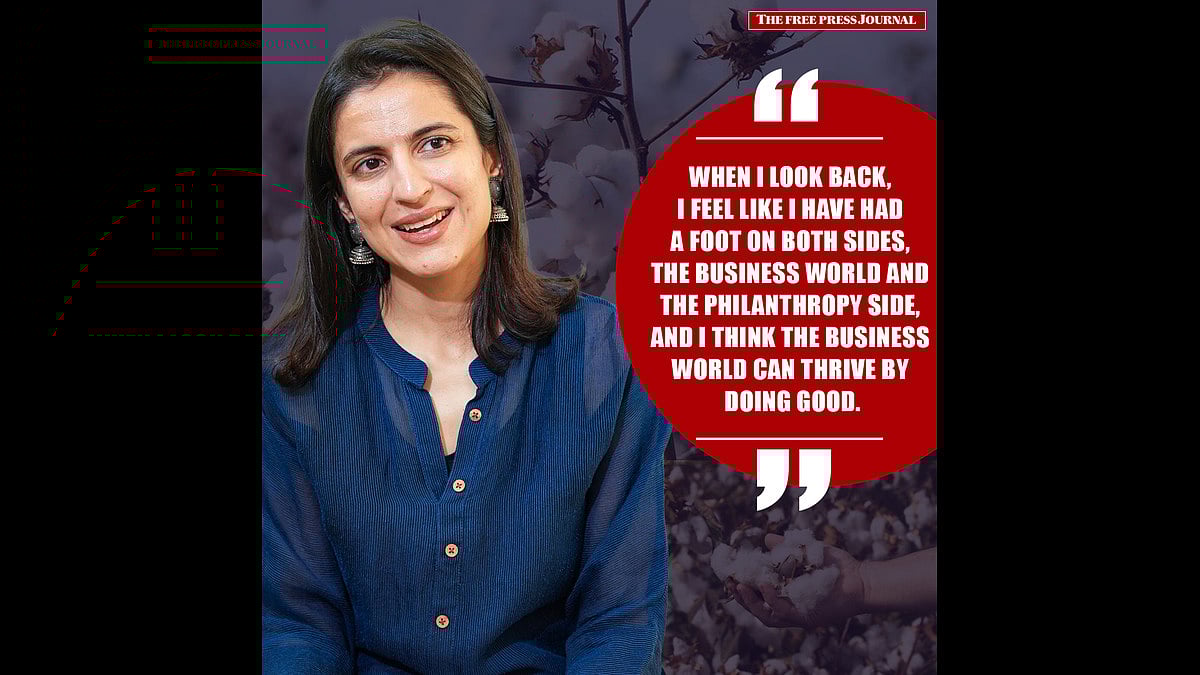
When you talk about organic fruits or vegetables, people are still getting conscious, and they want organic. But they care less about organic cotton.
We started working with 500 farmers in an area called Katol outside Nagpur and we built an end-to-end regenerative farming model where we started from seed production all the way to waste management. We invested heavily in R&D, different varieties of seeds that could be more resistant.
We've done a fantastic job with the cotton there. We've got all the global certifications over a three-year journey.
The end goal was a repeatable model and with our model, in year one, we could make it sustainable. When the farmer stops putting in pesticides and fertilisers, his yield drops, but he can’t charge a premium for organic produce because a crop is not technically organic for three years. That is where philanthropy capital comes in. We covered their costs while we learn, so that the farmer is incentivised to make the journey to the end of three years.
On market linkages also, I wanted to build sustainable models versus philanthropic models where I am constantly churning money in. So we created a social enterprise to build market linkages for these farmers. Fortunately, our first buyer for these farmers is a luxury goods manufacturer. Now we have to scale this entire model.
What about in heritage, where you’re not looking at numbers of sites that you're restoring, or how many people are visiting, but taking a very unique approach of wanting to document histories, communities, build their ownership of the space, etc.
You have hit it on the head. I want to start off by saying that I am in a privileged position to have capital, which I think is something the sector needs to recognise, that we need to give capital with a little bit of a free hand, without having it completely hardcoded into numbers.
With the heritage project, my goal was preservation through storytelling, preservation through building sustainable models, to bring tourism into the space so that the local economy would kickstart, which then gives the locals an incentive to preserve that site. This was the model I was building for preservation. With Worli-Koliwada, we first built access to the fort, we worked to move out the encroachments, we built a playground to create an event site, l and much of the capital was the BMC’s. Everything on top, which was design-led, was our capital. We hired researchers, built a bank of old stories of Koliwada, we put up signages, we trained locals to conduct walks and tell the stories, we invited artists to come in and paint, and we did musical events. Then we built the Chefs of Koliwada programme to bring tourism to their homes, to support them to build a catering business.
Our next site will have a very different story because their reality is different. And I think our strength is to be able to bring this kind of strategic vision.
Do you want to tell us which is your next site?
Yes, Sewri Fort is our next site. For me, the scalable model for this project is that we have basically built the know-how on how to do this. And today we can take a site and with very little capital, which is the storytelling part, transform a site. You do need a guardian who's overseeing the site. We’re also encouraging people to pick up sites in their neighbourhood. So if you are a corporate in Jaipur, then you should pick up a site in your neighbourhood and we can help you as a partner to make that site yours.
You have argued that business, philanthropy and government must not work in silos if we are to improve outcomes across social issues. How is this practical, when ultimately business and social sector organisations’ end goals are different?
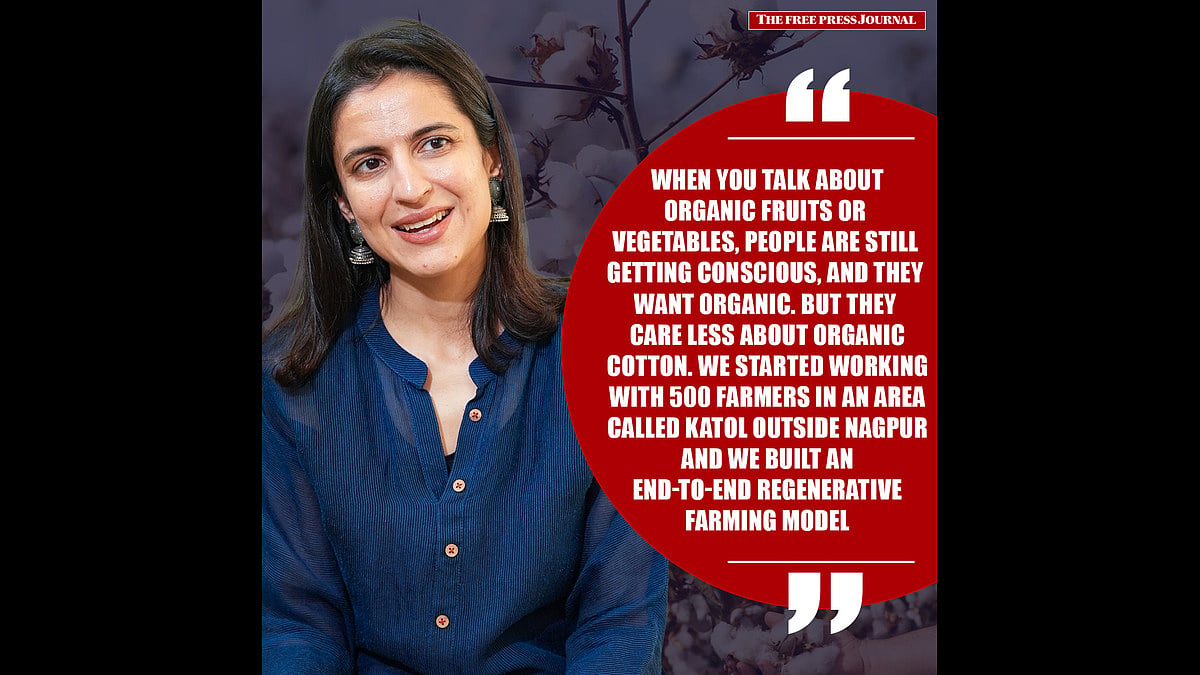
Business, philanthropy and government are ultimately all serving people. Philanthropy wouldn't exist without business, it’s the business houses that are funding philanthropy. So in that sense, they're already co-working. When I look back, I feel like I have had a foot on both sides, the business world and the philanthropy side, and I think the business world can thrive by doing good. When a founder starts a company, he's thinking, “Is there a need for something in the market that is not being filled?” Over time, as this gets lost, it starts causing problems in society with pollution, etc. Then they put philanthropy capital out to solve those problems. So essentially it's all a web of things. In this article I wrote, I was considering whether there is a world where we can actually do business and do good at the same time? I do hope that the next phase of my life is trying to find that middle ground. There are enough beautiful examples, and my goal is to try and push even our companies to start thinking about how they can genuinely do something good in terms of impact.

