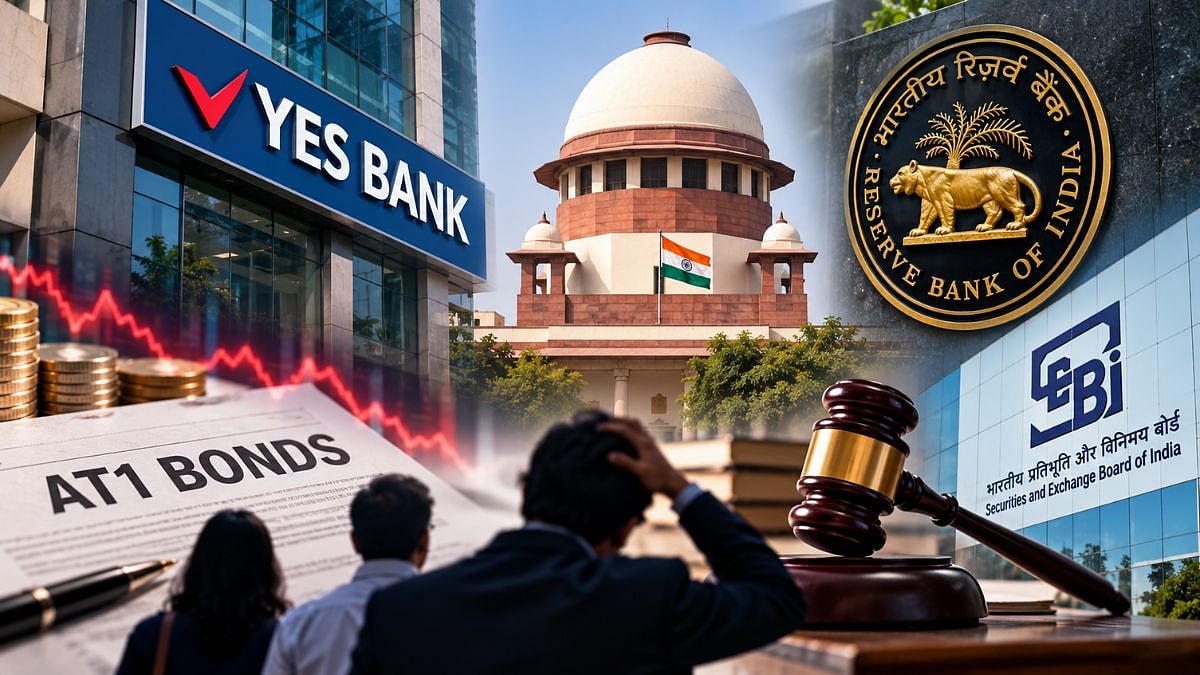
The Supreme Court’s October 15 judgement, upholding the quashing of Yes Bank’s ₹8,415 crore Additional Tier 1 (AT1) bond write-off, raises a fundamental question of regulatory accountability: how did India’s financial watchdogs allow a banking crisis to culminate in the unauthorised extinguishment of investors’ securities?
The RBI may have had legitimate reasons to rescue Yes Bank in March 2020 to protect depositors and financial stability. But the need for a rescue does not absolve it of responsibility for the circumstances that brought the bank to the brink of collapse.
The draft reconstruction scheme contained a provision to write off the bonds. That provision was omitted from the final scheme in 2020. Yet, the administrator proceeded with the write-off the following day. The Supreme Court upheld the Bombay High Court’s decision to set it aside. Clearly, financial stability cannot be pursued by disregarding the law.
The larger problem is that banks pay premiums for deposit insurance, yet troubled banks are repeatedly rescued through takeovers by other institutions, even when their failure may not pose a systemic threat. The fear of contagion may sometimes be genuine, but a bank’s failure also reflects on the quality of regulation. Bailouts are consequently managed through decisions taken at the highest levels, beyond the market’s reach.
The RBI must explain why the write-off proceeded without authority under the final scheme and whether losses were allocated between shareholders and AT1 bondholders in accordance with the rules and contractual terms. Bypassing prescribed safeguards could undermine confidence in Indian bank capital instruments and increase future borrowing costs.
The Mis-Selling Scandal
The regulatory failure is compounded by how these bonds were sold. In April 2021, SEBI acted against Yes Bank over deficiencies in selling AT1 bonds to individual investors. The controversy centred on representations that made high-risk securities appear comparable to fixed deposits, sometimes described as “Super FDs”.
SEBI deserves credit for investigating the alleged mis-selling. But the RBI must explain how sophisticated capital instruments reached ordinary customers through the bank’s distribution network and whether it adequately scrutinised sales practices.
The RBI cannot treat investor protection as exclusively SEBI’s responsibility when the issuing bank and its capital instruments fall within its regulatory framework.
Where Was SEBI When The Bonds Were Written Off?
Mutual funds held these securities, exposing their investors to the reconstruction’s consequences. SEBI could not unilaterally reverse a banking decision, but it could have urgently engaged with the RBI, examined the legality of the write-off and considered intervening in the litigation to represent mutual fund investors. Why was the securities regulator not a more visible champion of their interests?
Investor protection means ensuring that securities are sold lawfully and losses are imposed according to the rules. Neither regulator can retreat behind jurisdictional boundaries when banking decisions directly affect securities market investors.
Interest, Provisioning And Disclosure
In January 2023, Yes Bank’s managing director reportedly told analysts that previously unpaid coupons would not have to be paid, citing their non-cumulative nature and applicable conditions. The Supreme Court’s October 15 order states that annual coupon payments must be made in accordance with the bonds’ information memoranda. The implications for unpaid coupons, therefore, require clarification.
Was provisioning required for the potential liability? Were accounting standards correctly applied? Did Yes Bank adequately disclose the litigation and its possible financial consequences? These questions affect reported profits, capital and investor decisions. SEBI should examine disclosures to stock exchanges, while the RBI should assess the implications for financial stability.
The Post-Judgement Questions
The ruling has settled the legality of the write-off, but practical issues remain. How and when will the ₹8,415 crore principal be reinstated? How will the bonds’ status and associated rights be restored? What is payable towards unpaid coupons, and when?
The capital impact is significant. Yes Bank has indicated that restoring the principal could reduce its core equity capital ratio from 13.7% to around 11.4%. This is a capital and accounting impact, not an immediate cash outflow of ₹8,415 crore.
Rating agencies have estimated that the ratio could fall to around 10% if accumulated coupons must also be recognised and paid. This remains a conditional estimate, not a settled liability.
Yes Bank is evaluating capital management options, including a possible capital raise. It must disclose its accounting treatment, reinstatement timeline and coupon calculations. The RBI must clarify the implications for regulatory capital. Investors should not be left navigating continuing uncertainty through speculation. The bank must also explain how it will balance these obligations with the need to maintain adequate capital for future lending.
Accountability Cannot Be One-Way
The RBI must explain how Yes Bank reached the brink of collapse, why the write-off proceeded without authority and whether the applicable loss allocation rules were respected. It must also examine the distribution of AT1 instruments to individual investors.
SEBI must explain whether it adequately protected mutual fund investors and whether stronger intervention was possible. The judgement does not make AT1 bonds risk-free; it establishes that investment risks must be governed by law.
The ultimate test of a regulator is not merely whether it penalises market participants; it is whether it identifies risks early, acts within its legal authority, protects investors and acknowledges its failures.
When ₹8,415 crore of securities can be written off through a process held unauthorised by the Supreme Court, the public deserves answers. Why did supervision fail? Were investors adequately informed? Was the prescribed loss allocation framework respected? Why did the regulators not do more?
Regulators cannot investigate everyone except themselves. These questions demand accountability, not silence.
The writer is a retired IRS officer and former Chief of Surveillance at SEBI. He is an adviser to corporates, market participants and tech entrepreneurs.
To get details on exclusive and budget-friendly property deals in Mumbai & surrounding regions, do visit: https://budgetproperties.in/

