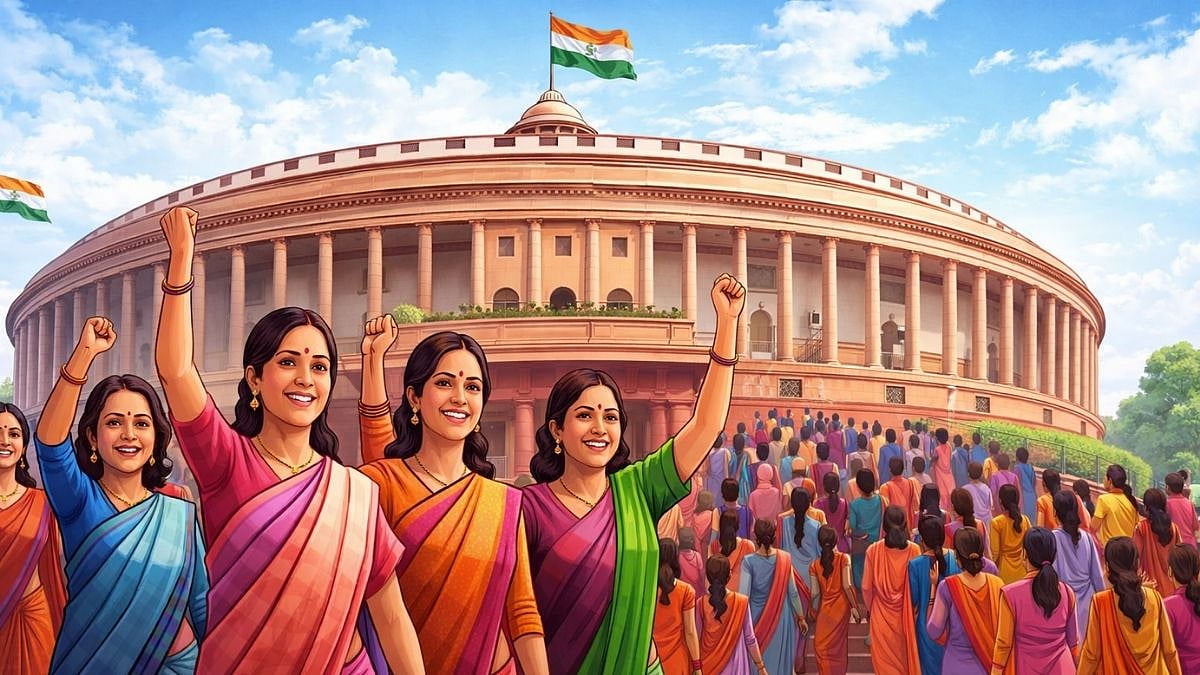
India’s commitment to a ‘Pink Parliament’ with at least one-third of the seats occupied by women is expected to be realised in 2029. The question is whether the women’s reservation law can be put into effect even before a fresh delimitation of constituencies, and if so, are political parties prepared for such a sweeping shift in the electoral landscape?
Link to census and delimitation
Implementation of the Nari Shakti Vandan Act (2023) is statutorily linked to Census 2027, scheduled to begin in March next year, and the subsequent delimitation. Given the complex and time-consuming nature of the exercise, the Centre is reportedly considering an amendment to the Act, which will delink women’s reservation from delimitation.
Political implications and legislative hurdles
The powerful optics of such a move would doubtless work in the BJP’s favour, particularly in the upcoming assembly elections in Kerala, West Bengal, and Tamil Nadu, where it is seeking to break new ground. But the amendment will necessitate a constitutional amendment, with a two-thirds majority in both Houses of Parliament. This means that the BJP will have to drum up the support of its allies and the Opposition.
Delimitation timeline raises concerns
The last Delimitation Commission, constituted after Census 2001, started work in 2002 and submitted its report in 2007. Census collection and data publication are likely to take at least a couple of years, even with the use of biometrics and artificial intelligence tools. Assuming that the new commission hits the ground running, it’s unlikely to complete its work before 2031 at the earliest.
Resistance from incumbents
Therein lies the problem. Delimitation is expected to increase the number of seats in Parliament and the state legislative assemblies—expand the size of the pie, so to speak. In that scenario, many of the veteran male MPs and MLAs could expect to retain their seats, even with one-third being set aside for women, and the boundaries of all the constituencies redrawn. Without that assurance, the beleaguered men may want to put the implementation of the Act off as long as possible and may filibuster if an amendment is introduced.
History of opposition to women’s reservation
The turbulent history of women’s reservation makes it clear that there is a high degree of latent opposition. Introduced in 1996 by the H D Deve Gowda government, it was taken up in 1998, 1999, 2002, 2003, 2008, and 2010. It met with fierce opposition from OBC leaders every step of the way and was passed only in 2010 and only by the Rajya Sabha.
Rise of the ‘W’ factor in elections
The emergence of the ‘W’ factor in Indian politics makes it difficult to openly oppose the implementation of the law. Women slightly outnumbered men in the 2019 and 2024 general elections, and in the 2025 Bihar assembly elections, they were a mile ahead, with a 71.6 per cent turnout as compared to 62.8 per cent for men. The women’s vote is now recognised as the critical factor in elections and is reflected in the array of freebies targeting women voters, from Ladli Behna in Madhya Pradesh to free bus passes in Karnataka and cash transfers under the CM Mahila Rojgar Yojana in Bihar.
Representation still lags globally
Even so, the share of women in the Lok Sabha has increased at a snail’s pace, from 4.5 per cent in 1951–52 to 13.6 per cent in the 18th Lok Sabha. Globally, the average stands at 27.5 per cent, so India is ranked an abysmal 149th in terms of women’s representation, way behind Pakistan. Reservation for women could potentially push India to the top ten of the table, displacing many of the 56 countries where women occupy a third of the legislature.
Potential impact of the Act
The Nari Shakti Vandan Act proposes a minimum of one-third seats for women—to be rotated after each decadal delimitation—but pre-reservation, women already hold 74 seats in the Lok Sabha. Many of them will be elected without the benefit of a quota, so the resulting legislature could well come close to achieving gender parity.
Challenges for political parties
The challenge for political parties is not just limited to finding viable women candidates; it is also about adjusting to their presence and influence!
The BJP has a country-wide ecosystem it can tap for women nominees. So far, there has been a dissonance between the grassroots mobilisation of women by the RSS and their representation in electoral politics. The party’s top women leaders have tended to be dynasts, spiritual leaders, or parachuters rather than ‘insiders’. Finance Minister Nirmala Sitharaman, for instance, joined the party only in 2008.
Impact on Sangh Parivar dynamics
The transformative impact of increased political participation of women on the patriarchal Sangh Parivar will be interesting to watch. While the RSS frontals have been increasingly onboarding women, the RSS itself still remains an exclusively male preserve. Pracharaks, who are all men, form the core of the organisation, which, therefore, tends to reflect the male perspective. For example, a larger family size is encouraged as a matter of policy. This prescriptive approach is bound to annoy female legislators, as women’s reproductive rights are non-negotiable.
Congress faces candidate pipeline challenge
Unlike the BJP, the Congress does not have a robust pipeline of potential candidates. As the Congress discovered in the 2022 Uttar Pradesh assembly elections, it is not enough to find women nominees; those who are fielded must have a high winnability quotient. While it distributed 40 per cent of the tickets in the state to women, the only one to win was a dynast. To be fair, the party only won two seats in the state. In 2024, the party’s official news magazine, Congress Sandesh, declared that it would apply the one-third reservation for women to “the next round of assembly elections in 2025”. However, out of 70 candidates in the Delhi elections, it was able to field only nine women.
Need for grooming women leaders
Parties rarely look outside the families of incumbents for women candidates. One of the arguments against reserved seats was that they would go to the wives, mothers, sisters, or daughters of political families. While reservation must start somewhere, each party should ideally step up grooming of promising nominees to avoid last-minute headhunting.
Bhavdeep Kang is a senior journalist with 35 years of experience in working with major newspapers and magazines. She is now an independent writer and author.

