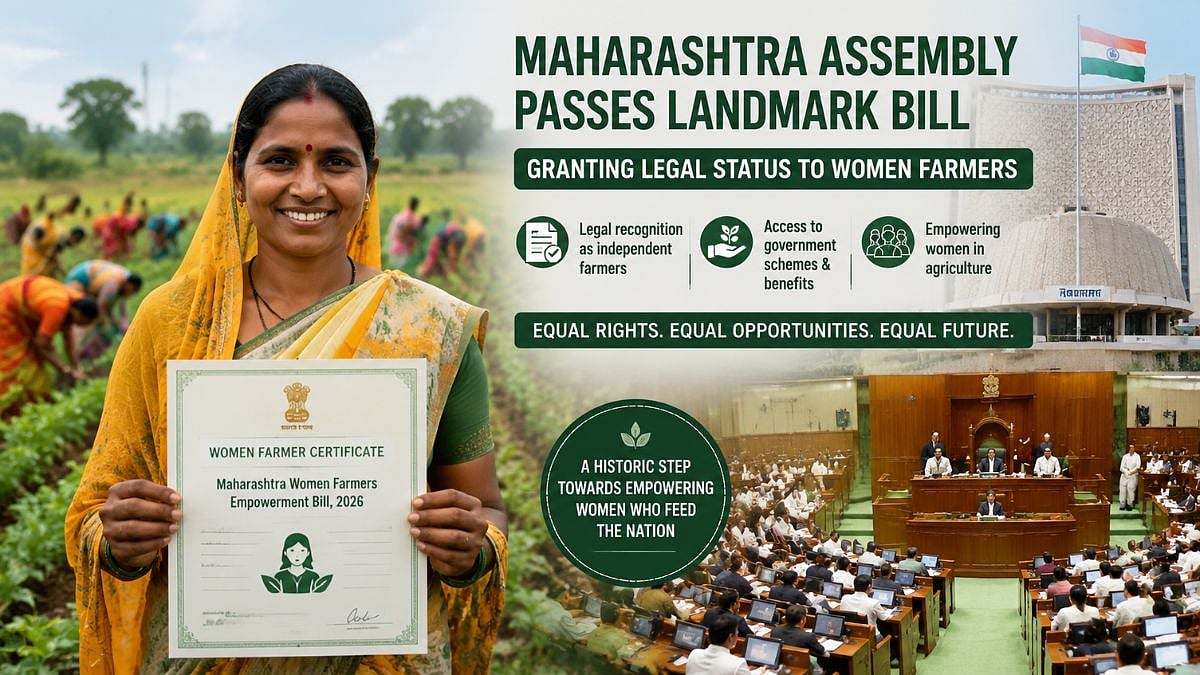
In a welcome throwback to its once-progressive character, Maharashtra now has a law specifically on women farmers’ right to land and access to benefit schemes. The Maharashtra Women Farmers Empowerment Bill, 2026, tabled in the state assembly last week, was unanimously passed and should soon become law. This holds promise for millions of women involved in the agricultural sector across the state—a staggering 88 per cent of rural women here—of not only rightful ownership of land and benefits but also the status and dignity that has been long denied to them.
The law matters because in Maharashtra, and in the rest of India, the formal definition of a ‘farmer’ has been tied to land ownership, but, as the All-India Report of Agriculture Census 2015-16 showed, women hold barely 15.5 per cent of the operational agricultural land in the state. This is higher than the national average of around 12 per cent but hardly anything to crow about. In the absence of formal recognition as ‘farmers’, women farmers and farm widows who are engaged in every aspect from sowing the field and harvesting to rearing the livestock and poultry have been denied crop insurance, Kisan Credit Cards, and subsidies and benefits because the land records bear the names of their husbands, fathers-in-law, or other male members of the family.
The Devendra Fadnavis-led government must be commended for moving the Bill and ensuring that it received the unanimous assent of the House. It was a long-overdue move. Maharashtra was the first state in India to have brought in the state Women’s Policy in June 1994 when Sharad Pawar was the chief minister. Among other initiatives, it ensured financial and property rights for all women in the state—joint property ownership for land and houses for both spouses being a significant one—which went some distance in securing women’s status. While household land rights were enforced, although fitfully, the lack of specific agricultural land rights left rural women at sea in their work.
The law is the critical first step. Several aspects, from legal to societal, need to be addressed before its impact can be felt. For example, the issuing of a woman farmer certificate cannot be caught in bureaucratic hurdles causing delays, women farmers in crisis zones or farm widows need special recognition, and women’s land ownership must not be dependent on inheritance from the men in the family. The Maharashtra example must be followed by other states; perhaps it is best mandated at the national level. In fact, India’s reputed agricultural theorist, MS Swaminathan, had moved a Private Member’s Bill to this effect in 2011, delinking land ownership from the status of ‘farmer’, but it lapsed in 2013. Maharashtra did well to revive it at the state level; a lot now rides on the implementation.
