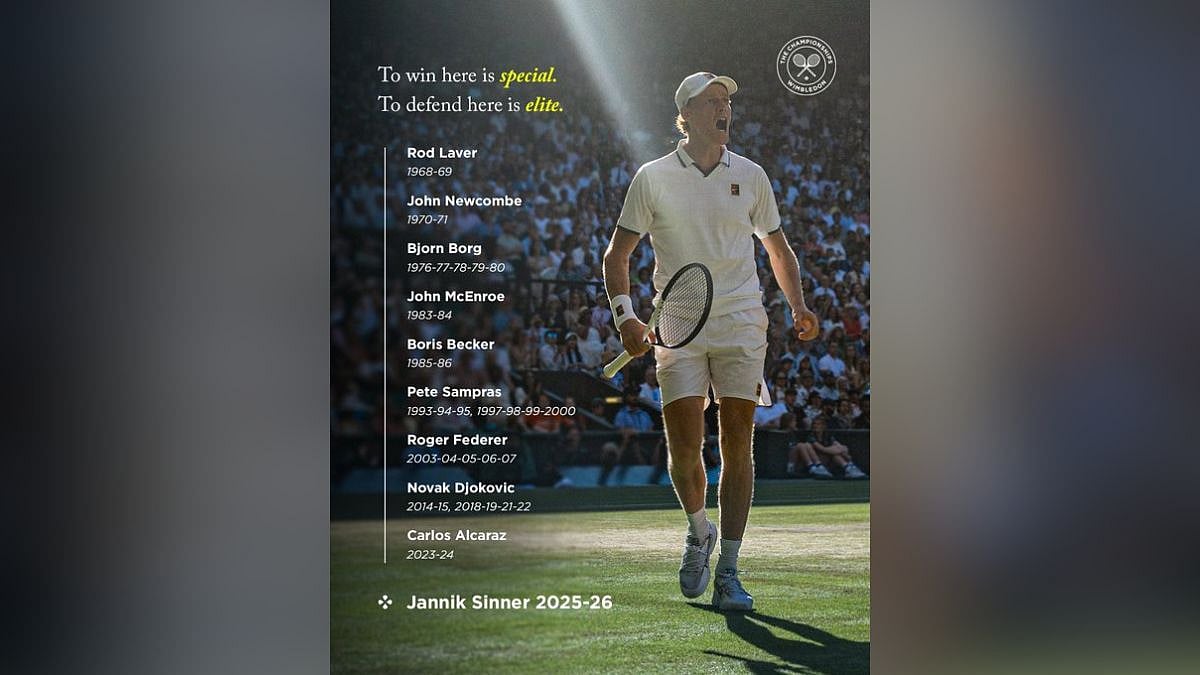
The 2026 Wimbledon Championship may well be remembered as the tournament that confirmed a generational shift in world tennis. Jannik Sinner's successful defence of the men's singles title and Linda Noskova's breakthrough triumph in the women's event signal not merely the emergence of two worthy champions but also the arrival of a new order in a sport that has spent the past two decades under the shadow of a handful of extraordinary personalities.
Sinner's rise has been steady rather than spectacular. In an era when every promising youngster is prematurely labelled the next great champion, the Italian has allowed his tennis to do the talking. His latest Wimbledon triumph reflects a game built on discipline, consistency, and mental resilience rather than flamboyance. With Roger Federer retired and Rafael Nadal and Novak Djokovic no longer dominating the Grand Slam landscape, Sinner has stepped into the vacuum with remarkable composure. His victory is not simply another title; it is evidence that men's tennis has found a worthy standard-bearer.
The women's singles championship was equally significant. Linda Noskova's maiden Grand Slam title underlines the growing depth of the women's game. At just 21, the Czech displayed maturity beyond her years, overcoming pressure and expectations to prevail upon the sport's grandest stage. Her victory continues her country's proud tradition of producing Wimbledon champions, while demonstrating that success today demands far more than raw talent. Fitness, tactical intelligence, and mental strength have become indispensable attributes.
Wimbledon has always stood for more than pristine grass courts and enduring traditions. It remains a measure of excellence, where champions are tested over two demanding weeks against the very best. The 2026 edition reaffirmed that the tournament continues to reward players who combine technical excellence with temperament. The changing of the guard is inevitable in every sport. Tennis has often struggled to imagine life after its iconic champions, yet history repeatedly shows that every era produces players capable of inspiring a new generation. Sinner and Noskova now carry that responsibility. Their achievements will encourage young players across Europe and beyond to believe that sustained hard work can still overcome experience and reputation.
The sport, however, should resist the temptation to burden either champion with unrealistic comparisons to the legends who preceded them. Federer, Nadal, and Djokovic defined an extraordinary period that may never be replicated. Sinner's task is not to emulate them but to build his own legacy. Likewise, Noskova should be allowed to develop free from expectations that accompany every new Grand Slam winner. If Wimbledon 2026 has delivered one lasting message, it is that tennis remains in capable hands. The champions may have changed, but the pursuit of excellence that defines the sport endures. That is reassuring not only for Wimbledon but also for the future of tennis itself.

