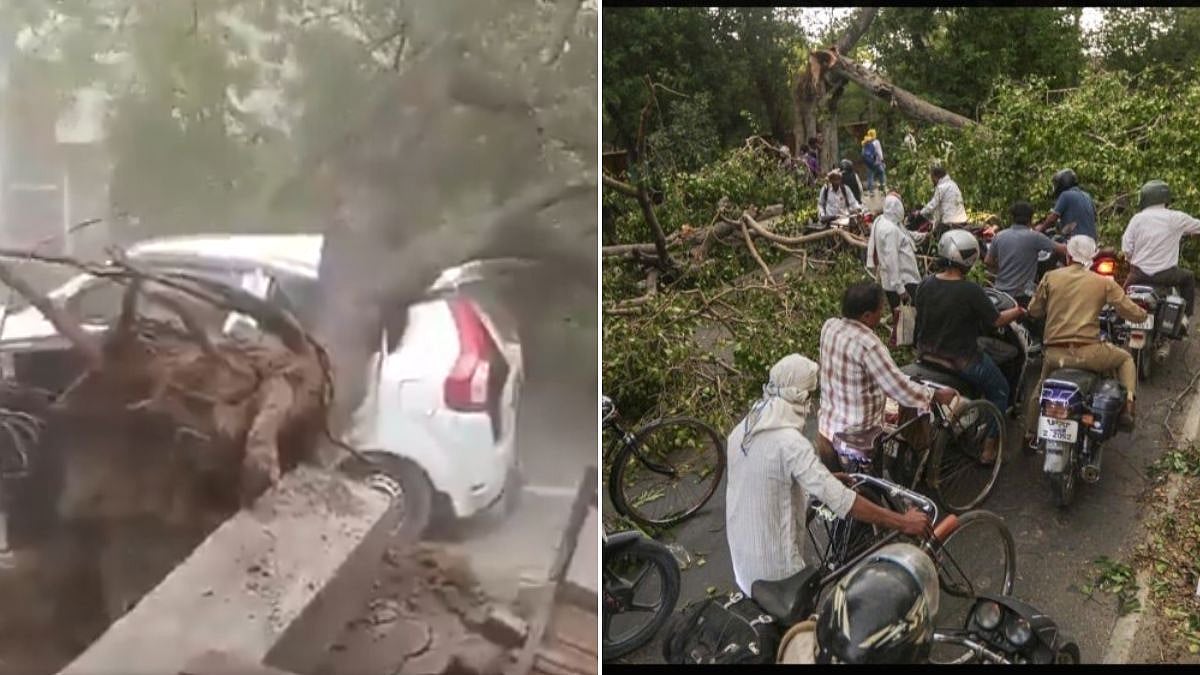
Hailstones, thunderstorms, lightning and fierce winds heaped death and destruction in parts of Uttar Pradesh in what many called a freak summer storm after a globally monitored heatwave in the affected area.
At least 111 people lost their lives in the extreme weather event that uprooted trees and crushed weak houses across 26 districts, including Varanasi, Prayagraj and Kanpur divisions.
Extreme weather events on the rise
As climate watchers point out often, the Indian subcontinent has encountered punishing weather for many years now, with the biggest killer being extreme heat — an estimated 30,000 people die prematurely in a five-day heatwave.
This is followed by excess deaths caused by cyclones and floods — a rise of about 94% in two decades — and lightning strikes, the latter up by over 52%, mainly in the eastern states.
Even with an augmented disaster response system at the state and national levels, severe events impose high costs in a country with low purchasing power, a lot of poor-quality housing and chaotic urbanisation.
Changing weather patterns and storm intensity
Scientific evidence points to non-tropical storms or western disturbances originating in the Mediterranean, gathering moisture over inland seas as they travel east and aggravating the effects of an atmosphere heated up by aerosol particles.
The presence of hail in these storms is usually a winter phenomenon, but the occurrence of large hailstones in the peak of summer, with preceding 40-degree temperatures, is significant.
Hot westerly winds from the Thar desert and moisture from the Bay of Bengal converging over the Vindhyas also produce stormy conditions.
Notably, in the latest hailstorm, 130 km/h winds were recorded in Prayagraj and Bareilly and only slightly less in other places.
Need for resilient housing and public safety
Property destruction wrought by extreme weather events is mostly excluded from insurance coverage as acts of God, making it incumbent upon the government to step in as the insurer of last resort.
In the wake of the devastation in Uttar Pradesh, the state government has ordered compensation of Rs 4 lakh to families of the deceased and payments to farmers who suffered crop losses of 33% or more.
A closer look at the mortality data shows that many of those who perished lived in sub-optimal housing; collapsing roofs and walls led to their deaths.
If governments take climate change warnings seriously, they must conduct a census of such dwellings and come up with a programme to replace those at high risk. This could be undertaken as part of the PM Awas Yojana.
Early warning systems and preparedness
Sensitising the population to heed extreme weather warnings and arranging shelter for vulnerable groups has to be a priority.
The SACHET cell-broadcast-based emergency alert system on mobile phones, tested by the Communications Ministry and National Disaster Management Authority, was indeed deployed in Uttar Pradesh, asking the population to take safety measures.
But accurate weather forecasting can save lives in an uncertain climate future only if governments improve housing and public safety.

