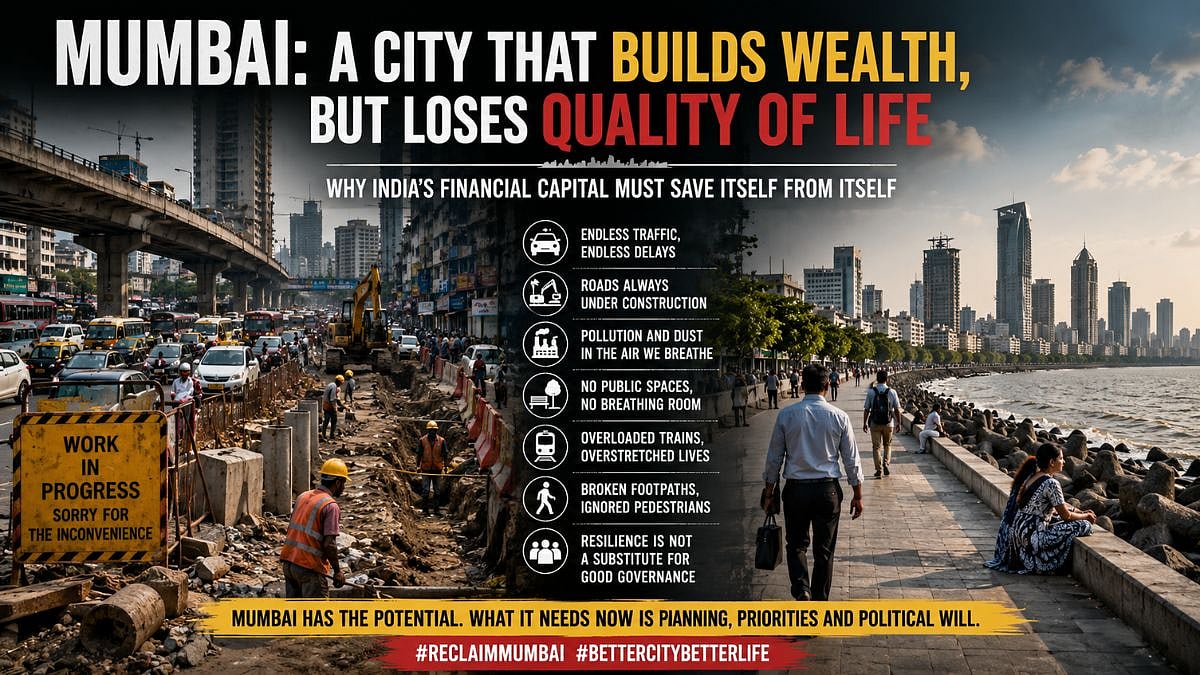
Mumbai talks big about inevitability: India’s financial capital, the country’s commercial nerve centre, and the city that endures. The numbers feed that mythology—close to 6% of the national GDP, headquarters for the country’s biggest banks and corporations, and one of India’s wealthiest municipal budgets. Yet, the lived reality tells a different story: a city whose prosperity no longer buys decent civic life.
Other Indian cities have problems—Bengaluru’s gridlock, Delhi’s pollution, and Chennai’s floods—but Mumbai’s dysfunction feels endemic. It is normalised, woven into daily life until commuters accept interminable journeys, clogged streets, and perpetual worksites as the price of opportunity. Development here rarely feels like progress; it often feels like the city devouring itself.
A City Trapped In Perpetual Disruption
The most obvious symptom is the road network. Mumbai exists in a near-permanent state of excavation. Miles are dug up every year for metro construction, utility repairs, and piecemeal upgrades, executed by overlapping agencies with no synchronised plan. The same stretch is torn up repeatedly within months. Barricades become semi-permanent fixtures. Peak-hour speeds collapse to a crawl, and a cross-city commute can take longer than many inter-city trips elsewhere. Compared with Delhi’s arterial grid, Hyderabad’s Outer Ring Road or Ahmedabad’s integrated projects, Mumbai’s infrastructure works more like a series of stabs in the dark than a coherent transformation.
The harm is not merely economic. Cities structure rhythm, predictability, and dignity. Mumbai now offers none. Long commutes, dust from incessant construction, noise, and constant diversions create a low-grade civic malaise. The average office worker here routinely spends two to four hours a day commuting. That squandered time erodes family life, dents productivity, harms mental health, and corrodes civic engagement. A global city cannot claim stature while forcing its citizens to spend large parts of their lives navigating broken systems.
Pollution And Vanishing Public Spaces
Construction-driven pollution compounds the crisis. Large swathes of the metropolis resemble one continuous building site; dust hangs over neighbourhoods for months, and air quality dips whenever works intensify. In other rapidly expanding cities, construction is distributed; in Mumbai, its density magnifies every disruption. Works do not happen at the margins—they engulf the city.
Public space is perhaps Mumbai’s greatest failure. The city offers one of the lowest open-space ratios in India; many island-city neighbourhoods have less than 2 square metres of accessible open space per person. Parks, promenades, and communal areas are not luxuries; they are essential for health, social life, and resilience. Mumbai’s coastline, which could be a civic jewel, is largely inaccessible, polluted or poorly maintained. Marine Drive stands out precisely because it is exceptional. That should be a provocation, not a consolation.
Pedestrians are routinely treated as an afterthought. Footpaths are broken, obstructed or simply end in traffic. Walking often means threading between parked cars, rubble, and speeding vehicles. This is absurd in a city where a significant share of trips is on foot.
Transport Challenges And Civic Apathy
Transport infrastructure exposes another contradiction. The suburban railway network is one of the world’s most intensively used systems, yet it runs at crushing capacity. Metro expansion is vital, but projects are being delivered as disconnected interventions rather than as parts of an integrated mobility strategy. Last-mile connectivity, station access, and multimodal planning lag far behind. Delhi’s metro network shows the dividends of coordinated planning; Mumbai’s incrementalism too often shifts bottlenecks rather than resolves them.
Worst of all is the collapse of civic expectation. Citizens are learning to adapt rather than demand better. Delays and low quality are anticipated. Dust and congestion are accepted. Municipal budgets have swelled, yet visible improvements remain spotty; turnout in civic elections often hovers around, or below, 50%, a grim sign of disengagement.
Why Mumbai Must Demand Better Governance
This resignation must end. Romanticising Mumbai’s “resilience” as an inexhaustible virtue risks allowing endurance to become a development strategy. Resilience is not a substitute for good governance. A city of such economic weight cannot rely on its workforce’s tolerance while its civic systems fray.
Mumbai still has unique assets: human capital, entrepreneurial energy, and a prime geographic position. Those advantages could—and should—finance far better public services, coherent mobility, reclaimed public spaces, and cleaner air. What is required is political will and institutional reform: coordinated project planning across agencies, enforceable timelines, and accountability for disruptions; a pedestrian-first approach and legally protected open spaces; integrated transport planning that unites rail, metro, buses, and last-mile services; and immediate action to restore coastal access and sewage treatment.
Survival is not an urban strategy. The harder test for Mumbai is whether it will stop mistaking endurance for achievement and start demanding that governance match its economic standing. If the city does not act now, dysfunction will not remain an episodic nuisance—it will become Mumbai’s defining feature.
Kalyani Srinath, a food curator, blogs at https://www.sizzlingtastebuds.com and is a columnist.

