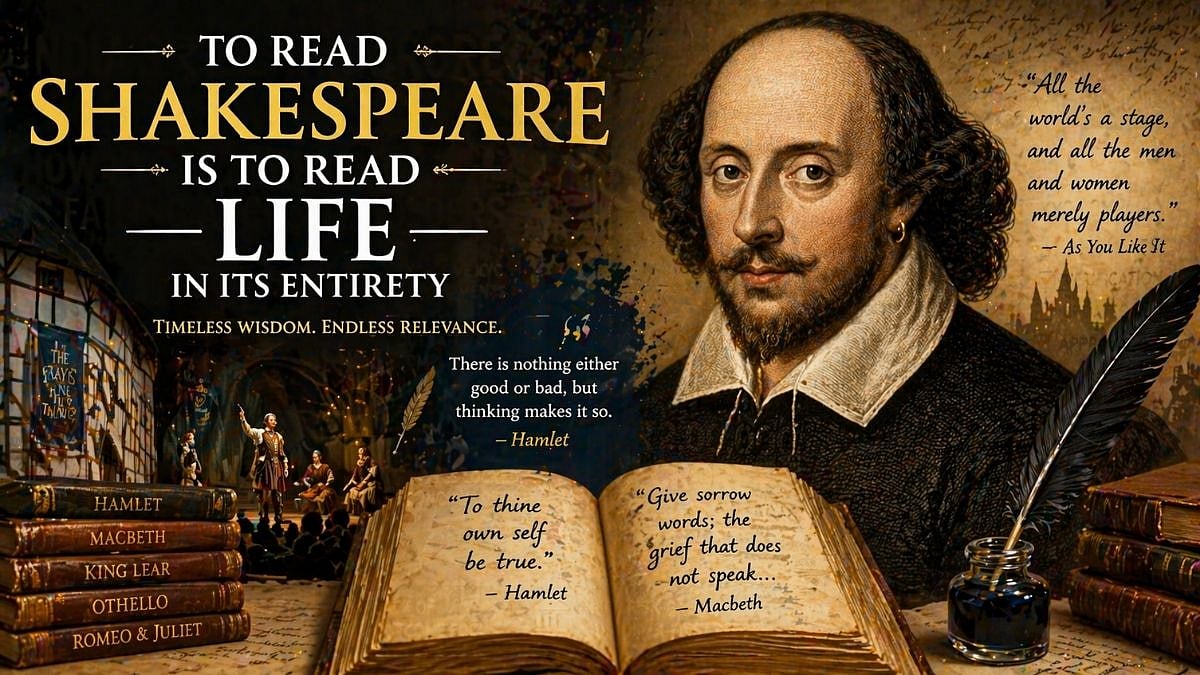
Looking for the traces of psychology, spirituality, and philosophy in the works of great writers and poets started in the early 20th century when the legendary Shakespearean critic A.C. Bradley began to study Shakespeare’s oeuvre from all aspects and facets.
The undercurrents of spirituality in the works of the Bard of Avon have always fascinated critics, readers, and connoisseurs. Here, it must be mentioned that 'spirituality' is one indispensable dimension that a discerning reader or critic finds in the works of any great writer because spirituality is the summum bonum of life. Spirituality is beyond God and religion. It is a metaphysical manifestation of existence.
Though Shakespeare was a devout Christian, he was not religious, at least in his works. So, religious values are pretty well non-existent in his works. Shakespeare's plays focus on the “human” condition—the condition of the body, the mind, human relationships, decisions, and actions or lack of them. He did not spend much time on the “soul”. Shakespeare was a moralist, not a mystic. He was 'worldly spiritual', to use an oxymoron.
Spiritual depth in Shakespeare’s works
Shakespeare was undoubtedly an enlightened being. In his sonnets, he wrote that “The secret is for Man to live in tune with timeless spiritual values”. The prefix and root of 'enlightenment' combine to form the idea of ‘into the light’, suggesting a move from darkness to clarity and understanding. His works continue to shine light.
Spirituality in Shakespeare's works explores the enduring presence of healing themes like forgiveness, redemption, and compassion, and the spiritual struggles and suffering of his characters, offering profound insights into the human condition and the consequences of spiritual neglect on our anxiety, suffering, and mental illness.
Shakespeare's characters often grapple with their own spiritual health, resulting in sorrows stemming from spiritual blindness and spiritual bankruptcy. His characters often fail to use spiritual resources that could have saved them. While avoiding overly didactic moments, Shakespeare subtly uses irony to convey his message, with his tragedies often presenting a world suffering from spiritual disease. And who are we to argue?
Themes of healing and human condition
Shakespeare offers many spiritual and healing quotes, such as "The miserable have no other medicine but only hope" (from King John) and "Give sorrow words; the grief that does not speak knits up the o'er-wrought heart and bids it break" (from Macbeth). Shakespeare offers spiritual healing themes through quotes relating to the concept of accepting suffering and surrendering to it.
In Henry IV, Hotspur, as he is dying, sums up the human predicament thus:
"But thought's the slave of life, and life time's fool;
And time, that takes survey of all the world,
Must have a stop."
We think we know who we are and what we ought to do about it, and yet our thought is conditioned and determined by the nature of the sum of our lives’ experiences as psychological states on this particular planet. Thought, in other words, is life's fool—the ego mind, which is always wrong and which fills our heads with a brash voice spouting untruths.
There is a beautiful term in classical Dutch. It is called 'Glenuts' (deep observations involving life and its myriad moods). Every observation of Shakespeare in his 38 plays and 154 sonnets has a profound message for all times. They are spiritual or metaphysical truths like these gems:
Timeless quotes and lessons
'Love all, trust a few, do wrong to none' from All's Well That Ends Well encapsulates the essence of interpersonal relationships and moral conduct. He advises us to love unconditionally, embracing a compassionate and empathetic approach towards others. However, he warns against blind trust, acknowledging that trust should be earned and not given freely to everyone.
Shakespeare further emphasises the importance of ethical behaviour, urging us to never intentionally cause harm or wrongdoing to anyone. This quote serves as a timeless reminder to cultivate love, exercise discernment in trust, and consistently uphold a righteous and virtuous character in our interactions with others. It also teaches us to be desirably indifferent in our interactions and relations.
'To thine own self be true' from Hamlet (Act 1, Scene 3) emphasises the significance of self-awareness and authenticity. In this statement, Shakespeare encourages individuals to remain true and honest to themselves, without trying to mould their thoughts, opinions, or actions to conform to societal expectations or the influence of others.
The quote encapsulates Shakespeare's belief in the importance of self-discovery and individuality. It encourages people to embrace their unique qualities and to make choices that align with their personal values and beliefs. By staying true to oneself, it is possible to live a life that is genuine, fulfilling, and true to one's own identity.
"All the world's a stage, and all the men and women merely players," from his play As You Like It, beautifully captures the essence of life by comparing it to a vast stage. He suggests that everyone, regardless of their status or gender, is merely a player in the grand theatre of existence.
This metaphor emphasises the transient and ephemeral nature of human life and reinforces the idea that we are all bound to play different roles at various stages. It reminds us that life is a performance, full of various scenes, acts, and characters, each with their own unique part to play.
Shakespeare's quote invites us to reflect on the fleeting nature of our experiences and encourages us to embrace our roles with passion and authenticity. It serves as a poignant reminder that our time on this "stage" is limited, and it is our responsibility to make the most of our performance while we have the chance.
"It is not in the stars to hold our destiny but in ourselves," from his play Julius Caesar (Act 1, Scene 2), encapsulates the human capacity for self-determination and personal agency. Contrary to the widespread belief in celestial influences, he suggests that we are the masters of our own fate. Rather than succumbing to external factors beyond our control, Shakespeare urges us to recognise the power within ourselves to shape our own destinies.
This quote serves as a timeless reminder that our choices, actions, and perseverance ultimately determine the course of our lives. Shakespeare's words inspire us to take charge and embrace our own agency, empowering us to create our own path and seize the opportunities that present themselves along the way.
There is a profound quote, "What's past is prologue", from the play The Tempest. This evocative quote encapsulates the notion that our past experiences, both personal and collective, shape and influence our future. Rather than dismissing the past as irrelevant or inconsequential, Shakespeare suggests that it serves as a prelude or introduction to what lies ahead. Our past actions, choices, and circumstances provide a foundation for future events and decisions.
This quote encourages us to reflect on our past, drawing wisdom from it and recognising the role it plays in shaping our present and future. It emphasises the importance of learning from past mistakes, understanding historical contexts, and acknowledging the interconnectedness of time, emphasising the cyclical nature of life. Ultimately, Shakespeare's words challenge us to recognise the prologue that the past sets for the narratives of our lives.
Conclusion
To read Shakespeare is to read life in its entirety. Paraphrasing Shakespeare's own quote for Cleopatra from his play Antony and Cleopatra (Act II, Scene II), it can be said that age cannot wither him (Shakespeare) nor custom stale his infinite variety.
Shakespeare was a sage and a savant whose psycho-spiritual insights will continue to enrich our lives and spiritual selves. He reified and actualised our deep spiritual cravings through his timeless wisdom and uncanny observation. Shakespeare cannot and should not be confined to a specific time frame. He is for all ages and eras.
Sumit Paul is a regular contributor to the world’s premier publications and portals in several languages.

