In the harrowing opening of Kim Stanley Robinson’s 2020 science fiction novel, The Ministry for the Future, a humid 38°C heatwave in Uttar Pradesh turns the very air into a mass executioner, transforming a familiar landscape into a graveyard of climate catastrophe.
As I write, the temperature in Banda, Varanasi, and Agra in Uttar Pradesh has crossed 44°C. Delhi is sizzling.
This is not just an Indian story. Asia is warming nearly twice as fast as the global average, fuelling more extreme weather and wreaking a heavy toll on economies, ecosystems, and societies, according to the World Meteorological Organisation (WMO).
Japan’s legal response to rising heat
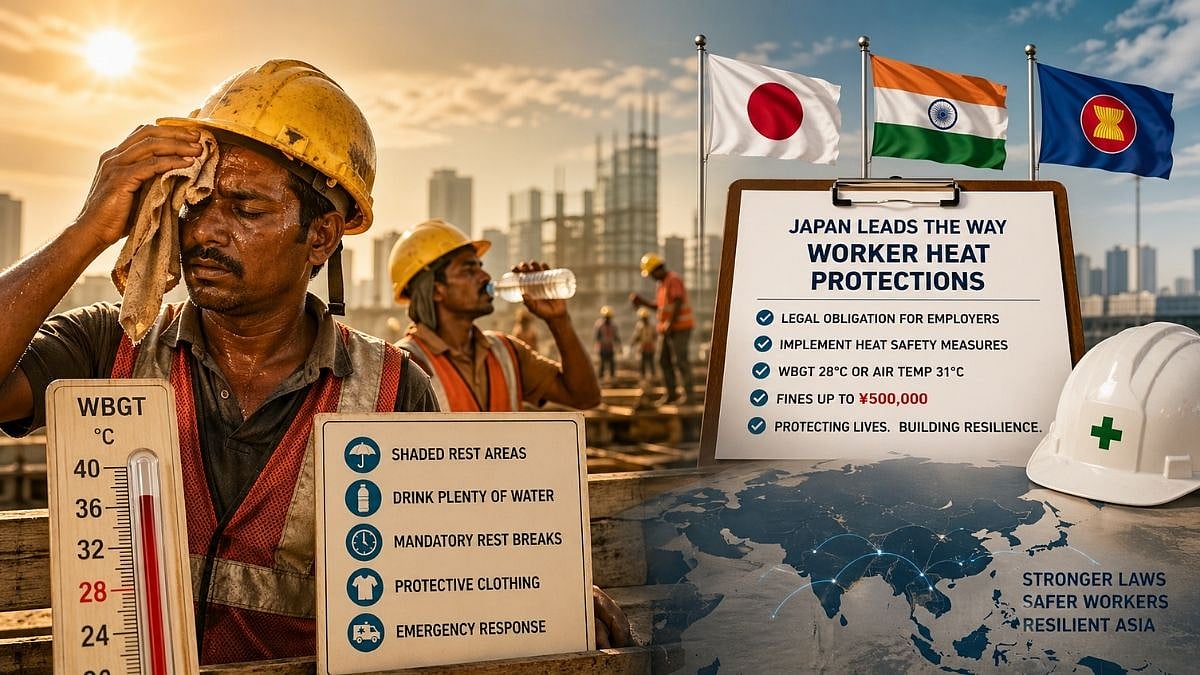
Japan is one country that has responded with decisive action. In June 2025, it amended an existing law to make heatstroke prevention a legal obligation for employers. Firms must implement measures—such as shaded break areas, breathable clothing, air-conditioned rest spaces, mandatory rest breaks, and clear emergency transport protocols—whenever the Wet Bulb Globe Temperature (WBGT) reaches 28°C or air temperatures reach 31°C for sustained periods.
WBGT is the "true feel" of heat because it combines air temperature with humidity, wind, and solar radiation, providing an early warning for heatstroke. Failure to comply can bring fines of up to ¥500,000 (about USD 3,475), public citations, or even imprisonment in rare cases. Driven by rising heat deaths in construction and manufacturing, Japan's new mandate finally gives heat safety legal teeth.
India and ASEAN lag behind
India and the ASEAN nations face the same escalating threat, yet their responses remain fragmented and largely advisory. India is home to one of the world’s largest informal sectors, but despite advisories from the Ministry of Labour and Employment, “there is no legally binding standard in Indian labour law that mandates enforceable heat-specific occupational safety requirements, leaving significant gaps in protection for large segments of the workforce, including those employed in industrial, construction, and supply chain activities," says a February 2026 white paper by the Delhi-based Council on Energy, Environment and Water, a leading climate think tank.
“This absence of enforceable heat stress regulations constrains firms’ ability to integrate worker-centred climate adaptation measures into routine operational compliance frameworks, thereby weakening overall industrial resilience.”
India's national and state Heat Action Plans provide guidance—rest breaks, water, and shaded areas—but they are not legally binding and carry no specific fines for non-enforcement.
ASEAN presents mixed picture
The ASEAN presents a patchwork. Singapore comes closest to Japan’s model, using shade as climate armour, expanding covered walkways, planting streetside trees, and relying on buildings to cool public spaces. Since 2023, employers at outdoor worksites must install wet bulb sensors, monitor heat, and enforce threshold-based protections—mandatory water breaks at 31°C WBGT and 10 to 15-minute shaded rests at 32-33°C or higher. The rules are backed by the Workplace Safety and Health Act, with the Ministry of Manpower issuing inspections, fines, and stop-work orders.
Thailand maintains an older occupational heat standard using WBGT limits for different work intensities, requiring adjustments, protective gear warnings, and health checks.
Economic and human costs of heat stress
Japan’s decisive step shows what is possible when governments treat extreme heat as the occupational emergency it is. Mandated worker protection is a cost-saving measure, not a cost.
Millions of India’s outdoor and informal workers—construction labourers, street vendors, gig riders, farmers, and garment factory staff—suffer headaches, dizziness, cramps, and worse, with no paid leave or legal safeguards. Heat stress-affected India lost 4.3 per cent of working hours in 1995 and is projected to lose 5.8 per cent of working hours in 2030, according to the International Labour Organisation.
Pressure on Indian garment sector
Then, there are emerging factors. In 2025, the International Accord for Health and Safety in the Textile and Garment Industry formally expanded its mandate to include a binding protocol on heat stress and renewed its safety operations in manufacturing regions. Currently, textile and garment factories in the Accord’s covered countries are in Bangladesh and Pakistan.
But Indian garment suppliers will be under pressure to adopt similar preventive measures—better ventilation, cooling, workload adjustments, and rest breaks—if they want to stay competitive in international supply chains.
India’s community tools offer lessons
India’s Heat Action Plans, though non-binding, contain community-level tools—early warnings, public cooling centres, and awareness campaigns—that the ASEAN could adapt for informal workers and the urban poor.
There is also an urgent need to equip frontline workers to diagnose and treat heat-related ailments.
“India has heat training plans in place, but they are slow to reach the workers who need them the most. ASHA workers and community health staff often receive guidance only after the heatwave has already begun. Some hospitals now have dedicated heatstroke wards, but these remain patchy—especially rural primary health centres lack the requisite equipment or the training to handle heat emergencies.
The encouraging sign is that the central government is now taking this seriously, pushing guidelines down to every district, and embedding heat preparedness into routine health programmes. If that momentum holds, frontline workers should be significantly better equipped within the next few seasons. The training material is also being translated into the local language and is more pictorial,” says Dr Vidhya Venugopal, Country Director, NIHR Global Health Research Centre for Non-Communicable Diseases and Environmental Change, and faculty at Sri Ramachandra Institute of Higher Education and Research, Chennai.
Need for regional cooperation
India and the ASEAN can learn from Japan—and from one another. Mutual learning could even spark regional cooperation: an ASEAN-India dialogue on heat-resilient labour standards, sharing data, inspector training, and passive cooling innovations from the new ASEAN roadmap.
Patralekha Chatterjee is a writer and columnist who spends her time in South and Southeast Asia, and looks at modern-day connects between the two adjacent regions. X: @Patralekha2011

