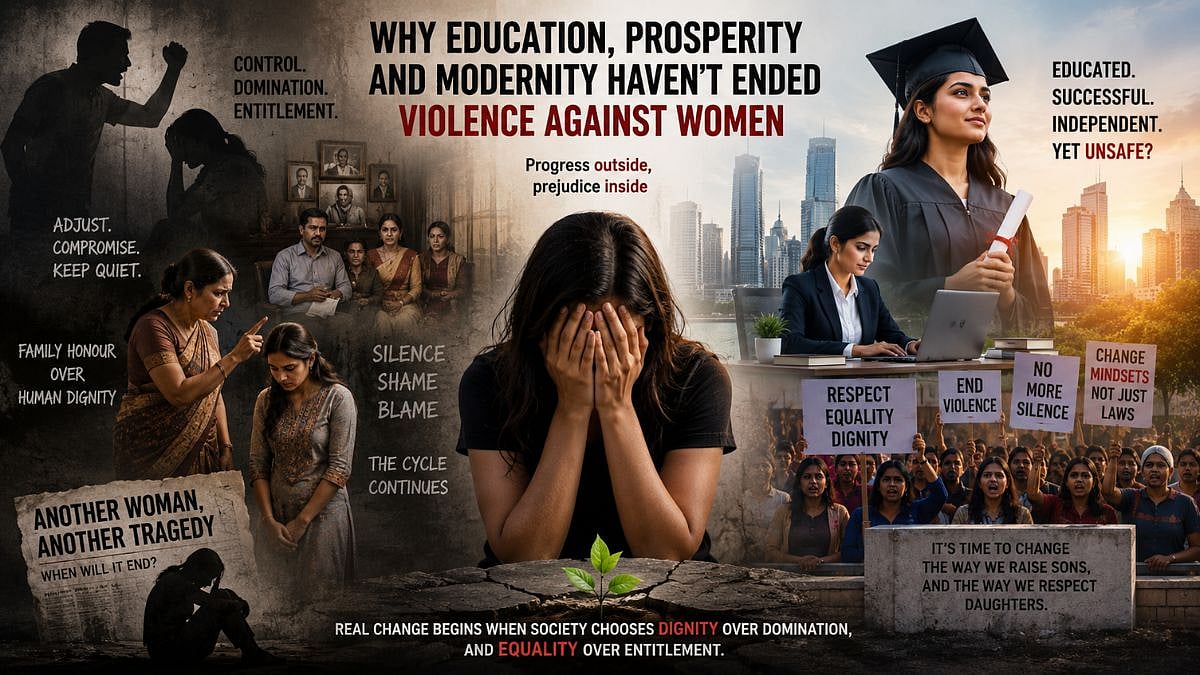
Despite decades of education, prosperity, and social progress, violence against women continues to plague Indian society, highlighting that material advancement has not translated into moral or cultural transformation.
Cycle of outrage and hidden realities
Every time another woman dies inside a home that was supposed to offer love and protection, society reacts with outrage. We search for monsters, condemn families, demand harsher punishments, and reassure ourselves that such evil belongs to a few individuals. Yet, when the outrage subsides, another tragedy emerges, and the cycle begins again.
The real question is not why violence against women still shocks us, but why, after decades of education and progress, patriarchal mindsets persist. The recent death of Twisha Sharma and associated allegations serve as a stark reminder. Much public anger focused on her husband, but allegations involving her mother-in-law reveal that patriarchy is not sustained by men alone; sometimes women themselves enforce the very hierarchies that once oppressed them.
Patriarchy, power, and social conditioning
Recognising this truth does not absolve men of responsibility. Violence against women remains a grave moral failure, and men must confront attitudes that enable domination. Patriarchy survives because it is about power, not merely gender, and has defenders across generations, families, and even among those who have experienced injustice.
Many daughters are still taught adjustment as a virtue, while sons are quietly taught entitlement. Families often confuse obedience with respect and silence with maturity. Entire communities prefer compromise over confrontation and reputation over justice. Violence often begins emotionally—control mistaken for care, emotional abuse dismissed as normal, and family honour prioritised over dignity.
Impact of education and prosperity on attitudes
Material progress has not changed mindsets. India today is more educated, wealthier, and connected than ever, yet prejudice persists. Education creates successful professionals, but does not automatically foster compassion. Modernity and prejudice often coexist under the same roof.
Economic considerations increasingly dominate relationships. Marriage discussions often focus on salaries and lifestyles, while social media fuels comparison and status anxiety. Prosperity and ambition are not enemies, but when acquisition eclipses affection, relationships become transactional, and human worth is measured by possessions rather than character.
Society’s moral mirror
Markets can produce wealth efficiently but cannot teach compassion. Violence against women is thus a mirror to society itself, revealing the gap between economic modernisation and human moral development. Public condemnation of violence contrasts with private tolerance for domination. Celebrating women publicly does not always translate into respect for them privately.
Beyond laws and punishments
The challenge extends beyond legislation and punitive measures; it lies in changing societal norms, what is normalised, and what is rejected. Civilisations are judged not only by the rights they proclaim but by behaviours they reward, injustices they excuse, and silences they maintain.
Despite technological breakthroughs, AI, and unprecedented prosperity, future generations may ask a simple question: with all our progress, why was it so difficult to treat each other with dignity? Violence against women reminds us that while lifestyles have transformed, societal conscience has lagged.
Dr Srinath Sridharan is a policy researcher and corporate adviser. X: @ssmumbai

