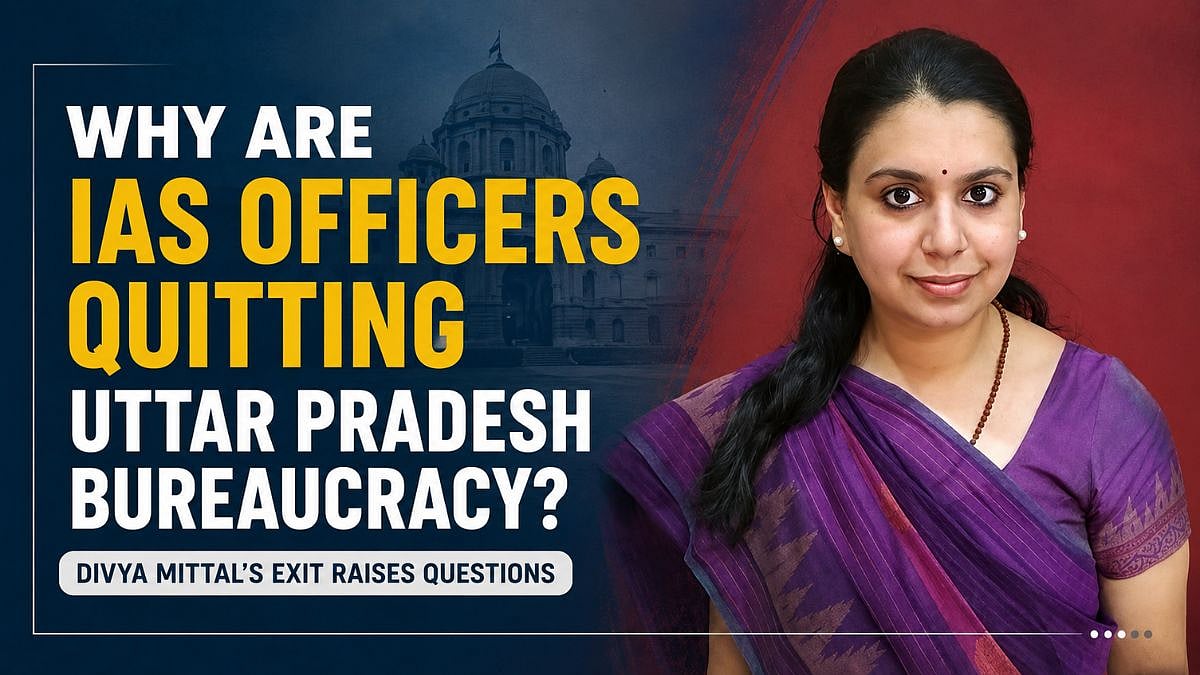
Divya Mittal's decision to quit the IAS after 13 years should worry Uttar Pradesh more than it should invite political speculation. A 2013-batch officer, she was only 42 and had a long administrative career ahead of her. Yet, on August 30, she chose to leave the service.
Mittal, who served as district magistrate of Mirzapur and Deoria, developed a reputation as a hands-on field officer. In Mirzapur, she was known for taking government schemes to remote areas and for her initiative to provide piped water to the inaccessible village of Lahuria Dah. She also held several development and administrative assignments.
Her farewell message, however, did not blame the government or allege political interference. She described the decision as her own. That makes it difficult to attribute her resignation to any single cause. But it also raises a larger question: why would an officer with a strong field record choose to leave the country's premier civil service in the middle of her career?
IAS Departures Raise Questions
Mittal is not an isolated case. Since 2017, several IAS officers of the Uttar Pradesh cadre have opted for voluntary retirement or resigned before completing their tenure. Among those who took VRS are Mohammad Mustafa, Amod Kumar, Rigzian Samphel, Renuka Kumar, Juthika Patankar, Vikas Gothalwal, and Anamika Singh. Vidya Bhushan, Abhishek Singh, S Muthu Shalini, and now Divya Mittal have resigned.
Their circumstances were different. Some had personal reasons, some sought opportunities outside government, and some faced career choices that cannot be reduced to politics. It would, therefore, be wrong to describe every departure as evidence of political pressure. But when a pattern emerges, the institution needs to ask questions.
The first is whether the administrative system is making enough use of the talent it recruits. The IAS has traditionally offered three powerful attractions: prestige, authority, and the opportunity to influence people's lives. But the profile of its recruits has changed. Many officers now enter government after studying at leading institutions in India or abroad and, in some cases, after working in the private sector.
Mittal's Mid-Career Exit
Mittal is a striking example. An IIT Delhi and IIM Bangalore alumnus, she worked in London as an exotic derivatives trader before returning to India and joining the IAS. She had already chosen public service over a lucrative career once. Her decision to leave after 13 years, therefore, deserves more attention than a routine resignation.
The second issue is the changing nature of administrative work. For many officers, the district magistrate's job represents the most satisfying phase of the IAS career. A DM can directly address problems involving roads, schools, hospitals, water, land, welfare schemes, and law and order. Decisions are visible, and their impact can often be measured.
As officers rise through the system, their work increasingly moves into secretariat files, meetings, consultations, and policy coordination. The distance from the citizen becomes greater. For an officer who entered the service wanting to see tangible change, that transition can be frustrating.
Political Pressures And Transfers
There is also the political question, which cannot simply be brushed aside. The relationship between elected representatives and civil servants has always involved tension. In Uttar Pradesh, with its enormous political and administrative machinery, the pressure on district officials can be particularly intense. A DM must work with ministers, MLAs, and MPs while enforcing rules that may sometimes conflict with political expectations.
An elected representative has every right to demand accountability. A civil servant has an equally important duty to enforce rules. A healthy system requires both sides to respect the other's constitutional role. Problems arise when disagreement itself becomes unacceptable.
Transfers and postings add another layer to the problem. If officers begin to believe that an unpopular but legitimate decision could affect their next posting, they may become cautious. The consequence is an administration that avoids risk rather than solving difficult problems. Uttar Pradesh needs civil servants who can challenge an incorrect proposal and also take responsibility for innovative decisions. Neither is possible if professional survival becomes more important than professional judgement.
But bureaucratic independence cannot mean immunity from accountability. Officers must answer for poor decisions, corruption or negligence. The government also has the right to set priorities and demand results. The real challenge is to ensure that accountability does not become arbitrary control.
Private Sector Offers Alternatives
The private sector has made that challenge more difficult. For an officer with an IIT, IIM or foreign university background, government service is no longer necessarily the only avenue for a meaningful career. Consulting, corporations, think tanks, international organisations, and entrepreneurship offer alternatives. An officer who becomes dissatisfied with the system can now realistically consider leaving it.
That changes the old social contract of the civil service. Job security and prestige may no longer be sufficient to retain talented mid-career officers. They also want meaningful assignments, professional respect, predictable tenure and the freedom to take decisions.
Why Officers Choose To Leave
Divya Mittal's resignation should, therefore, not become another political slugfest. The opposition may see it as evidence of an oppressive administrative environment, while the government may regard it as a personal decision. Neither explanation, by itself, addresses the larger issue.
The government cannot and should not prevent officers from leaving. But it can examine why some of its most capable officials increasingly see professional possibilities outside the system.
The real question for Uttar Pradesh is, therefore, not why Divya Mittal quit; it is whether the system is giving its best officers enough reason to stay.
The writer is a senior journalist. Views expressed are personal. Connect writers on X: @biswajeet01

