The Azim Premji University recently released its annual report, The State of Working India, 2026. The report explores different aspects of the labour market in India. It rightly emphasises that even as education has its own intrinsic value, where you learn what you learn, how long you learn ‘determines employment and earnings’ not just at the time of your entry into the job market but also over your entire lifetime.
Accordingly, the report devotes an entire chapter analysing different aspects of higher education in India and their impact on an individual’s employment prospects and outcomes.
While the detailed and nuanced report deserves to be read in full, I propose to sum up two key aspects of higher education in India, as described in the report. In this column, I would sum up factors affecting access to higher education for the young, and in the next column, I would briefly describe one key parameter of quality education: the student-teacher ratio and how it has changed over time in institutions of higher education in India.
Expansion of higher education with persistent disparities
In the past four decades, India’s higher education system has experienced a remarkable shift and expansion from a relatively small, elitist, almost exclusively state-funded system in the 1990s to one of the largest in the world, with more than 58,000 institutions of higher education and about 4.3 crore students, with widening access to students not only from relatively poor backgrounds, economically and socially, but also from distant, remote places. However, significant disparities persist. As a result, even now, questions as to who can access this system and what it costs to participate in it remain relevant.
Cost of education shapes access and choices
One key parameter that affects who accesses higher education relates to the cost of education. This is especially the case regarding the choice of courses for students from economically weaker sections. For estimates of costs, the report relies on periodically carried out national sample surveys of household social consumption on education between the periods 2007-08 and 2017-18.
The first thing to note is that course selection at the graduate level is not driven only by academic interests and expected returns but also by limits of household financial resources. The cost of pursuing higher education varies significantly across courses. Professional courses, such as medicine and engineering, are among the most expensive ones, costing an average Rs 1,10,000 and Rs 82,000 per year, respectively, in 2007-08. Further, over the years, these costs have sharply increased.
Income inequality reflected in enrolment trends
An analysis of the gross enrolment ratio (GER) in higher education over the years informs us that, in general, richer households have a higher enrolment—in 2007-08, the GER for the richest 25% of the population at 40% was nearly 10 times that of the poorest 25% of the population at 4%. By 2017-18, this gap had reduced considerably. The GER of the poorest 25% was about 14% compared to 26% for the richest 25%.
When one looks at the individuals enrolled in undergraduate courses, in 2007-08, almost 51% of those enrolled came from the richest 25% of households compared to only 8% from the poorest 25%. This proportion improved by 2017-18, when about 41% of undergraduates came from the richest 25% of households and about 15% of students came from the poorest 25%, but the differences persist.
Course distribution reflects economic background
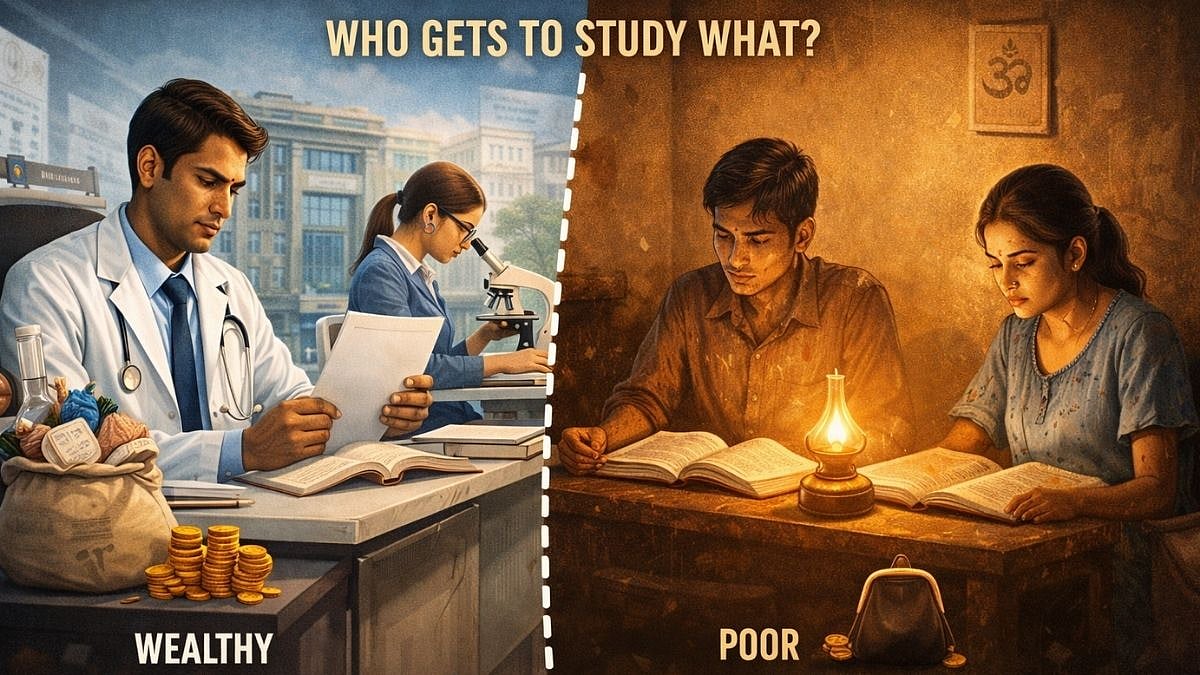
Next, the report looks at the distribution of streams of study and their variations over time for different income groups. In 2007, courses like medicine and engineering were almost exclusively dominated by students from rich households. In humanities, the poor were prominent. Even by 2017, the trend continued. Now there is a marginal increase in the share of students from poorer households in medicine and engineering. The reason for the gap is, of course, the income of the household.
In fact, for the poorest 25%, the cost of professional degrees like medicine and engineering is as much as the annual per capita expenditure of a household. Thus, even as access has improved and enrolment has increased, affordability remains a decisive factor in shaping academic aspirations and outcomes. Even for the richest 25%, the cost of a professional degree is quite significant.
Gender and caste disparities continue
Similarly, gender discrimination continues to operate in the selection of courses. Data indicate that female students are less likely to enrol in engineering courses and more likely to choose humanities and medicine, though the gender gap had somewhat reduced in STEM courses between 2007 and 2017, reflecting a slow but positive trend towards gender parity in these courses. Several studies have consistently pointed out that, generally, households spend less on girls’ education relative to boys’. This remains true at the higher education level as well. While a part of this gap relates to different choices of courses for girls and boys, sadly, even for the same courses, from similarly placed households, expenditure on girls is lower than that for boys!
The report also notes disparities in course selection by caste. Professional courses continue to attract a larger proportion of students from the general (upper caste) category. Increasingly, the OBC students broadly follow the same pattern now. However, the SC and ST students are more likely to pursue courses in humanities and less likely to enter professional courses like medicine and engineering.
This gap becomes significantly larger when the economic status of households is taken into account. In other words, not only is there a strong correlation between caste and the economic status of the household, but economic and social disadvantages also reinforce each other in shaping the academic choices for the young in higher education.
Vrijendra taught in a Mumbai college for more than 30 years and has been associated with democratic rights groups in the city.

