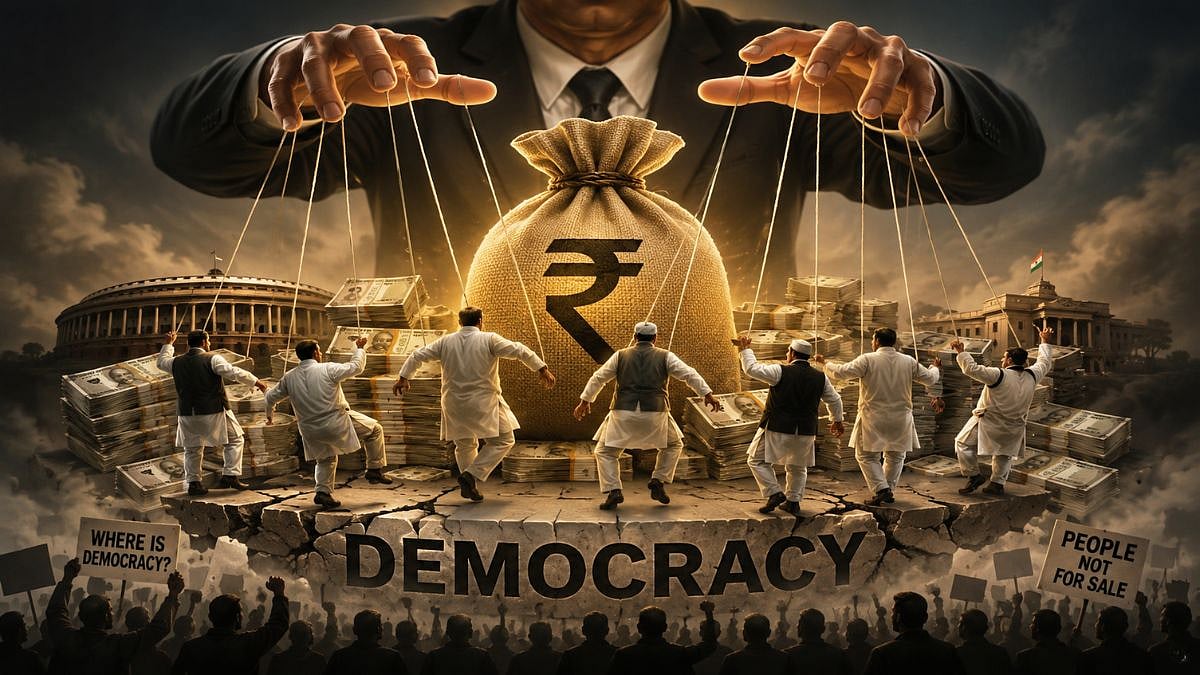
"All money corrupts, and big money corrupts bigly." Oliver Bullough, the British investigative journalist and author who wrote this in his book Moneyland: Why Thieves and Crooks Now Rule the World and How To Take It Back, sharply adapted Lord Acton's famous warning about power: "Power tends to corrupt, and absolute power corrupts absolutely." Bullough's quote was published when Moneyland was released in 2018 and has since become a sharp commentary on how vast wealth corrupts political systems globally.
Cut to 2026, and it can be further extended in the current political situation in India to, "Money corrupts politics, and endless money corrupts democracy." It fits the present political reality with unsettling precision. When a party becomes flush with astronomical funds, money ceases to be merely a tool of election. Instead, it becomes a weapon to purchase opposition MPs and destabilise the opposition completely. If morality erodes as power increases and corruption becomes inevitable when power is total and unchecked, a deadly combination emerges when total power is backed by absolute money power. This flipped version of the original saying suggests that money, especially when concentrated in extreme amounts, can erode morality just as power does.
Money, Power And Political Influence
This is what one has been witnessing for over a month and a half since the West Bengal elections concluded with the BJP's massive first-ever victory in the state. The Trinamool Congress, which ruled the state for 15 long years with a vice-like grip, is now in complete tatters. First, voters deserted it, and now its lawmakers have turned their backs on the party mercilessly. About 80 newly elected party MLAs have deserted, and 20 Trinamool MPs have defected. Unverified allegations suggest they were paid in crores to dump the Trinamool Congress and side with the BJP instead.
Six Shiv Sena (UBT) MPs have also bolted away, with similar allegations that the BJP paid hefty sums to desert their party and join Maharashtra Deputy Chief Minister Eknath Shinde's faction.
There is no denying the BJP has played a huge role in these activities, though it is difficult to establish if money changed hands in their change of heart. If money played no role, why did those dead opposed to the Modi government suddenly develop a soft corner for the Prime Minister and his party? The frozen fact is that the BJP is India's richest political party by far, with total assets of Rs 12,171 crore, more than double the combined wealth of the next four national parties. These are no speculations or allegations, but the BJP's own confession through its annual income-expenditure statement filed with the Election Commission under the Income Tax Act for FY 2024-25. The BJP accounted for 85.03 per cent of total income declared by all six national parties in FY 2024-25 and witnessed a 171 per cent surge from the previous year. The BJP's total assets exceed the annual budgets of Sikkim (Rs 9,600 crore) and Mizoram (Rs 10,500 crore). A single political party owns more wealth than entire state governments spend on healthcare, education, roads and policing for a year.
Defections And Shifting Mandates
The BJP came to power through backdoors in Goa and Manipur in 2017 after finishing second and ran the government for five years after opposition representatives defected. The same was witnessed in Madhya Pradesh in March 2020, when 17 Congress MLAs of the Scindia faction rebelled and joined the BJP to form the government, not based on the mandate but despite it.
Its encore was witnessed in June 2022 when Eknath Shinde bolted away with 37 of the 55 Shiv Sena MLAs, joined hands with the BJP and toppled Uddhav Thackeray's MVA government in Maharashtra, followed by Ajit Pawar walking away with the majority of NCP MLAs to join the BJP.
Defections from opposition ranks in West Bengal and Maharashtra may not be the last. Speculations are rife that the target is now the Samajwadi Party in Uttar Pradesh and the Aam Aadmi Party in Punjab, both due to go to polls next year.
The BJP, on its part, may say anything, though it is not saying much, just smiling and welcoming the turncoats. It is clear that the Modi government does not accept defeat easily. The opposition defeated the Women's Reservation Bill, as the ruling coalition lacked the numbers in Parliament. The government wants to increase its numbers sufficiently to pass the Bill, which it feels holds the passage to its fourth consecutive term in power in 2029.
Questions Over Democratic Processes
But the bigger question is, what is the hurry? Weakening opponents before elections is understandable, but what else explains these post-poll activities if the target is not the passage of the Women's Reservation Bill?
There is another question: Does the government know something the nation does not, and is that why it disagrees that fresh delimitation should be done after the 2027 census and not based on the data of the 2011 census?
The alleged use of money power to increase numbers after elections may not be the first instance. Congress has done it often during its heyday. But then, two wrongs do not make one right. Sadly, in the haste to get the Women's Reservation Bill passed, democracy is on the verge of getting steamrolled under the weight of absolute power and the endless flow of money.
Ajay Jha is a senior journalist, author and political commentator.

