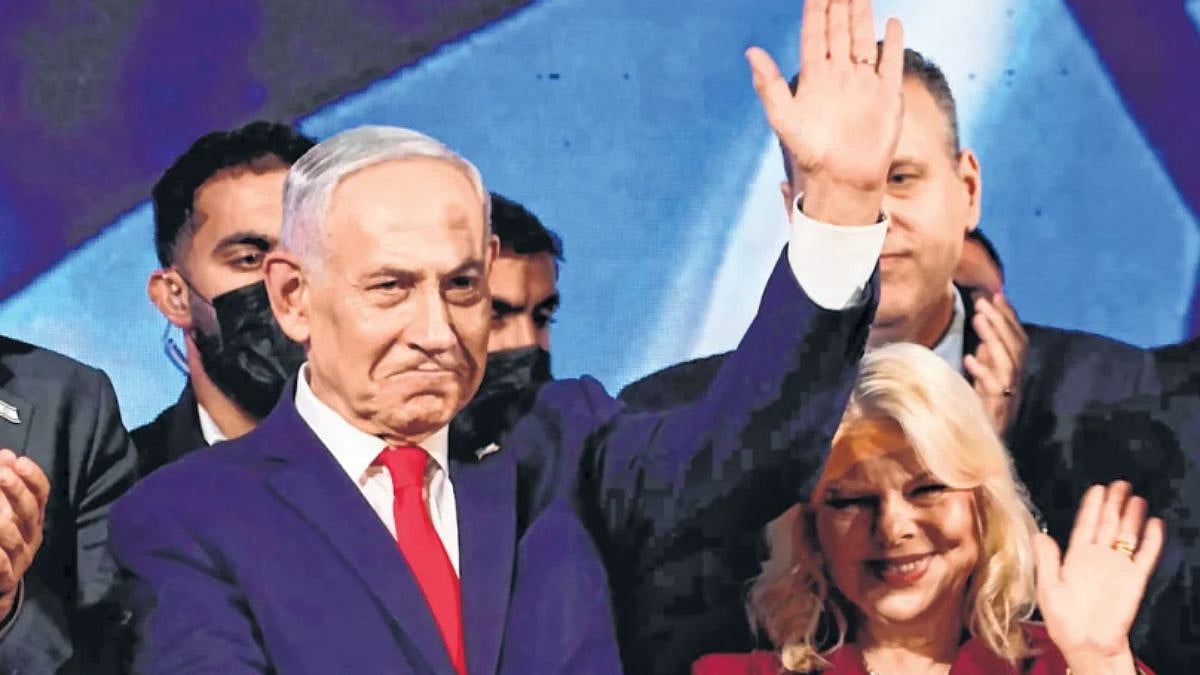
Israel’s general elections this week have delivered a paralysing political deadlock, a situation that could forever impact the region — and the rest of the world. At the time of writing this piece, with nearly 97 per cent of votes counted, no political faction has secured the 61 seats required to form a majority in the 120-seat Knesset, or the Parliament of Israel.
Prime Minister Benjamin Netanyahu’s coalition of right-wing, far-right and ultra-Orthodox parties leads with 53 seats, eight short of a majority. Trailing closely is the (more or less) centrist, anti-Netanyahu opposition bloc led by Gadi Eisenkot of the Yashar party, with 48 seats.
This means that the kingmakers are likely to be Arab-led parties, with the Joint List claiming 11 seats and Ra'am securing eight, bringing their combined total to 19.
No matter what the numbers are, there will be a frantic search for an ideal coalition to set up the next government, which, in all likelihood, will dictate the trajectory of the ongoing conflict with Iran and shape the rhetoric surrounding the United States midterm elections next Tuesday. It could also test the resilience of Israel’s strategic partnership with India, which had expanded recently on the foundation of a deep personal friendship between Netanyahu and Prime Minister Narendra Modi.
This election outcome leaves Netanyahu with a hurdle-filled path to retaining power. To unseat him, Eisenkot’s faction must forge a highly sensitive partnership with the 19 Arab-led parliamentarians. If Netanyahu can exploit these ideological differences, he may force a minority government or another election cycle, which has no guarantee of not repeating the first. Nevertheless, Netanyahu’s grip on power will weaken.
Iran War And Regional Security
The ongoing, multi-front war with Iran and its regional proxy networks will be the first to be impacted. Like most strongmen, Netanyahu has always projected himself as the sole protector of Israeli interests in the region, specifically against Iran. If he is forced to step down and Eisenkot assumes power, the tactical execution of the Iran war may witness a notable shift.
Eisenkot and his partners would want to prioritise tighter coordination with the US and its regional Sunni partners. This could hold true especially in the case of limiting military strikes to avoid uncontrolled regional escalation while actively seeking diplomatic and economic leverage over Tehran. A case in point: seniormost ministers, generals and diplomats from Saudi Arabia, Turkiye and Pakistan secretly visited Tehran earlier this week to build bridges with the Iran Revolutionary Guard Corps (IRGC) and the Iranian political leadership.
A Netanyahu-led coalition, on the other hand, will double down on the war effort, intensifying the confrontation and even risking a regional conflagration.
Tehran, meanwhile, is watching the Knesset’s paralysis closely, viewing any internal Israeli political instability as a tactical window of opportunity to advance its own regional footprint.
US Midterm Elections
Next Tuesday, exactly a week after Israel, the United States will go to the polls. The midterms in the US are always a referendum on the incumbent President, in this case, Donald Trump. A decisive Netanyahu victory could have spurred Trump’s supporters into thinking hard about not voting on the basis of rising fuel prices and the debilitating cost of living, and taking a hardline stance against Iran instead. That is no longer a certainty.
If a moderate Israeli government led by Eisenkot is sworn in, Trump’s MAGA base may not be so enthused to vote, wondering whether there is any point to the Iran war in the first place. They know, despite their cult-like loyalty to Trump, that an extended Iran war would further raise gas prices, and their lifestyle could spiral out of control.
India’s Strategic Engagement
New Delhi has more or less decoupled its Israel-Palestine two-nation policy, forging a more strategic partnership that spans defence procurement, cybersecurity, agricultural technology and the I2U2 multilateral framework (India, Israel, United States, United Arab Emirates).
It is unlikely that the elections in Israel will fundamentally change the trajectory of this alliance. The BJP and the Likud Party may be ideological siblings, but the India-Israel relationship is insulated from partisan shifts within the Knesset. All parties view New Delhi as a vital anchor and a crucial strategic counterweight in the broader Indo-Pacific theatre.
A prolonged political stalemate in Israel could temporarily stall or delay the execution of defence pacts, or delay the expansion of joint technological ventures. India wants a stable government in Tel Aviv because it is eager to expand multilateral economic integration, steering the partnership away from a purely security-centric focus and towards broader trade, climate tech and innovation initiatives.
Senior journalist and analyst Sachin Kalbag teaches foreign policy at St Xavier’s College. He can be reached at sachinkalbag@gmail.com
To get details on exclusive and budget-friendly property deals in Mumbai & surrounding regions, do visit: https://budgetproperties.in/

