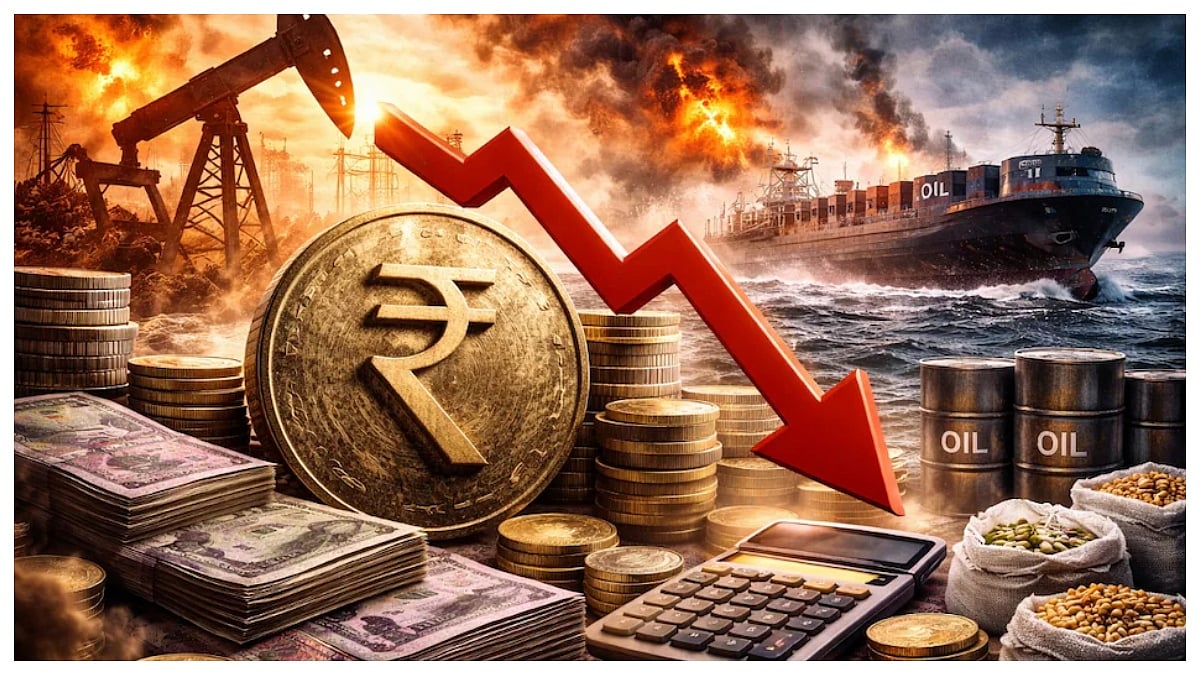
The ongoing military conflict in West Asia involving Israel and the US on the one side and Iran on the other has heightened geopolitical tensions and geo-economic uncertainty. How long the conflict will last and what will be the outcome is anybody’s guess at this time.
The impact on global commodity markets in general and energy markets in particular is severe. With the virtual closure of the critical passage through the Strait of Hormuz, energy supplies (crude and LNG) face massive disruption.
Energy infrastructure in the Gulf has faced attacks even as many producing countries have shut down production. Security risks have forced down tanker movements, freight rates have surged and insurers have turned extremely hesitant.
No wonder crude oil prices have spiked, with Brent breaching the psychological $100 a barrel. Natural gas prices, too, have moved up sharply. It is well recognised that the Asian region is a net oil importer and, therefore, exposed to shocks from supply disruption and higher global oil prices.
According to the International Energy Agency, the Asia Pacific region was a net importer of crude oil, gas and coal for the decade through to 2023. These economies still use oil, coal and natural gas as key sources of energy. India is no exception. Our crude oil import dependence is well over 80 per cent.
Energy shock likely to push inflation higher
In a short period of a few days, the war has changed the energy market fundamentals. Oil has gone from one of oversupply to scarcity as countries struggle to look for alternatives.
As crude oil is a universal intermediate, rising energy prices are sure to push inflation higher. On their part, the central bankers would become hesitant to reduce interest rates. The initial growth optimism for 2026 is now gradually giving way to caution.
Aluminium market also faces supply pressures
Beyond energy, metal markets too face the brunt of the war. One metal that is likely to engage the attention of market participants is aluminium. To be sure, aluminium production consumes enormous amounts of energy. Even at the start of 2026, it was clear that the world market was focused on tightening fundamentals.
To be sure, China is set to approach its production cap, along with several producers elsewhere considering closures due to high-power prices. The new demand segment for power consumption—data centres and artificial intelligence infrastructure—raises power costs.
Demand for aluminium, too, is rising. In addition to its increasing use as a replacement for copper for lightweighting (cars, for example), we see increased defence spending across regions. Aluminium is an integral part of defence equipment.
In early 2026, it was anticipated that the world aluminium market would stay in a state of deficit estimated at anything between 200,000 and 600,000 tonnes. Although production in Indonesia is rising, its pace may not be able to offset the metal’s near-term tightness.
Supply risks from Strait of Hormuz disruption
Early this year, analysts were in consensus that aluminium prices might average $2,900 a tonne. The upside risk to the outlook included stronger demand if global industrial activity picked up, while downside risks included faster-than-expected Indonesian supply growth and whether China’s capacity cap will hold.
The West Asia conflict has now skewered the market. The Middle East accounts for 8 per cent of global aluminium capacity. Key producers like Saudi Arabia, the UAE and Bahrain rely on the Strait of Hormuz for importing raw material and exporting finished products.
Closure of the key passage has created new supply risk and, in turn, upside price risk. It is becoming increasingly clear that the global supply will remain tight even as inventories are running thin. In the bourses, speculative positioning stands elevated. Policy risk increasingly shapes regional markets.
Experts expect that the LME will keep trading a mix of fundamentals and momentum, while the US premiums will remain the clearest gauge of any policy move.
Prices may rise further amid uncertainty
The ongoing military conflict is set to widen the global aluminium market deficit. Even if the disruption is short, prices are likely to move to $3,300 and $3,400 a tonne levels. Prolonged disruption may take the market even higher towards $3,600 and $3,800 levels.
The big question in the minds of market participants is whether prices would breach the $4,000/t mark.
The global commodity markets are morphing continually, depending on geopolitical developments. No one knows the duration of the war and its outcome. Under the circumstances, it may be advisable to avoid taking far-forward trading positions. Caution is the watchword.
G. Chandrashekhar is economist, senior journalist and policy commentator specialising in commodity markets. Views are personal.

