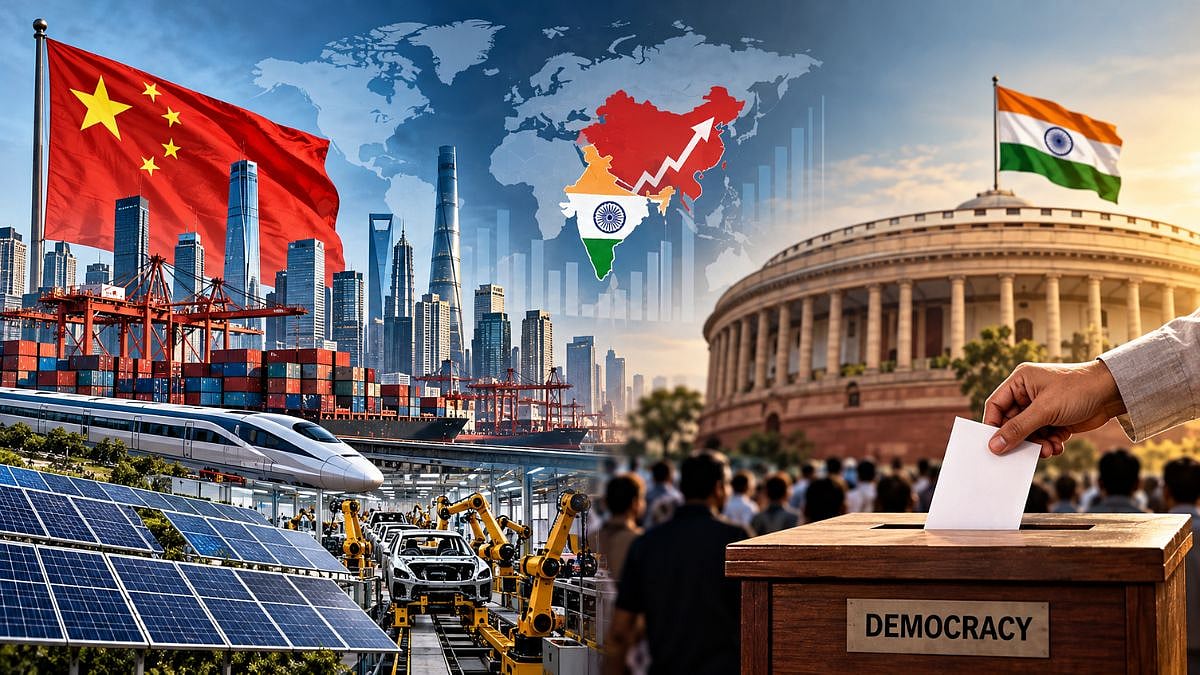
Francis Fukuyama, the distinguished political economist and scholar of geopolitics, famously wrote the book ‘The End of History and the Last Man’ in 1992. In his book, Fukuyama argued that Western liberal democracy coupled with economic freedom and market capitalism is the pinnacle of human social and cultural evolution. Those were the heady days of the collapse of the Berlin Wall (1989), the unification of Germany, liberation of the East European states from the Soviet yoke, and, amazingly, the sudden collapse and dismemberment of the once mighty Soviet Union (1991).
Competing Systems Before World War II
In the period between the two great wars (1919-1939), there were three competing systems of government vying for global supremacy. Hitler and Mussolini built fascist societies and achieved quite breathtaking results. A resurgent Germany witnessed inflation coming under control, massive infrastructure building, full employment, re-militarisation, and restoration of national morale. The Soviet Union appeared to demonstrate communism in practice with infrastructure buildup, collectivisation, militarisation, missile and space capabilities, and expansion of education and public goods. The United States, Britain, and France continued on the path of liberal democracy, economic competition and consumer choice, and market capitalism. For a moment, it appeared that the fascist model was invincible.
The Second World War ended with the decisive defeat of fascism. The United States emerged as the preeminent economic and military superpower, as Britain lost its empire and global clout. Soviet Union, fresh from the heroic resistance and sacrifice that contained and helped defeat fascism, became the sole challenger of American hegemony, just as the US was the sole power to contain international communism that sought to export the revolution to the rest of the world. The resultant Cold War was, at its core, an ideological battle to determine which system fulfilled human aspirations best. The famous kitchen debate between Soviet premier Khrushchev and US vice-president Nixon in 1959 was all about which system delivered prosperity better and which would prevail.
The West’s Apparent Triumph
Eventually, the limits of collectivisation and state monopoly were exposed, and, in 1991, it appeared that the West had triumphed. East Germans voted with their feet, and the Berlin Wall became a relic of the past. In country after country, people rose in revolt against communist dictatorships, and the Iron Curtain collapsed. Finally, in a sudden, unexpected development, the Soviet Union itself was dissolved on December 26, 1991, without a bullet being fired. With the collapse of communism, the Western model seemed to be invincible.
For much of the period between 1945 and 2010, it was axiomatic that liberal democracy, free markets, and capitalism go together, and that combination is an inevitable winner. That belief was articulated by Fukuyama sharply. Now, in the twenty-first century, China has proved that another model could be superior in generating material progress, technological innovation, and military might. While Deng Xiao Ping launched the four great modernisation and reform processes in 1978, China's spectacular rise started in 2001, with its admission into the World Trade Organisation. Within a decade, by 2010, China became the world's largest manufacturer and exporter.
China’s Rise Challenges Western Orthodoxy
The 2025 data is even more compelling. China now accounts for 35% of global manufacturing, 20% of manufacturing exports, and 13% of total global trade and enjoys the world's largest trade surplus of $1.2 trillion. It is the world's dominant player in the production of steel (53%), lithium-ion batteries (75%), solar panels (80%), machinery & equipment (33%), electrical equipment (40%), rare earth mining (60%), rare earth processing (91%), permanent magnets (94%), electric vehicles (75%), lithium iron phosphate (95%), battery cells (80%), solar power (40%), thermal power (53%), coal (58%), and cement (53%). These figures are stunning; they conclusively establish that the recipe of liberal democracy, free markets, and capitalism has been bettered by the Chinese model. The orthodoxies of the past eight decades need to be revised. History clearly has not ended!
Two questions emerge from these facts. How did China achieve this success? Why did liberal democracies lose the edge? Let us briefly examine these two questions.
What Explains China’s Success?
First, it would be wrong to say that before China's rise, it was always liberal democracies that achieved high growth and innovation. South Korea and Taiwan witnessed remarkable growth and innovation without the liberal democratic institutions and practices they have embraced today. To some extent, even Singapore's growth cannot be linked to a democratic model. Nor did Germany and Japan achieve great progress before the Second World War through democracy. A reasonable conclusion is that policies and a climate that fosters innovation, competition, and growth can exist even without liberal democracy. This seems to be true with China.
China married Asian cultural values of strong families that foster excellence in children and focus on education and skills and putting collective good above individual rights with modern technology, the market economy, and free trade with great success. China's relentless focus on quality education and skills, and its remarkable degree of decentralisation despite centralised decisions on big policy and national goals, paid rich dividends. Local governments in China control and spend 54% of all public expenditure—the highest share in the world! China also combined stability and order that come from communist rule with sensible policy and competition that foster growth and innovation. Certainly, CCP's control of Chinese society made it easy to pursue a rational policy to achieve long-term goals without the fear of short-term political price.
India’s Governance Challenges
Liberal democracies with regular elections are at a disadvantage in pursuing long-term policy, as pleasing the electorate in the short-term is critical for political survival. This challenge of short-term political pain can be addressed by effective decentralisation that gives citizens and local communities more agency and stakes in long-term growth, and people see the benefits flow to them through rational decisions. Unfortunately, in India, very little power is exercised by local governments; their share of public expenditure is a paltry 3%, the lowest among G20 countries! The appalling failure of educational outcomes and rule of law is not because of democracy; it is because of a dysfunctional state. In other words, we cannot use democracy as an excuse for our shortcomings. All these deficits can, and should, be overcome in a robust democracy with reasoned public debate. Reforming our electoral system, political parties, local governments, education, and rule of law are critical for us to fulfil our potential.
The author is the founder of Lok Satta movement and Foundation for Democratic Reforms. Email: drjploksatta@gmail.com / Twitter@jp_loksatta

